AI Software Development Case Study: Medication Replenishment Forecasting Platform
Rushkar built a live AI-powered replenishment forecasting and reminder automation platform for an anonymous multinational pharmacy supply-chain business operating across the UK, Europe, and the USA. The solution used LLMs, .NET, SQL Server, background jobs, Logic App, Upland SMS, and a web dashboard to interpret dosage instructions, calculate projected reminder dates, reduce manual review, send SMS reminders, and track month-on-month medicine ordering impact.
Quick Project Snapshot
| Field |
Details |
| Industry |
Pharmacy & Supply Chain |
| Client Type |
Multinational business operating in pharmacy distribution and supply-chain operations |
| Geography |
UK, Europe, and USA |
| Solution Type |
AI-powered medication replenishment forecasting, reminder automation, and analytics platform |
| Engagement Type |
AI consulting, LLM workflow design, backend automation, API integration, dashboard development, and production implementation |
| Technology Stack |
C#, .NET, OpenAI API, SQL Server, Background Jobs, API Endpoint, Logic App, SMS via Upland, Web Dashboard |
| AI Model Strategy |
Multi-model setup using GPT-5.5 and GPT-5.4-mini |
| Project Status |
Live |
| Business Impact Areas |
Accuracy improvement, manual review reduction, faster processing, operational cost reduction, improved reminder visibility, and better replenishment planning |
Executive Summary
A multinational pharmacy supply-chain organization operating across the UK, Europe, and the United States faced a persistent operational challenge: although prescription data contained clear signals of future medication demand, the business lacked a reliable mechanism for converting that information into actionable replenishment intelligence.
Dosage instructions were stored as unstructured text, written in highly inconsistent formats that varied by medication type, prescribing patterns, and operational processes. As a result, identifying when customers were likely to require their next medication supply depended heavily on manual interpretation. This limited proactive engagement, reduced visibility into future demand, and placed unnecessary pressure on warehouse and fulfilment operations when orders arrived unexpectedly.
Rushkar designed and implemented an AI-powered replenishment intelligence platform capable of interpreting complex dosage instructions, calculating projected medication replenishment reminder dates, automating reminder workflows, and providing end-to-end operational visibility through a centralized analytics layer.
Built using GPT-5.5, GPT-5.4-mini, .NET, SQL Server, OpenAI APIs, Logic App workflows, Upland SMS integration, and a custom business intelligence dashboard, the solution transformed replenishment planning from a reactive process into a proactive, data-driven operational capability.
The platform now operates as a live production system, enabling scalable forecasting, automated customer engagement, reduced manual intervention, and improved visibility across the entire replenishment lifecycle.
Client Overview
The client is a multinational pharmacy supply-chain enterprise responsible for managing medication distribution, fulfilment operations, and replenishment workflows across multiple regions, including the United Kingdom, Europe, and the United States.
A critical component of the organization's operational efficiency depends on accurately anticipating future medication demand and ensuring that customers receive timely reminders before their next replenishment cycle.
Due to confidentiality obligations, the client's name, internal systems, and proprietary operational identifiers have been omitted from this case study.
The Challenge
The organization faced a strategic visibility gap within its replenishment ecosystem.
Although prescription records contained sufficient information to estimate future medication requirements, that information was embedded within dosage instructions written in natural language rather than structured operational fields.
This created a significant obstacle.
While experienced staff could manually review individual prescriptions and estimate when a customer might require a future supply, performing the same exercise consistently across thousands of records was operationally expensive, time-consuming, and difficult to scale.
Consequently, replenishment opportunities often remained undiscovered until customers proactively placed new orders.
This challenge produced a ripple effect across multiple business functions.
From a commercial perspective, delayed visibility reduced opportunities for proactive customer engagement and reminder-driven reordering.
From an operational perspective, warehouse teams frequently experienced unpredictable order volumes, limiting their ability to prepare inventory and fulfilment resources efficiently.
The underlying complexity stemmed from the nature of the dosage instructions themselves.
Prescription records contained a wide variety of usage patterns, including the following:
- Daily medication schedules
- Quantity-based consumption models
- Pack-based usage instructions
- Cyclical treatment plans
- Active treatment periods followed by breaks
- Repeat dispensing arrangements
- Incomplete instructions
- Ambiguous directions such as "take as directed"
Traditional rule-based automation was incapable of handling this level of variability reliably. Creating and maintaining hundreds of rigid business rules would have introduced complexity without adequately addressing edge cases.
The client required a solution capable of interpreting dosage instructions contextually, distinguishing between deterministic and non-deterministic scenarios, and calculating projected medication replenishment reminder dates only when sufficient information existed to support a reliable forecast.
Equally important, the system needed to avoid speculation. If a reminder date could not be calculated with confidence, the workflow needed to classify the record appropriately rather than generate an unreliable output.
This requirement became the foundation of the solution architecture.
Solution Strategy
Before designing the platform, Rushkar conducted an AI feasibility assessment to determine whether Large Language Models could address the problem effectively while maintaining operational reliability.
The objective was never to automate every prescription record.
Instead, the focus was on identifying where AI could create measurable business value while preserving strict governance and control mechanisms.
The assessment revealed a critical insight:
- The success of the platform would depend not on maximizing prediction volume, but on accurately distinguishing between calculable and non-calculable records.
Based on this principle, Rushkar designed an AI-powered replenishment intelligence platform capable of transforming prescription-derived data into operationally actionable forecasts.
The platform ingests prescription information including medication quantities, dosage instructions, start dates, endorsement details, and related operational metadata.
Using a structured LLM orchestration framework, the system interprets dosage patterns, evaluates consumption behaviour, and determines whether a projected medication replenishment reminder date can be calculated reliably.
When sufficient information exists, the platform generates a reminder date and automatically routes the record into downstream engagement workflows.
When information is incomplete, ambiguous, or operationally insufficient, the platform returns a structured exception rather than attempting to infer missing values.
This approach ensures that automation is applied confidently where appropriate while preserving visibility into records that require human review.
Beyond forecasting, the solution was designed as a complete operational ecosystem incorporating:
- AI-powered dosage interpretation
- Replenishment forecasting
- Workflow orchestration
- Reminder automation
- SMS engagement
- Exception management
- Business intelligence reporting
- Performance analytics
The result was not merely an AI integration project but a comprehensive replenishment intelligence platform capable of supporting enterprise-scale pharmacy supply-chain operations.
Architecture & Workflow
Transforming replenishment forecasting into a scalable operational capability required far more than integrating an LLM into an existing application stack. The client needed a production-grade architecture capable of processing prescription records continuously, generating reliable forecasts, orchestrating reminder workflows, and providing complete visibility into AI performance and business outcomes.
Rushkar designed a multi-layered architecture that combines AI interpretation, workflow automation, backend validation, communication services, and business intelligence into a unified ecosystem.
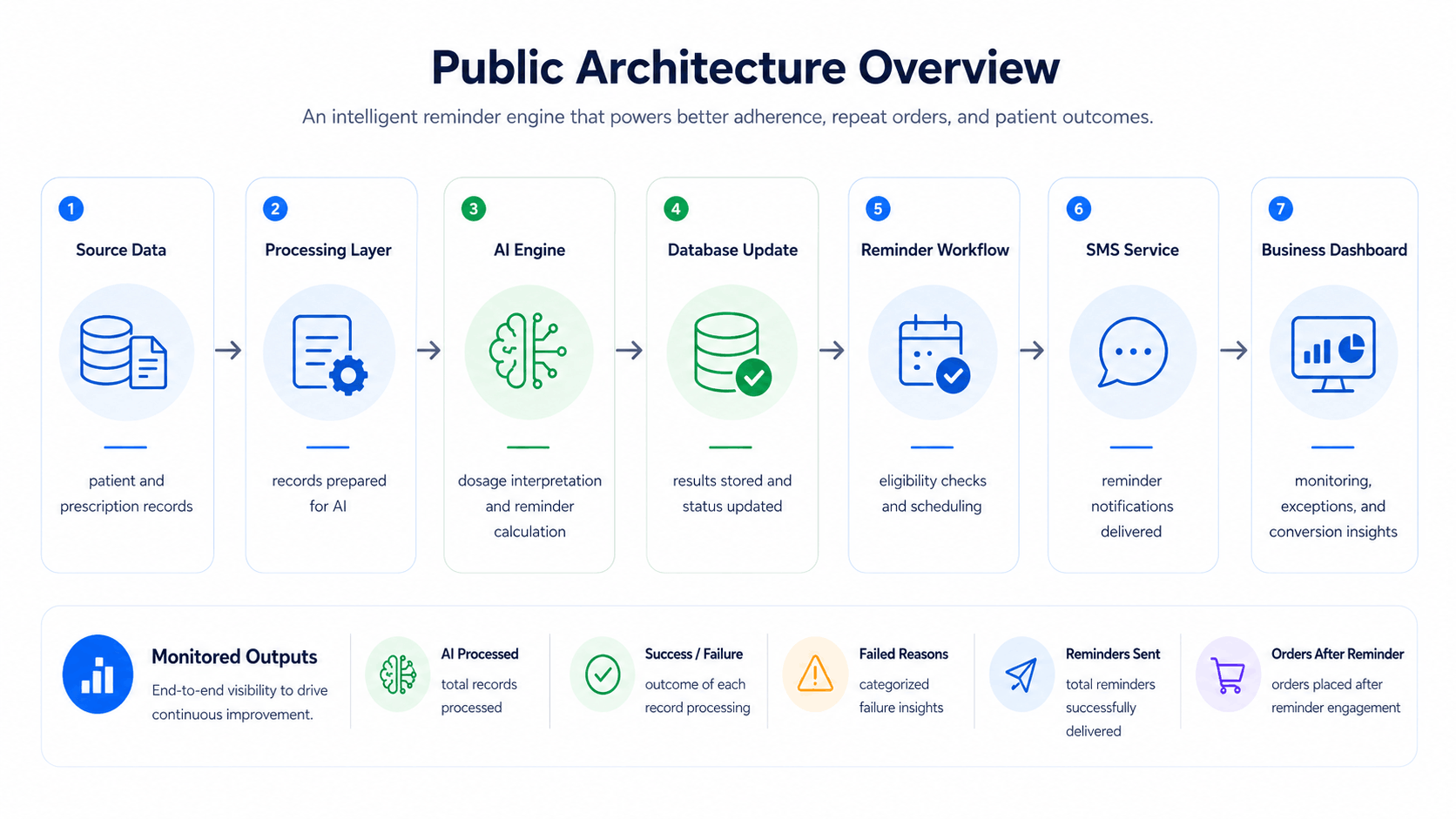
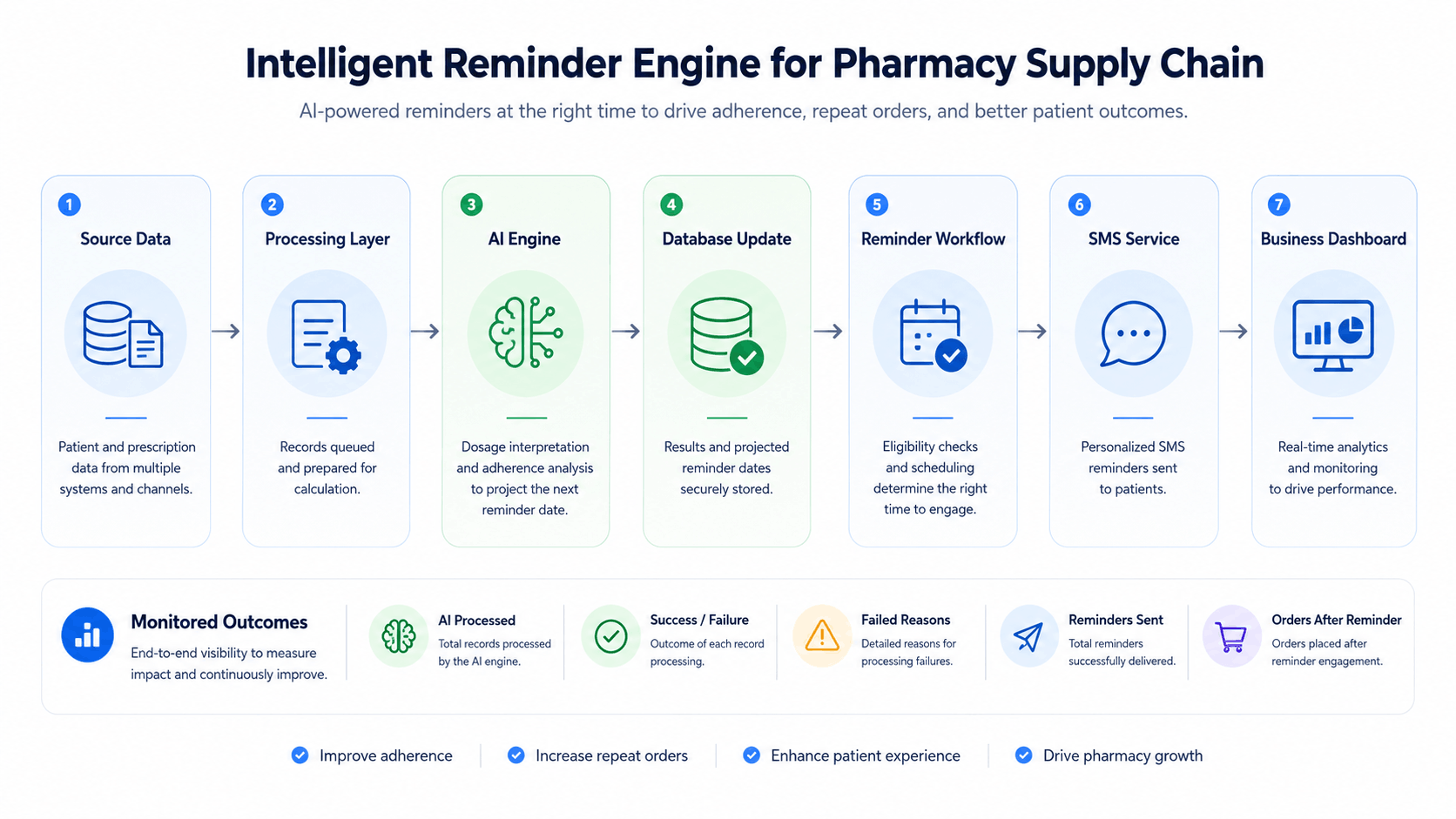
At a high level, the platform follows a closed-loop operational model:
Prescription Data -> AI Interpretation -> Replenishment Forecast -> Validation -> Reminder Automation -> SMS Delivery -> Business Intelligence Reporting
This architecture enables the organization to move from reactive replenishment handling to proactive demand visibility and customer engagement.
1) Intelligent Data Intake & Processing Layer
The workflow begins when eligible prescription records enter the operational environment.
Rather than processing every prescription indiscriminately, the platform identifies records that are relevant to replenishment forecasting, including repeat prescriptions and recurring medication schedules.
Once identified, these records are transferred into a dedicated processing layer that acts as the operational control centre for the entire workflow.
This layer maintains critical processing information, including:
- Prescription identifiers
- Dosage instructions
- Start dates
- Available medication quantities
- Processing status
- Reminder status
- SMS delivery status
- Exception classifications
- Failure reasons
By centralising workflow management, the platform ensures that every record can be monitored throughout its lifecycle.
2) AI Interpretation & Forecasting Engine
At the core of the solution is an AI-powered interpretation engine built using OpenAI models and a structured orchestration framework.
Unlike traditional systems that depend on rigid business rules, the AI engine evaluates dosage instructions contextually.
The system receives structured inputs including dosage instructions, medication quantities, prescription metadata, and treatment timelines.
The AI then analyses the information to determine:
- Prescription identifiers
- Dosage instructions
- Start dates
- Available medication quantities
- Processing status
- Reminder status
- SMS delivery status
- Exception classifications
- Failure reasons
The objective is not simply to understand dosage instructions but to determine whether a projected medication replenishment reminder date can be calculated with confidence.
This distinction is critical.
Many AI implementations focus on generating an answer for every request. Rushkar deliberately adopted a different philosophy. The platform prioritises reliability over coverage, ensuring that only deterministic forecasts proceed into downstream workflows.
3) Deterministic Forecast Generation
Once dosage instructions have been interpreted, the platform evaluates whether sufficient information exists to generate a reliable forecast.
The calculation process considers multiple variables, including:
- Medication quantity
- Dosage frequency
- Treatment schedules
- Break periods
- Consumption timelines
- Calendar calculations
If the record satisfies all forecasting requirements, the system generates a projected medication replenishment reminder date.
This date becomes the operational trigger for reminder orchestration and replenishment planning activities.
However, if information is incomplete, contradictory, or ambiguous, the platform intentionally avoids generating a forecast.
Instead, the record is classified as a structured exception and routed into an exception management workflow.
This governance-first approach significantly improves operational trust and prevents unreliable outputs from influencing business processes.
4) Validation & Control Framework
Enterprise AI systems require safeguards beyond the model itself.
To ensure forecasting integrity, Rushkar implemented a dedicated validation layer between the AI engine and downstream operational workflows.
This layer performs several critical functions:
By introducing independent validation controls, the platform reduces operational risk while maintaining transparency across the forecasting lifecycle.
5) Automated Reminder Orchestration
Forecasting creates value only when it drives meaningful action.
To close the operational loop, Rushkar developed an automated reminder orchestration framework responsible for converting replenishment forecasts into customer engagement activities.
When a valid reminder date becomes available, the system automatically schedules the record for future communication.
The orchestration layer continuously monitors upcoming reminder events and identifies records eligible for notification delivery.
This automation eliminates the need for manual reminder planning while ensuring customers receive timely replenishment communications.
The result is a more proactive engagement model that improves visibility into future medication demand.
6) SMS Engagement Layer
To support customer communication, the platform integrates directly with Upland SMS services.
Once reminder eligibility criteria are met, the system initiates automated SMS delivery.
The communication workflow includes:
- Reminder scheduling
- Message generation
- SMS dispatch
- Delivery tracking
- Notification status updates
- Duplicate prevention controls
Every communication event is recorded and tracked within the platform, providing complete visibility into reminder activity and customer outreach performance.
This capability transforms replenishment forecasting from a reporting function into an operational engagement mechanism.
7) Exception Management Framework
A distinguishing characteristic of the platform is its treatment of exceptions.
Rather than viewing failed records as system errors, Rushkar designed the architecture to treat exceptions as operational intelligence.
When a forecast cannot be generated, the platform captures detailed contextual information explaining why the calculation failed.
Examples include:
- Missing quantities
- Missing start dates
- Ambiguous dosage instructions
- Incomplete prescription information
- Unsupported scheduling patterns
Each exception is classified, stored, and surfaced through the reporting layer.
This approach enables operational teams to focus their attention on records requiring review rather than manually analysing entire prescription datasets.
8) Operational Intelligence & Reporting Layer
The final layer of the architecture is a dedicated operational intelligence platform designed to provide complete visibility into system performance and business outcomes.
The dashboard consolidates information across the entire workflow, allowing stakeholders to monitor the following:
- Prescriptions processed by AI
- Forecast success rates
- Forecast failure rates
- Exception categories
- Reminder activity
- SMS delivery metrics
- Reorder behaviour
- Processing trends
- Operational performance indicators
Beyond technical reporting, the platform also measures the relationship between reminder activity and subsequent medication ordering behaviour.
This enables business leaders to evaluate how replenishment forecasting contributes to operational efficiency, customer engagement, and overall commercial performance.
From Forecasting Tool to Replenishment Intelligence Platform
The true value of the architecture lies in its ability to connect forecasting, automation, communication, and analytics into a single operational ecosystem.
Rather than functioning as an isolated AI application, the platform integrates directly into the client's day-to-day supply-chain operations.
The result is a scalable replenishment intelligence framework capable of identifying future demand, automating customer engagement, reducing administrative overhead, and providing measurable visibility into business outcomes.
1) AI Intelligence Layer
While the architecture provides the operational foundation, the success of the platform ultimately depends on the intelligence layer responsible for interpreting dosage instructions, managing uncertainty, enforcing governance controls, and delivering deterministic forecasting outcomes.
The effectiveness of the platform depended not on the AI model alone, but on the intelligence framework governing how information was interpreted, validated, and transformed into operationally actionable outcomes.
Medication dosage instructions rarely follow a uniform structure. Even within the same organization, identical consumption patterns may be documented using entirely different terminology, abbreviations, or prescribing conventions.
Consequently, the challenge was not simply understanding language. The challenge was building an AI workflow capable of converting highly variable instructions into deterministic replenishment forecasts while maintaining enterprise-grade reliability.
To achieve this, Rushkar designed a structured AI intelligence layer combining prompt orchestration, multi-model processing, validation controls, and operational guardrails.
2) Converting Unstructured Instructions into Forecastable Intelligence
At the heart of the platform is a dosage interpretation framework designed to normalize complex prescription instructions into a structured consumption model.
The system processes a broad range of prescribing patterns, including:
- Daily medication schedules
- Quantity-based consumption instructions
- Multi-stage treatment plans
- Cyclical dosage regimens
- Active treatment periods
- Planned treatment breaks
- Repeat dispensing arrangements
Rather than extracting keywords, the AI evaluates the contextual meaning of each instruction and determines how medication is likely to be consumed over time.
This interpretation layer creates the foundation for replenishment forecasting.
Without it, downstream automation would be impossible.
3) Structured Prompt Orchestration
Rushkar implemented a prompt orchestration strategy designed specifically for operational forecasting workflows.
Instead of treating dosage interpretation as a single AI request, the workflow follows a controlled reasoning structure.
The process evaluates four key questions:
This structured approach significantly improves consistency while reducing the likelihood of unpredictable outputs.
4) Multi-Model Processing Strategy
Enterprise AI solutions must balance quality, speed, and cost.
Using a high-capability model for every request often creates unnecessary operational expense. Conversely, relying exclusively on lightweight models may compromise performance in complex scenarios.
To address this challenge, Rushkar implemented a multi-model architecture using GPT-5.5 and GPT-5.4-mini.
The stronger model is utilised for dosage instructions requiring deeper contextual interpretation, complex treatment schedules, or advanced reasoning.
The lightweight model handles more straightforward scenarios where forecasting logic is comparatively simple.
This strategy delivers three key advantages:
- Improved processing efficiency
- Reduced AI operating costs
- Consistent forecasting quality
The result is an architecture capable of supporting production-scale workloads without sacrificing reliability.
5) Deterministic Decision Framework
A defining characteristic of the solution is its deterministic operating model.
Many AI systems attempt to generate an answer regardless of data quality.
Rushkar deliberately rejected this approach.
The platform operates according to a simple principle:
- If a reminder date can be calculated reliably, calculate it. If it cannot, do not guess.
This principle governs every forecasting decision.
The AI is explicitly instructed to avoid:
- Estimating missing values
- Inferring unavailable information
- Making probabilistic assumptions
- Producing speculative forecasts
By restricting outputs to deterministic scenarios, the platform significantly improves operational trust.
6) Enterprise AI Guardrails
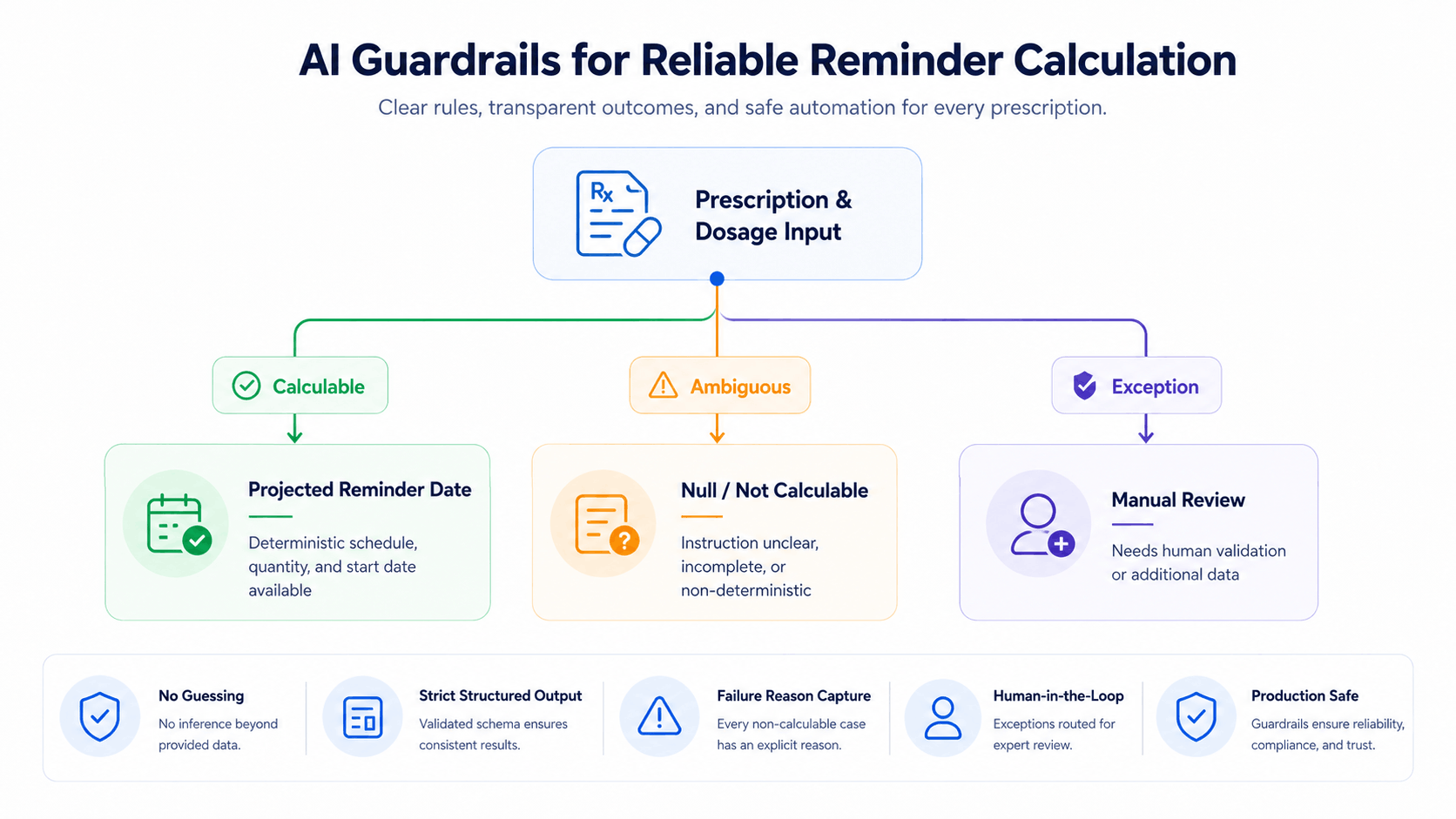
The governance framework is built around three possible outcomes.
- Calculable
Where sufficient information exists, the platform generates a projected medication replenishment reminder date and progresses the record through automated workflows.
- Non-Calculable
Where information is incomplete or ambiguous, the system returns a structured failure response without generating a forecast.
- Manual Review Required
Where additional human interpretation is necessary, the record is routed into an exception management workflow.
This model creates a clear separation between automation and oversight, ensuring that AI enhances operational decision-making without compromising reliability.
7) Structured Output Architecture
One of the most important engineering decisions involved output design.
Traditional conversational AI systems often generate lengthy explanations. While useful for human interaction, such responses create challenges for operational workflows.
Rushkar designed the platform to return compact, structured outputs containing only the information required by downstream systems.
Each response includes:
- Record identifier
- Processing status
- Forecast outcome
- Projected reminder date
- Failure status
- Failure reason
This approach delivers several advantages:
- Simplified backend integration
- Faster processing
- Lower token consumption
- Reduced API costs
- Improved workflow scalability
Most importantly, it ensures that AI outputs remain predictable and machine-readable.
8) Cost Optimisation Without Compromising Quality
Because the platform processes records continuously, cost management was a critical architectural consideration.
Several optimisation techniques were implemented, including:
- Compact prompt structures
- Multi-model routing
- Controlled response schemas
- Reduced token usage
- Exception-based processing logic
Rather than pursuing maximum model utilisation, the architecture focuses on generating the highest operational value per processed record.
This enables sustainable long-term deployment while maintaining forecasting quality.
Building Trustworthy AI for Operational Workflows
The intelligence layer was designed with a clear objective: transform AI from an experimental capability into a trusted operational asset.
By combining structured prompt orchestration, deterministic decision-making, enterprise guardrails, validation controls, and cost-optimised processing, Rushkar created an AI framework capable of operating reliably within a business-critical supply-chain environment.
The result is not simply an AI forecasting engine, but a governed intelligence layer that supports replenishment planning, customer engagement, operational visibility, and scalable automation.
1) Operational Intelligence Dashboard
Forecasting projected medication replenishment reminder dates was only one component of the solution. To generate sustained business value, stakeholders needed complete visibility into how the platform was performing, which records were being processed successfully, where exceptions were occurring, and whether reminder workflows were influencing customer reordering behaviour.
Rushkar addressed this requirement by developing a centralized operational intelligence and analytics platform that transformed AI processing data into actionable business insights.
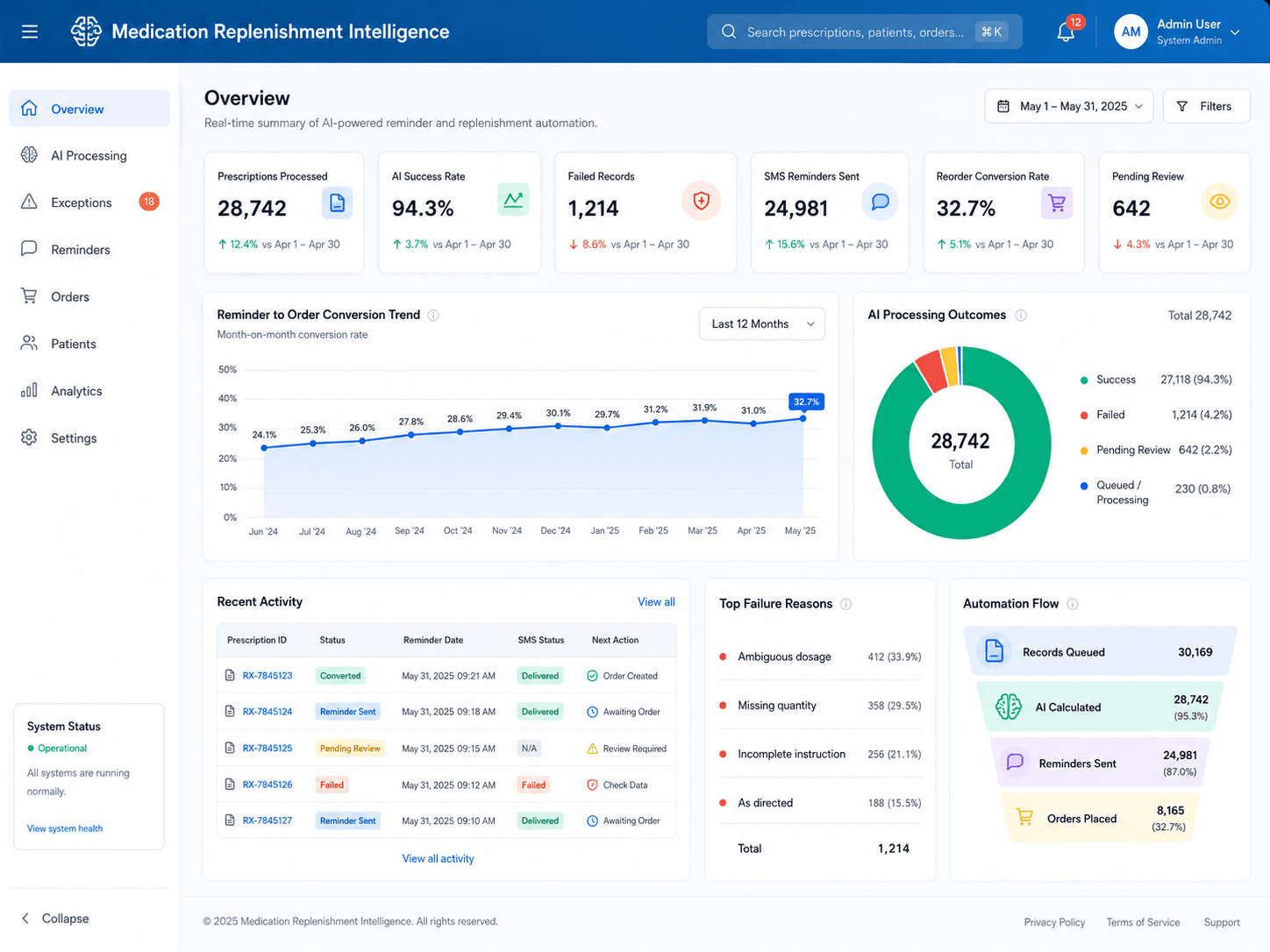
Rather than functioning as a traditional reporting interface, the dashboard was designed as a decision-support layer that enables operational teams, warehouse managers, and business leaders to monitor the health, effectiveness, and commercial impact of the replenishment intelligence ecosystem.
2) End-to-End Workflow Visibility
One of the client's primary requirements was transparency.
Stakeholders needed the ability to understand not only whether the AI was functioning correctly, but also how forecasting outcomes translated into operational activity.
The dashboard provides real-time visibility into every stage of the workflow, including:
- Total prescriptions processed
- Successfully forecasted records
- Exception records
- Forecast success rates
- Forecast failure rates
- Reminder activity
- SMS delivery performance
- Operational trends
This centralized view allows teams to monitor platform performance without relying on manual reporting processes.
3) AI Performance Monitoring
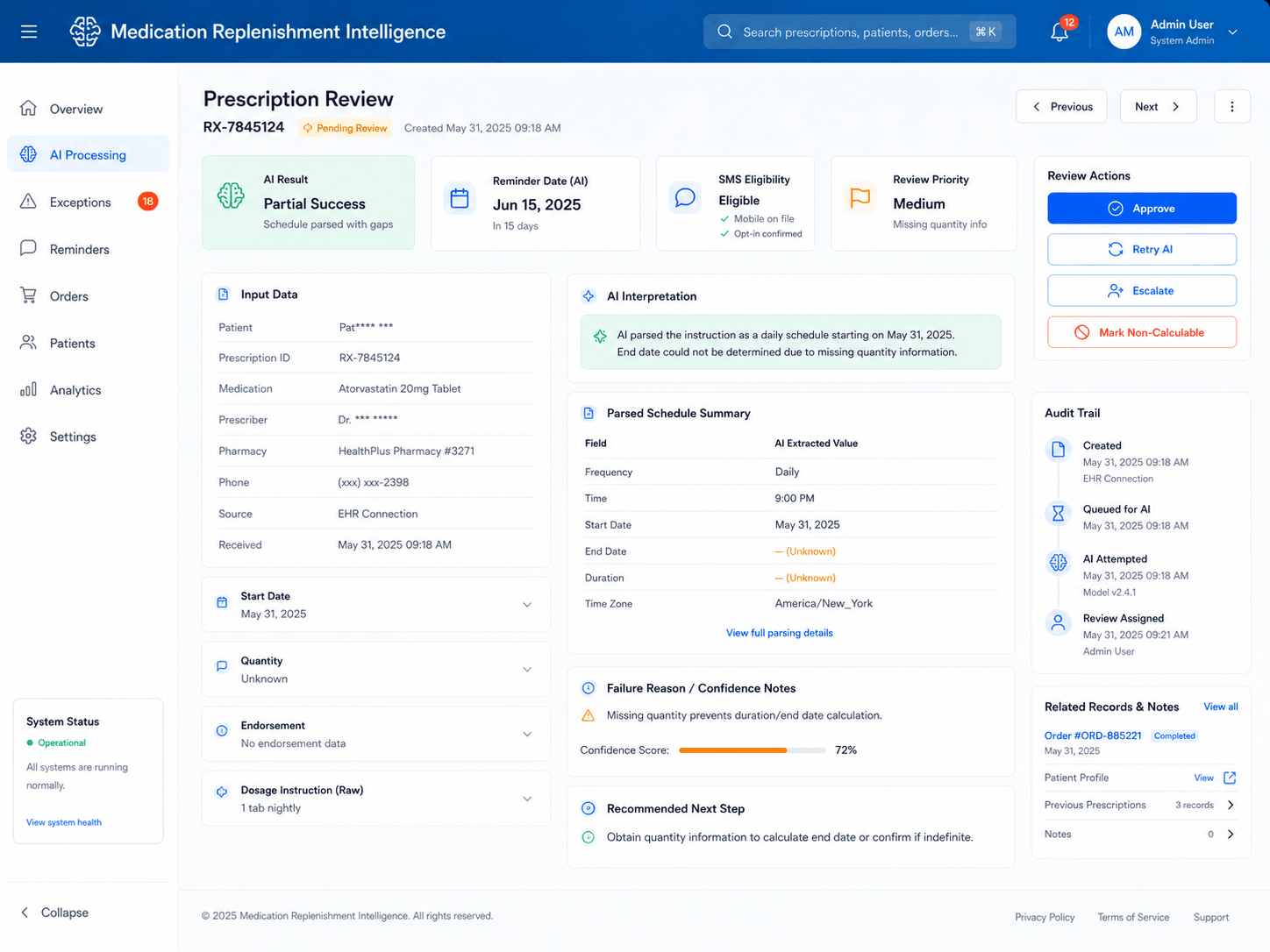
The platform continuously tracks AI processing activity and provides detailed visibility into forecasting outcomes.
Business users can evaluate the following:
- Forecast Success Rate
The proportion of records for which a projected medication replenishment reminder date was successfully generated.
These metrics provide a clear understanding of how effectively the AI system is operating within the production environment.
4) Exception Intelligence & Review Management
One of the most valuable components of the platform is its exception management capability.
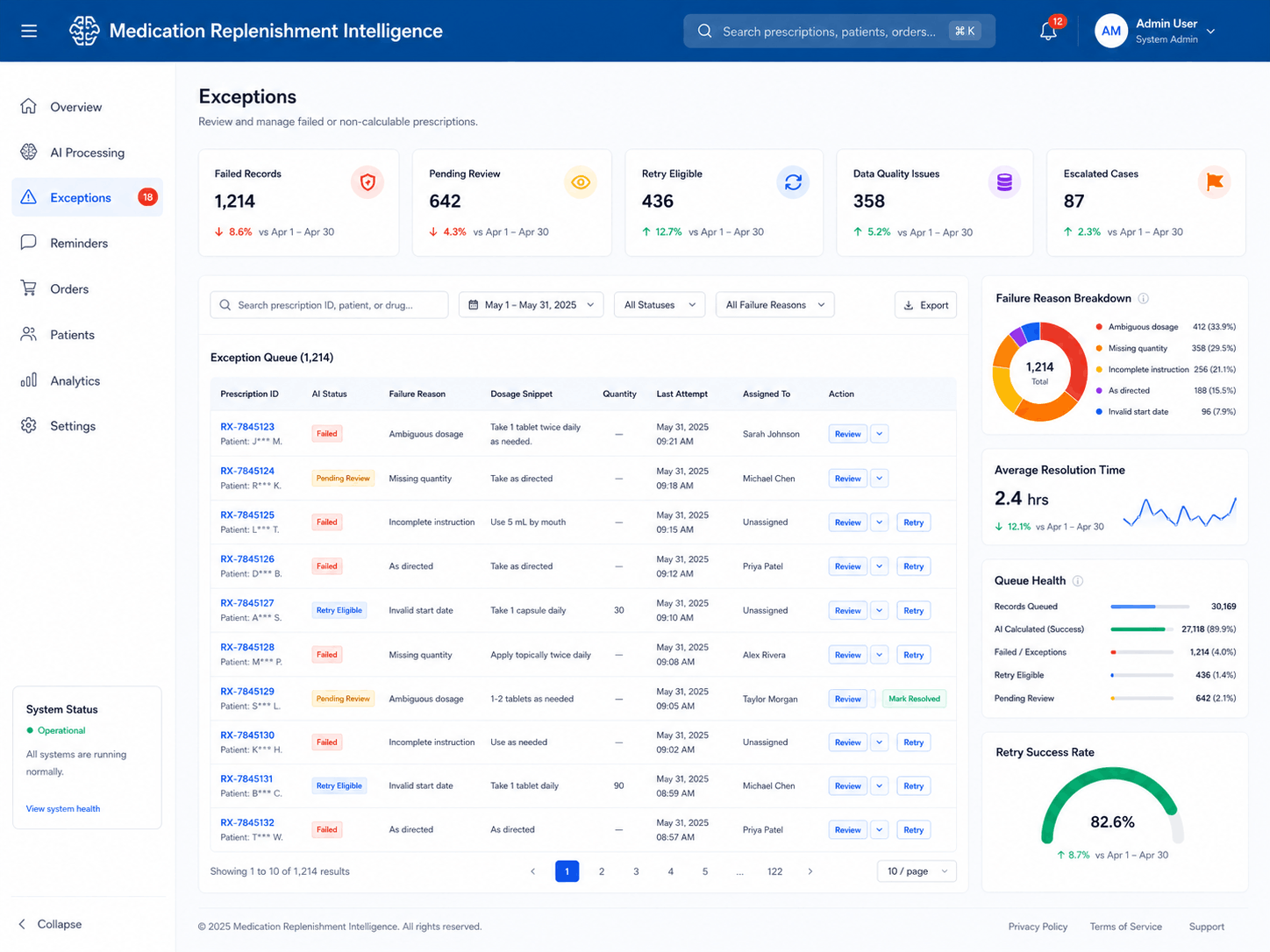
Rather than treating failures as system errors, the platform captures and categorizes exception records, enabling teams to investigate root causes and improve operational data quality.
Stakeholders can review:
- Failed prescription records
- Processing outcomes
- Failure categories
- Failure reasons
- Records requiring manual intervention
- Historical exception patterns
This dramatically reduces administrative effort by directing attention only to records that genuinely require human review.
5) Reminder Performance Analytics
The dashboard also provides visibility into customer engagement activity generated by the forecasting workflow.
Key metrics include:
- SMS reminders scheduled
- SMS reminders delivered
- Reminder activity by period
- Notification success rates
- Communication trends
This allows operational teams to verify that reminder workflows are functioning correctly and reaching customers at the intended time.
6) Measuring Business Impact Through Reordering Behaviour
One of the most significant advantages of the platform is its ability to connect AI forecasting activity with downstream business outcomes.
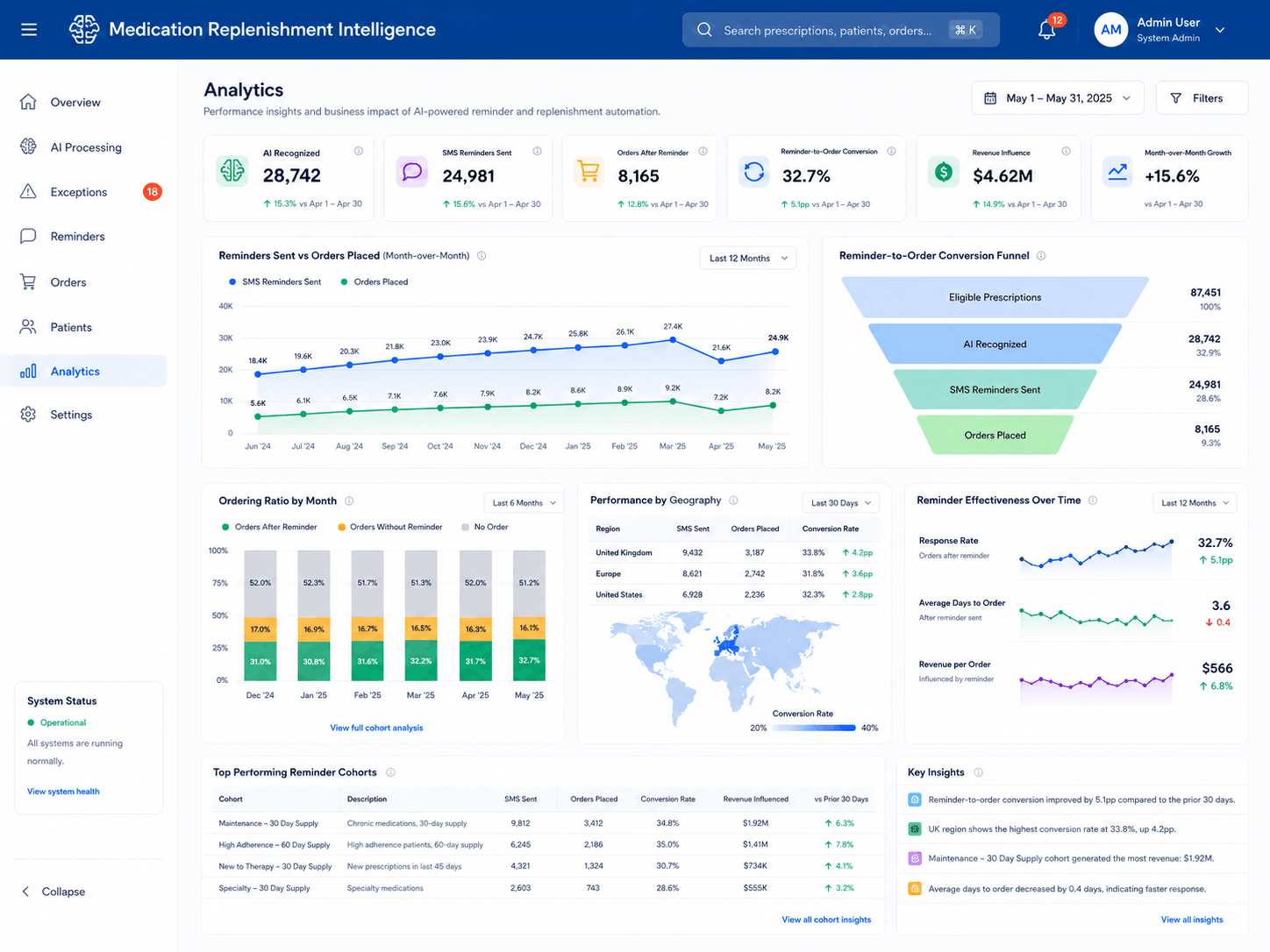
The reporting layer tracks:
- Reminder notifications issued
- Customer reordering activity
- Reminder-to-order relationships
- Ordering trends following reminders
- Month-on-month replenishment behaviour
This capability provides stakeholders with measurable evidence of how forecasting and reminder workflows contribute to broader business objectives.
Rather than evaluating AI solely through technical metrics, the organization can assess its impact through operational and commercial outcomes.
7) Transforming Data into Decision Intelligence
By consolidating forecasting activity, exception management, communication performance, and business outcomes into a single interface, the dashboard transformed the platform from an automation solution into an operational intelligence system.
Stakeholders gained the ability to:
- Monitor AI effectiveness
- Identify operational bottlenecks
- Prioritize exception handling
- Evaluate reminder performance
- Measure business impact
- Support continuous optimization
This visibility played a critical role in building confidence in the platform and accelerating adoption across the organization.
Technical Challenges Solved
Although the final platform presents a streamlined user experience, the underlying implementation required solving a series of complex technical, operational, and AI-specific challenges.
From interpreting highly inconsistent dosage instructions to preventing unreliable forecasts and integrating AI into a business-critical workflow, each challenge demanded a carefully engineered solution.
Successfully addressing these challenges was essential to transforming a promising AI concept into a production-ready replenishment intelligence platform.
Rushkar addressed these challenges through a combination of AI engineering, backend architecture, workflow orchestration, and validation frameworks.
1) Interpreting Highly Variable Dosage Instructions
The most significant challenge stemmed from the nature of the source data.
Dosage instructions were not stored in standardized formats. Instead, they existed as free-text entries written using different prescribing styles, abbreviations, and treatment descriptions.
A single medication schedule could be represented in numerous ways, making traditional rule-based processing ineffective.
Rushkar solved this challenge by implementing a structured LLM interpretation framework capable of understanding dosage intent rather than relying solely on predefined patterns. This enabled the platform to process a broad range of dosage structures while maintaining consistency and scalability.
2) Distinguishing Deterministic and Non-Deterministic Records
Not every prescription contained sufficient information to support forecasting.
Some records could be calculated confidently, while others lacked critical information such as quantity, start date, or dosage clarity.
The challenge was determining where automation should stop.
Rushkar addressed this by implementing a deterministic decision framework that evaluates each record before forecasting occurs. Records that meet predefined criteria proceed through automation, while non-deterministic cases are classified as exceptions and routed for review.
This approach prevents unreliable forecasts from entering operational workflows.
3) Maintaining Date Calculation Precision
Medication replenishment forecasting depends on accurate timeline calculations.
Even minor inaccuracies can create reminder schedules that drift away from actual medication consumption patterns.
This challenge became particularly complex when dealing with:
- Cyclical treatment plans
- Active dosage periods
- Scheduled breaks
- Quantity-based depletion calculations
- Multi-stage treatment schedules
Rushkar combined AI interpretation with backend validation mechanisms to ensure forecasting accuracy and reduce the risk of calculation errors.
4) Building Production-Safe AI Outputs
Large Language Models are naturally optimized for conversational interactions rather than operational workflows.
However, enterprise systems require structured, predictable, and machine-readable outputs.
The challenge was ensuring that AI-generated responses could be consumed reliably by downstream services without introducing ambiguity.
Rushkar implemented a strict response architecture that returns only the information required for operational processing, including forecast status, reminder dates, and exception classifications.
This significantly improved workflow reliability while simplifying system integration.
5) Controlling AI Processing Costs at Scale
Because the platform operates continuously, cost efficiency was a key architectural consideration.
Without optimisation, AI processing costs could increase significantly as prescription volumes grew.
Rushkar implemented a cost-conscious processing strategy that included:
- Multi-model routing
- Compact prompt structures
- Structured outputs
- Reduced token consumption
- Efficient exception handling
This enabled the platform to maintain forecasting quality while supporting sustainable long-term operation.
6) Integrating AI into Existing Enterprise Systems
The solution needed to operate within an established technology ecosystem rather than function as an isolated AI application.
Integration requirements included:
- .NET services
- SQL Server infrastructure
- Background processing workflows
- Logic App automation
- SMS communication services
- Business intelligence reporting
Rushkar designed a tightly integrated architecture that embedded AI directly into operational workflows, ensuring forecasting outcomes could drive meaningful business actions.
7) Delivering Visibility Beyond Automation
The final challenge involved transparency.
The client needed more than forecasting capabilities. They required visibility into AI performance, exception behaviour, reminder activity, and business outcomes.
Rushkar addressed this through a comprehensive operational intelligence platform that provides end-to-end visibility across the entire replenishment lifecycle.
As a result, stakeholders can evaluate not only how the AI performs, but also how forecasting activity contributes to customer engagement, operational planning, and replenishment performance.
By solving these challenges, Rushkar delivered a production-ready AI solution capable of operating reliably within a complex pharmacy supply-chain environment while maintaining scalability, governance, and measurable business value.
Results & Business Impact
The implementation of the replenishment intelligence platform fundamentally changed how the organization identifies future demand, engages customers, and plans operational activities.
What was previously a reactive process driven by manual interpretation became a proactive, intelligence-led workflow supported by AI, automation, and real-time analytics.
The impact extended beyond operational efficiency and created measurable improvements across forecasting visibility, workflow scalability, customer engagement, and business intelligence.
Improved Replenishment Visibility
One of the most significant outcomes was the organization's ability to identify replenishment opportunities before customers initiated a new order.
By transforming prescription-derived data into actionable forecasts, the platform created a forward-looking view of demand that was previously unavailable.
This enabled teams to engage customers proactively and improve visibility into future medication requirements.
Reduced Manual Intervention
Prior to implementation, dosage interpretation required considerable manual effort.
The AI-powered forecasting workflow now automates a substantial portion of this activity, allowing teams to focus on exception cases rather than routine record analysis.
This reduced administrative overhead while improving processing consistency and scalability.
Faster Operational Decision-Making
The automated forecasting framework significantly accelerated the identification of replenishment opportunities.
Instead of relying on periodic manual reviews, the organization now benefits from continuous processing and near real-time forecasting visibility.
This supports faster decision-making across operational and customer engagement teams.
Enhanced Warehouse Readiness
The platform provides earlier visibility into expected replenishment activity, enabling fulfilment teams to prepare more effectively for future demand.
By reducing reliance on reactive order management, the organization can improve planning, resource allocation, and operational responsiveness.
Automated Customer Engagement
The integration of reminder orchestration and SMS communication workflows introduced a scalable mechanism for proactive customer outreach.
Forecasts are automatically translated into engagement actions, reducing dependency on manual reminder processes and ensuring more consistent communication.
Greater Operational Transparency
The introduction of the operational intelligence dashboard provided stakeholders with unprecedented visibility into forecasting activity, reminder execution, exception trends, and system performance.
This transparency has improved confidence in AI-driven workflows while supporting continuous optimisation efforts.
Measurable Business Intelligence
Perhaps the most valuable outcome was the ability to connect forecasting activity with downstream ordering behaviour.
Through reminder tracking and analytics, stakeholders can evaluate how replenishment forecasts influence customer actions and monitor trends over time.
This transformed the platform from a forecasting solution into a measurable business intelligence capability.
Strategic Outcomes
The platform delivered value across multiple dimensions:
1) Operational Outcomes
- Reduced manual effort
- Faster processing workflows
- Improved exception management
- Greater scalability
2) Business Outcomes
- Enhanced replenishment visibility
- Improved customer engagement opportunities
- Better planning capabilities
- Stronger reporting and analytics
3) Technology Outcomes
- Production-ready AI deployment
- Enterprise system integration
- Cost-optimised processing architecture
- Governed AI operations
Most importantly, the organization successfully transitioned from reactive replenishment management to a proactive replenishment intelligence model capable of supporting long-term operational growth.
Why Rushkar
Organizations rarely struggle because they lack access to AI models. They struggle because transforming AI into a reliable business capability requires a combination of strategy, engineering, governance, integration expertise, and operational understanding.
This project demonstrates Rushkar's ability to bridge that gap.
This engagement showcases Rushkar's ability to deliver end-to-end AI Software Development Services that extend beyond model implementation. The project required AI Consulting Services, LLM Development Services, Prompt Chaining AI Services, AI Integration Services, Machine Learning Development Services, and AI Analytics Solutions working together within a single enterprise ecosystem. As a trusted AI development company, Rushkar helps organizations design, build, integrate, and optimize production-grade AI platforms that solve measurable business challenges.
Rushkar partnered with the client not merely as a development vendor, but as an AI transformation partner responsible for designing a production-grade solution capable of delivering measurable business outcomes.
The engagement required expertise across:
- AI Software Development
- AI Consulting
- LLM Workflow Design
- Prompt Engineering
- Enterprise Integration
- Backend Engineering
- Workflow Automation
- Business Intelligence Development
- Production Deployment
By combining AI capabilities with enterprise software engineering principles, Rushkar delivered a replenishment intelligence platform that integrates seamlessly into operational workflows while maintaining transparency, reliability, and scalability.
The result is a practical example of how AI can move beyond experimentation and become a trusted operational asset within a complex business environment.
Technology Stack
The platform was engineered using a combination of enterprise-grade technologies, AI services, workflow automation tools, and reporting infrastructure. Each component was selected to support scalability, reliability, maintainability, and seamless integration with the client's operational ecosystem.
| Layer |
Technology |
| Programming Language |
C# |
| Application Framework |
.NET |
| Database |
SQL Server |
| AI Models |
GPT-5.5, GPT-5.4-mini |
| AI Platform |
OpenAI API |
| Workflow Automation |
Logic App |
| Processing Engine |
Background Jobs |
| Communication Layer |
Upland SMS |
| API Integration |
REST APIs |
| Reporting Layer |
Custom Web Dashboard |
| Analytics Layer |
Business Intelligence Reporting |
| Monitoring & Governance |
Exception Tracking & Validation Framework |
This technology stack enabled the client to combine AI-powered interpretation, workflow automation, communication orchestration, and business intelligence within a single production-ready platform.
Key Takeaways
- AI can interpret complex dosage instructions and identify deterministic replenishment opportunities.
- LLM-powered forecasting can automate projected medication replenishment reminder date calculations.
- Structured prompt orchestration improves forecasting consistency and operational reliability.
- AI guardrails help prevent speculative forecasting and improve trust.
- Enterprise AI platforms require backend validation, workflow automation, and business intelligence reporting.
- Operational dashboards help connect AI processing activity with measurable business outcomes.
Frequently Asked Questions
1. What are AI Software Development Services?
AI Software Development Services involve designing, developing, integrating, and deploying AI-powered applications that automate workflows, generate insights, and improve operational efficiency. This project demonstrates how AI was used to automate medication replenishment forecasting and reminder workflows.
2. What is an AI-powered replenishment intelligence platform?
An AI-powered replenishment intelligence platform uses Large Language Models, automation workflows, analytics, and operational data to forecast future replenishment opportunities and trigger proactive customer engagement activities.
3. How do AI Integration Services help existing enterprise systems?
AI Integration Services enable organizations to connect AI models with existing databases, applications, communication platforms, workflow automation tools, and reporting systems. In this project, AI was integrated with .NET applications, SQL Server databases, SMS workflows, and business intelligence dashboards.
4. Can AI accurately calculate medication replenishment reminder dates?
Yes, provided sufficient information exists within the prescription record. In this project, the AI platform analysed dosage instructions, medication quantities, and treatment timelines to calculate projected medication replenishment reminder dates. However, the system was intentionally designed to calculate forecasts only when the available information supported a deterministic outcome.
5. How does the platform handle ambiguous dosage instructions?
The platform follows a strict governance model that prevents speculative forecasting. If a dosage instruction is incomplete, ambiguous, or lacks sufficient information for calculation, the system returns a structured exception rather than generating an unreliable reminder date. These records are surfaced through the dashboard for further review.
6. Why was a multi-model AI strategy used?
Different prescription records require different levels of reasoning complexity. The platform uses GPT-5.5 and GPT-5.4-mini to balance forecasting quality, processing efficiency, and operational cost. Complex scenarios can leverage advanced reasoning capabilities, while straightforward records can be processed more cost-effectively.
7. Can Large Language Models be integrated into existing pharmacy supply-chain systems?
Absolutely. One of the primary objectives of this project was to embed AI within existing operational workflows rather than create a standalone application. The platform integrates with .NET services, SQL Server databases, workflow automation tools, SMS communication systems, and reporting environments to create a connected operational ecosystem.
8. What role does prompt orchestration play in the solution?
Prompt orchestration provides structure and consistency to the forecasting workflow. Instead of relying on a single AI interaction, the platform evaluates dosage interpretation, forecast eligibility, reminder calculation, and exception handling through a governed process. This significantly improves reliability and operational predictability.
9. How does the platform control AI processing costs?
Rushkar implemented several optimisation mechanisms, including compact prompt structures, structured outputs, multi-model routing, reduced token consumption, and efficient exception handling. These measures help maintain high forecasting quality while supporting sustainable long-term deployment.
10. What business insights can stakeholders access through the dashboard?
The operational intelligence dashboard provides visibility into:
- AI processing volume
- Forecast success rates
- Forecast failure rates
- Exception categories
- Reminder activity
- SMS delivery metrics
- Reordering behaviour
- Month-on-month performance trends
This enables stakeholders to evaluate both AI effectiveness and broader business impact.
11. Can AI improve operational efficiency within pharmacy supply-chain environments?
Yes. AI can significantly reduce manual interpretation effort, improve forecasting visibility, automate customer engagement workflows, streamline exception management, and provide actionable operational intelligence. When combined with strong governance and integration practices, AI becomes a powerful operational enablement tool rather than simply a productivity enhancement.
Looking to Build an AI-Powered Operational Intelligence Platform?
Most organizations already possess the operational data required to unlock significant business value. The challenge lies in transforming that data into actionable intelligence that can drive forecasting, automation, decision-making, and measurable outcomes.
Rushkar helps organizations design, build, integrate, and deploy enterprise-grade AI solutions that solve real operational challenges through intelligent automation, Large Language Models, workflow orchestration, and advanced analytics.
Our expertise includes:
- AI Software Development Services
- AI Consulting Services
- AI Integration Services
- LLM Development Services
- Prompt Chaining AI Services
- Generative AI Development Services
- Machine Learning Development Services
- AI Analytics Solutions
- Dedicated AI Development Teams
Whether you are modernizing legacy workflows, automating complex operational processes, building AI-powered analytics platforms, or integrating Large Language Models into existing enterprise systems, Rushkar can help you transform AI potential into measurable business outcomes.
Ready to turn operational complexity into intelligent automation?
Connect with Rushkar's AI experts to explore how a tailored AI solution can accelerate efficiency, improve decision-making, and create lasting competitive advantage.