AI-Powered Insurance Lead Matching & Quote Management Platform
AI-Powered Insurance Lead Matching & Quote Management Platform
Automobile insurance customers, agents and insurance firms often work with the same information but approach it from different directions. Customers need suitable coverage and quotes, agents need relevant opportunities to work on, and firms need a way to identify potential customers who fit their business criteria.
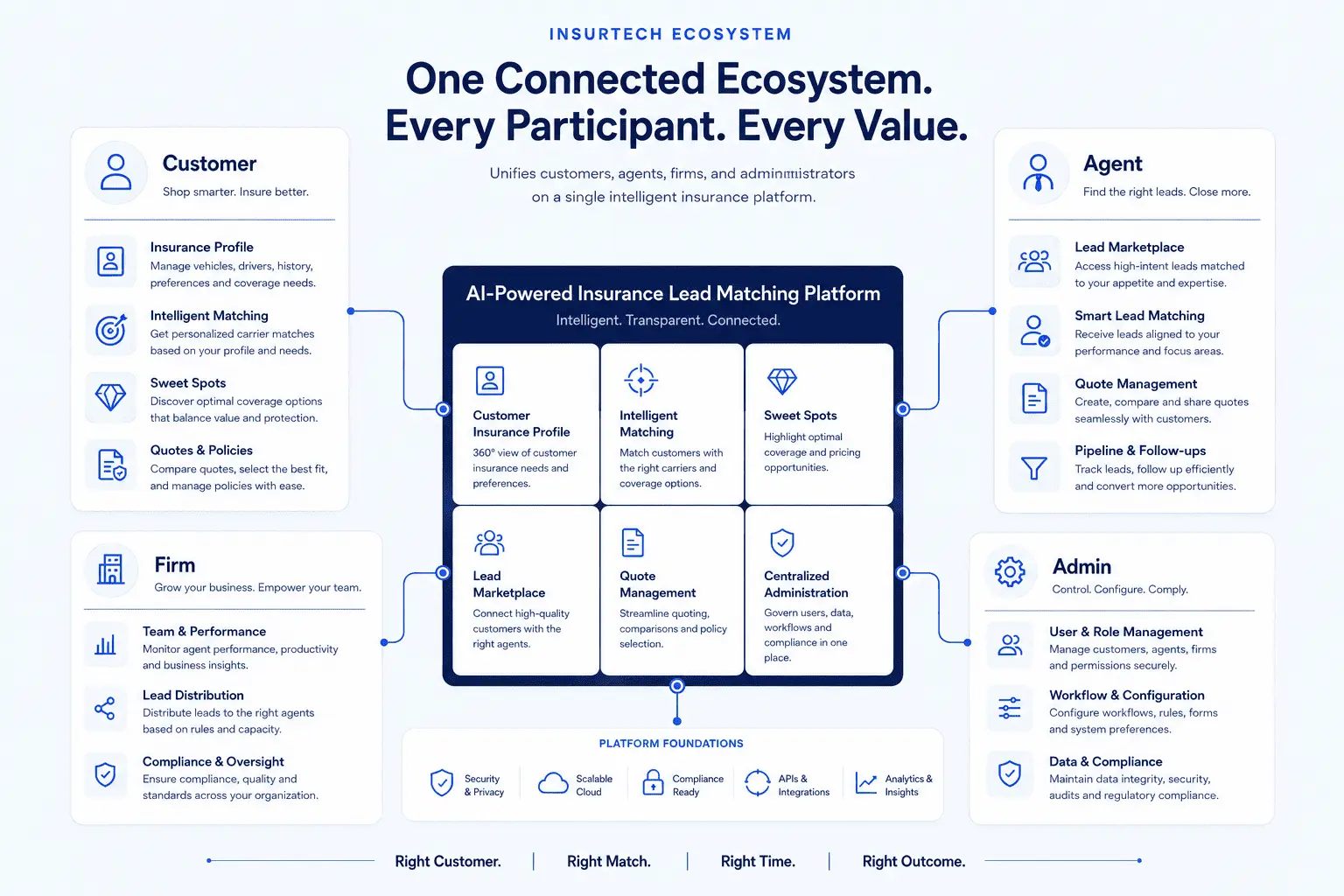
Rushkar Technologies developed an AI-powered insurance lead matching and quote management platform for the US automobile insurance market. The platform captures customer insurance details, allows firms to define their preferred customer profiles through Sweet Spot criteria, and uses intelligent matching to connect those profiles with relevant insurance opportunities.
Beyond matching, the platform supports lead distribution, agent and firm operations, quote and proposal handling, customer communication, payment workflows and administrative controls. Each role works with the information and functions relevant to its responsibilities, while customer details and opportunity activity remain connected throughout the platform.
Platform Highlights
- Industry: US Automobile Insurance
- User Roles: Customer, Agent, Firm and Admin
- Intelligence: AI / Intelligent Matching
- Lead Distribution: Shared and Exclusive Leads
- Core Workflows: Insurance Data Intake, Lead Management and Quote Management
- Integrations: Stripe, Twilio and RingCentral
02. Quick Project Snapshot
| Project Detail |
Information |
| Industry |
Insurance / InsurTech |
| Target Market |
United States |
| Insurance Focus |
Automobile Insurance |
| Solution |
Insurance Lead Matching & Quote Management Platform |
| User Roles |
Customer, Agent, Firm and Admin |
| Intelligent Capabilities |
AI / Intelligent Matching |
| Lead Distribution Model |
Shared and Exclusive Leads |
| Frontend |
Angular |
| Backend |
.NET |
| Database |
Microsoft SQL Server |
| Payment Integration |
Stripe |
| Communication Integration |
Twilio |
| Calling Integration |
RingCentral |
| Project Duration |
20 Weeks |
| Team Size |
8 Members |
| Development Methodology |
Agile |
03. Executive Summary
Finding an automobile insurance quote is not always a straightforward process. A customer may need to provide household details, driver information, vehicle specifications, driving history and existing coverage information before an agent can assess the request. For insurance firms, the challenge is different. They need to identify customers who fit their business preferences, distribute leads appropriately and manage the work that follows each enquiry.
Rushkar Technologies built a platform around these connected requirements. Customers can submit and manage their insurance information, while firms define the customer profiles they want to pursue using Sweet Spot criteria. The intelligent matching capability connects customer profiles with relevant opportunities, helping firms and agents work with leads that align with their configured preferences.
The platform also supports the next stages of the process. Agents can manage assigned leads and customer records, prepare or share quotes and proposals, and maintain follow-up activity. Customers can review the information shared with them and indicate their interest. Firms can oversee agents, licensing records, lead acquisition, referrals, wallet credits, transactions and related business operations.
The administrative side covers platform dashboards and insurance master data, including geographic information, vehicle classifications, insurance carriers and licence types. Stripe, Twilio and RingCentral support the associated payment, communication and calling functions.
The important distinction is that the platform does more than collect enquiries. It connects insurance information with firm-defined targeting, lead distribution and quote-related activity. The final insurance policy purchase remains outside the platform, between the customer, agent and insurance firm.
04. Client / Product Overview
The platform was designed around four distinct user groups. Each group participates in the insurance workflow, but each has different responsibilities and access requirements.
- Customer
Customers provide their automobile insurance information, maintain relevant details and review quotes or proposals shared with them. Their profile can include information about household members, licensed drivers, vehicles, current coverage and driving records. Keeping these details organised gives agents a clearer starting point when assessing an insurance request.
- Agent
Agents work with assigned leads and customer records. Their responsibilities include reviewing customer information, following up on opportunities, preparing quotes or proposals and sharing relevant documents with customers. The platform gives agents a defined workflow for handling these activities instead of treating every enquiry as a separate administrative task.
- Firm
Firms manage the commercial and operational side of lead acquisition. They can configure Sweet Spot criteria, oversee agents and licence records, manage leads and customers, review referrals, and handle wallet credits and transactions. These controls help firms align lead acquisition with their preferred customer profiles and operational requirements.
- Admin
Administrators oversee the wider platform. Their responsibilities include reviewing operational dashboards and maintaining the master data used across the system, such as insurance carriers, vehicle information, geographic classifications and licence types. Centralised administration helps maintain consistent reference data across different user workflows.
05. Business Challenge
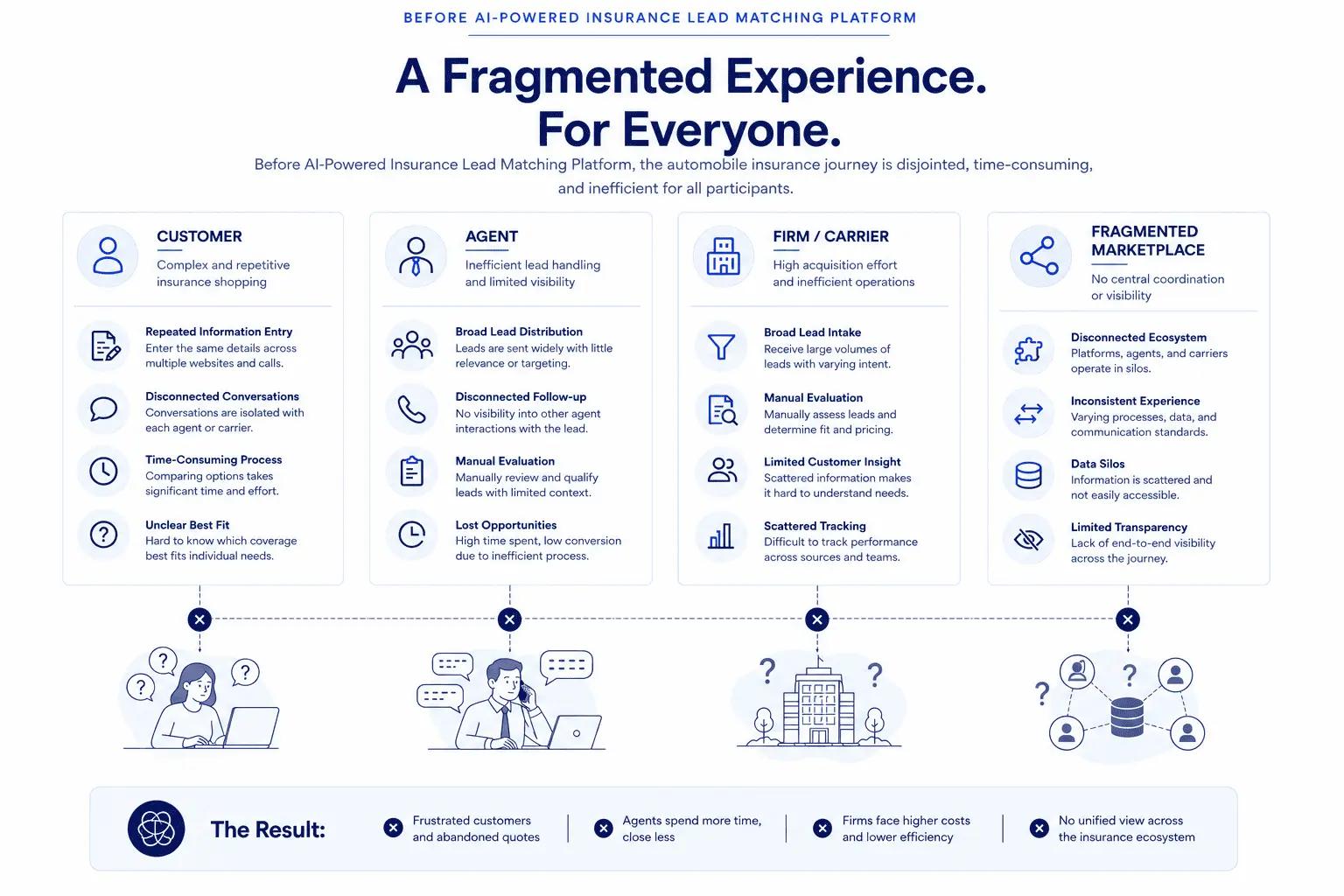
The central challenge was to connect customer insurance information with lead targeting and subsequent quote management without overlooking the details that make automobile insurance enquiries complex.
1. Customer Challenges
Insurance enquiries require more than a name and contact number. Agents may need details about household members, licensed drivers, vehicles, existing coverage, driving history and premium information before they can assess a request. When customers approach different providers through separate channels, they may need to explain similar information repeatedly.
This can make it harder to keep documents, conversations and quote details organised. Customers also need a clear way to review the information shared with them and communicate their interest in the next steps.
2. Agent Challenges
Agents need enough information to assess an opportunity before investing time in follow-up. When lead acquisition and customer information are handled separately, agents may have to review records manually, establish missing context and coordinate quote preparation through disconnected processes.
The challenge was to give agents access to structured customer information while supporting the activities that follow lead assignment, including customer management, quote preparation and communication.
3. Firm Challenges
Insurance firms need to decide which customer profiles fit their business objectives. They also need to manage the agents working on those opportunities, maintain licence records and oversee lead acquisition, customer activity and financial transactions.
Without clearly defined targeting criteria and operational controls, lead management can become difficult to coordinate as the number of firms, agents and customer records grows.
4. The Platform Challenge
The platform needed to address these requirements as parts of one business workflow. Customer information had to support matching, matching had to support lead distribution, and lead activity had to connect with agent operations and quote management. At the same time, the system needed role-specific functionality, configurable insurance reference data and integrations for payments, communication and calling.
06. Existing Insurance Shopping Process
In a fragmented insurance shopping process, customer information and agent activity can become separated across multiple interactions.
-
The customer starts an insurance enquiry. They look for suitable automobile insurance and contact an agent or firm.
-
The agent collects the required details. Information about drivers, vehicles, existing coverage and other relevant factors is gathered to understand the request.
-
The agent evaluates the customer profile. The available information is reviewed to determine whether the enquiry fits the firm's offering and requirements.
-
The customer may approach another provider. Similar information may need to be supplied again, particularly when previous details are not available in the next interaction.
-
Quotes and conversations develop separately. Documents, follow-up discussions and proposal details may sit across different channels or records.
-
The customer reviews available options. Comparing information can require moving between separate conversations and documents.
-
The agent and customer discuss the next steps. Further discussions take place before the customer decides whether to proceed with an insurance provider.
The underlying issue is not simply the number of steps. Customer information, lead selection and quote activity do not always follow a consistent digital workflow. The platform was designed to connect these stages while retaining the information needed for insurance-related decisions.
07. Solution Strategy
Rushkar Technologies approached the project by mapping the information and decisions required at each stage of the insurance lead lifecycle.
- Structured customer information
The platform captures automobile insurance details across relevant categories, including insured parties, household members, licensed drivers, driving records, vehicles, existing coverage and communication preferences. This provides a consistent profile for subsequent workflows.
- Firm-defined Sweet Spot criteria
Instead of treating every enquiry as equally relevant to every firm, the platform allows firms to define the customer characteristics they want to target. These preferences are represented through Sweet Spot criteria and can be applied to existing records, future leads or both.
- AI / Intelligent Matching
The matching capability connects customer profiles with firm-defined criteria to identify relevant insurance opportunities. This links customer information to the preferences firms have configured for lead acquisition.
- Shared and exclusive lead distribution
The platform supports both shared and exclusive leads, giving lead distribution a defined place in the wider commercial workflow. The selected model determines how an opportunity is made available to participating firms or agents.
- Agent and quote workflows
Once an opportunity enters the relevant workflow, agents can manage the lead, work with customer information, prepare or share quotes and proposals, and maintain follow-up activity. Customers can review the shared information and indicate interest.
- Firm and administrative controls
Firm-level features support agent management, licensing, lead acquisition, customer records, referrals and financial activity. Administrative functions provide dashboards and configurable insurance master data used throughout the platform.
The strategy connected the main operational requirements without treating matching, lead distribution, quote management and administration as isolated modules.
08. Architecture & Workflow
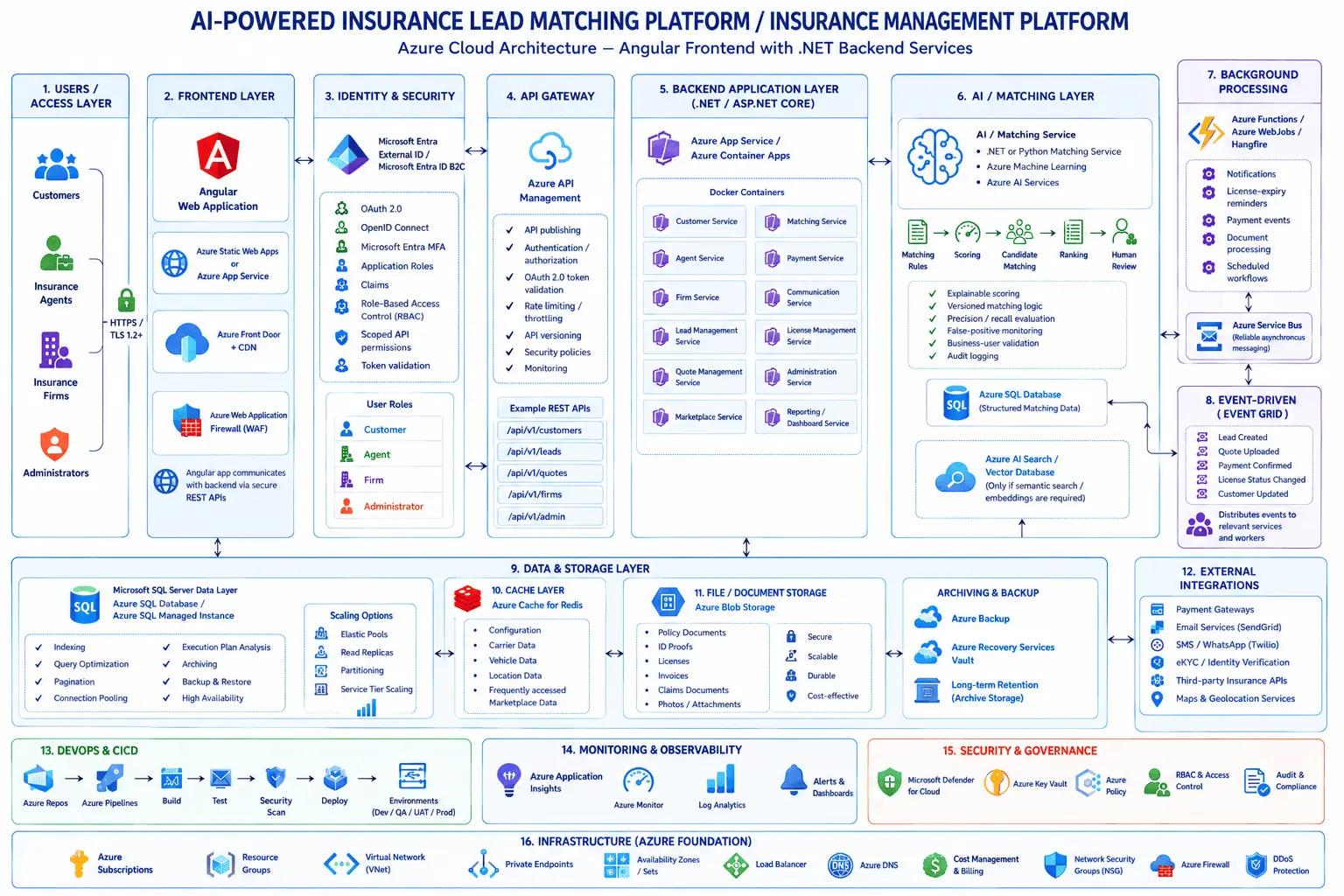
The platform uses Angular for the frontend, .NET for application and business logic, and Microsoft SQL Server for structured data storage. AI / Intelligent Matching supports the insurance opportunity-matching process, while external integrations provide payment, communication and calling functionality.
Architecture Overview
User Layer - Customer, Agent, Firm and Admin | Frontend Layer - Angular | Application Layer - .NET Application and Business Logic | Matching Layer - AI / Intelligent Matching | Data Layer - Microsoft SQL Server
Integration Layer
- Stripe: Payment workflows
- Twilio: Communication functionality
- RingCentral: Calling functionality
Angular provides the interface through which each role accesses its relevant features. The .NET application manages the business rules and workflows that connect those interfaces with platform operations. Microsoft SQL Server stores structured information required for customer records, lead activity, firm configuration and other business functions.
The intelligent matching capability connects customer insurance profiles with the criteria configured by firms. The integrations support specific activities around the core workflow, including payments and customer communication.
This separation gives the platform a clear technical foundation: user interactions take place through the frontend, business processes are handled by the application layer, structured records are maintained in the database, and the matching capability supports the identification of relevant opportunities.
09. Intelligent Insurance Data Intake
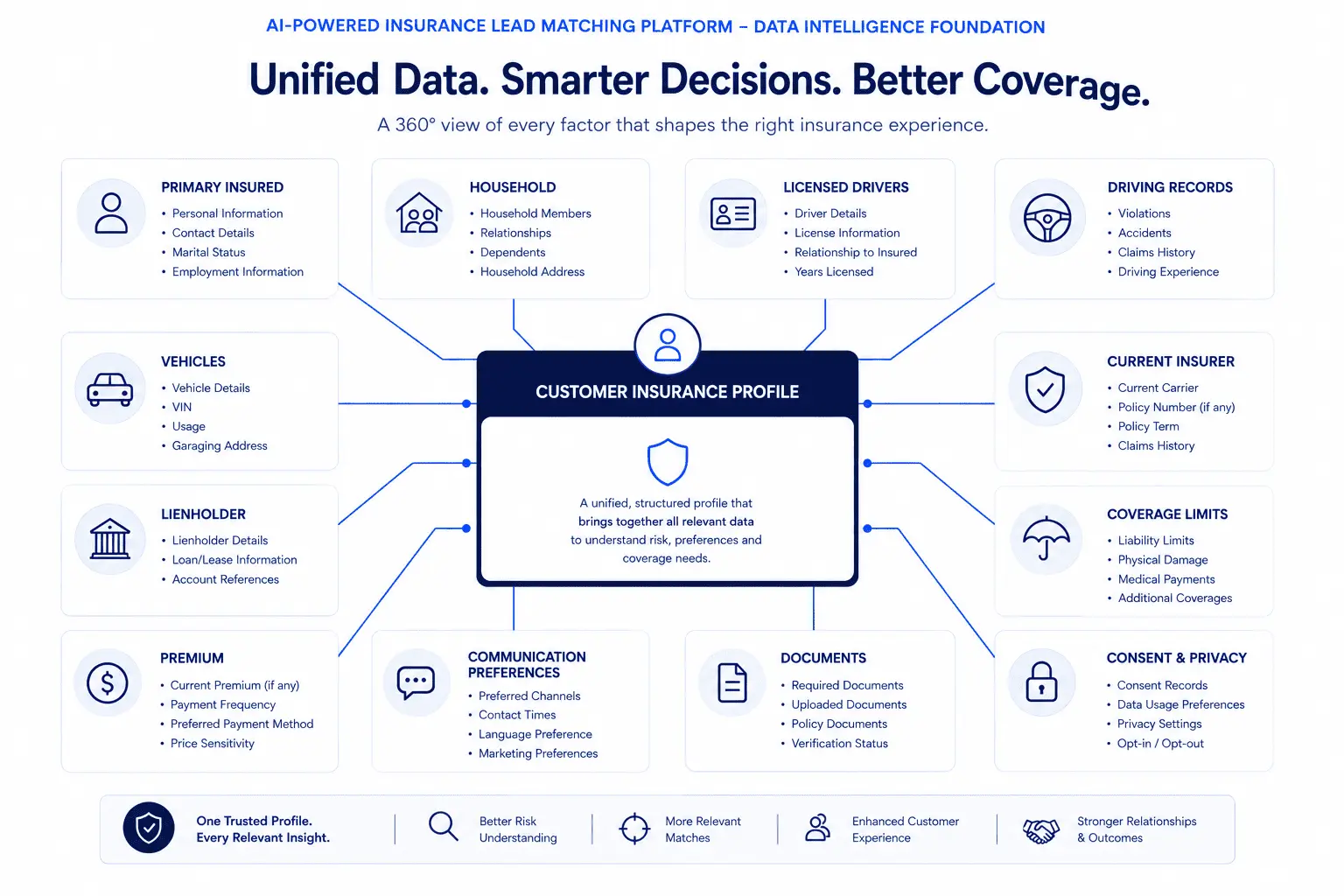
Insurance lead matching depends on the quality and relevance of the customer information available to the platform. A basic contact record does not provide the same context as a profile containing driver, vehicle and coverage details.
The platform captures information across several areas of an automobile insurance profile:
- Primary insured: Details relating to the principal person seeking insurance.
- Household information: Relevant household details used within the insurance profile.
- Licensed drivers: Information about drivers associated with the request.
- Driving records: Driving history and related information provided for assessment.
- Vehicles: Details about the vehicles included in the insurance request.
- Lienholder: Relevant lienholder information associated with a vehicle.
- Current insurer: Information about the customer's existing insurance provider.
- Coverage limits: Details of current or requested coverage limits.
- Premium information: Relevant premium details associated with the insurance profile.
- Communication preferences: Customer preferences governing communication.
- Documents and comments: Supporting records and additional information associated with the request.
- Consent and communication choices: Customer selections relevant to permitted communications and related interactions.
These categories serve different purposes. Driver and vehicle information helps describe the insurance risk being presented, while existing coverage and premium details provide context for the customer's current position. Documents and comments can supply additional information that does not fit neatly into a standard field.
Keeping the information organised gives matching and downstream workflows a more consistent source of customer context. It also helps agents review a profile without relying entirely on information gathered through separate conversations.
10. AI-Powered Matching & Sweet Spot Intelligence
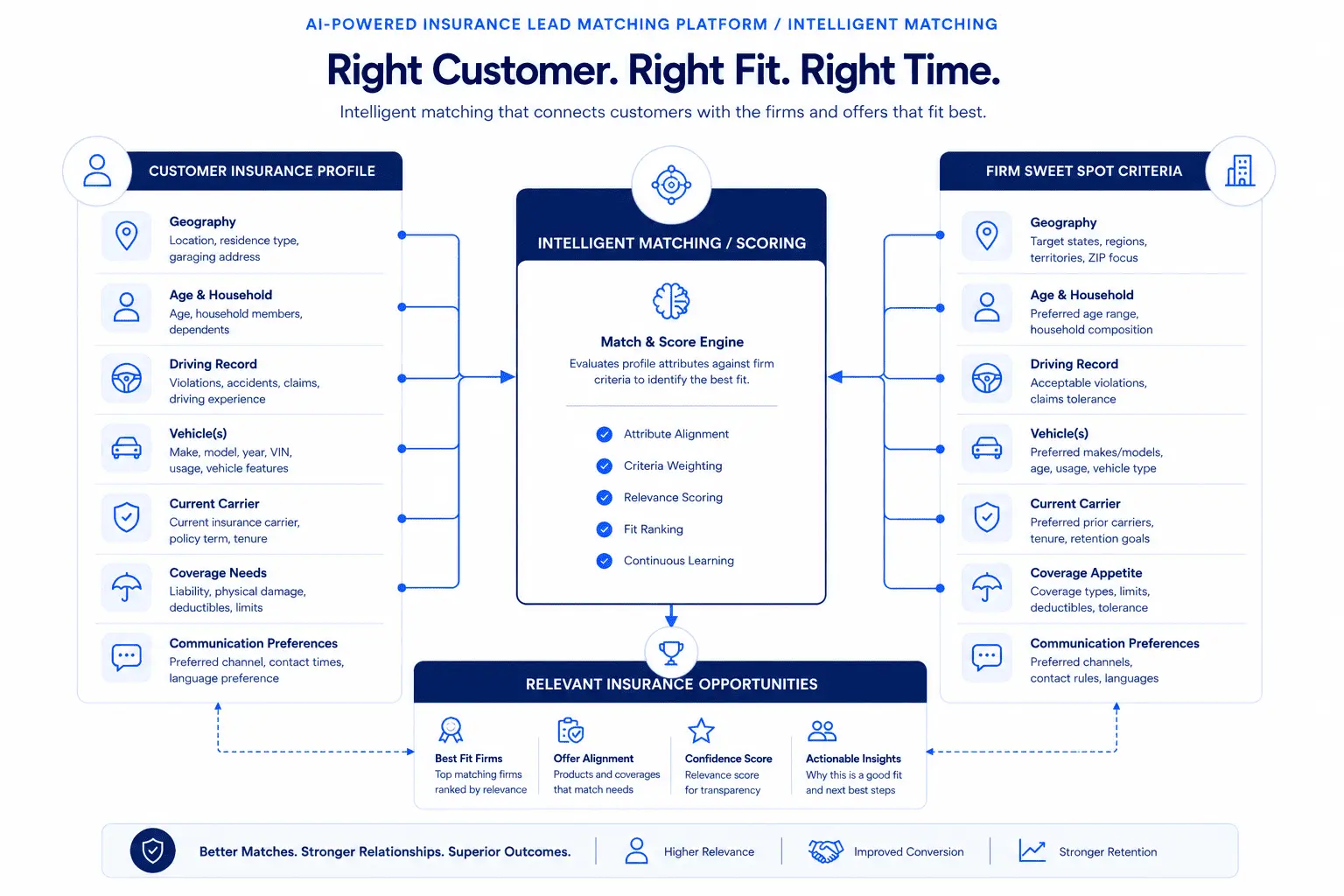
The platform's intelligent matching capability connects two sides of the lead process: the information available about a customer and the customer characteristics a firm wants to target.
How Matching Works
- Customer Insurance Profile
The platform maintains structured information about the customer's insurance request, household, drivers, vehicles, coverage and other relevant characteristics.
- Firm Sweet Spot Criteria
The firm defines the customer profiles it wants to pursue. These preferences determine which characteristics are relevant to its lead-targeting requirements.
- AI / Intelligent Matching
The platform applies its intelligent matching capability to connect customer profiles with relevant opportunities based on the configured criteria.
- Relevant Insurance Opportunities
The matching process supports the identification of opportunities that align with the firm's preferences, which can then enter the applicable lead distribution and management workflows.
Sweet Spot Criteria
The platform supports targeting criteria across multiple categories:
Marital status
Gender
Age
Employment
Education
Credit score
Language
State, county, city and ZIP code
Household information
Driving record
Vehicle information
Current insurance carrier
Coverage limits
Communication preferences
Lead source
These criteria allow firms to describe the customer profiles they want to target using more than location or a single demographic field. For example, a firm's configured preferences may combine geographic information with vehicle details, current coverage and other supported characteristics.
Sweet Spots can be applied to existing records, future leads or both, depending on the firm's configuration. This distinction matters because firms may need to assess records already available on the platform as well as opportunities entering the system later.
The platform's AI / Intelligent Matching capability is the confirmed intelligence component. The implementation should not be interpreted as evidence of specific machine-learning models, predictive conversion scores or automated carrier recommendations unless those capabilities are separately established.
11. Lead Marketplace & Distribution
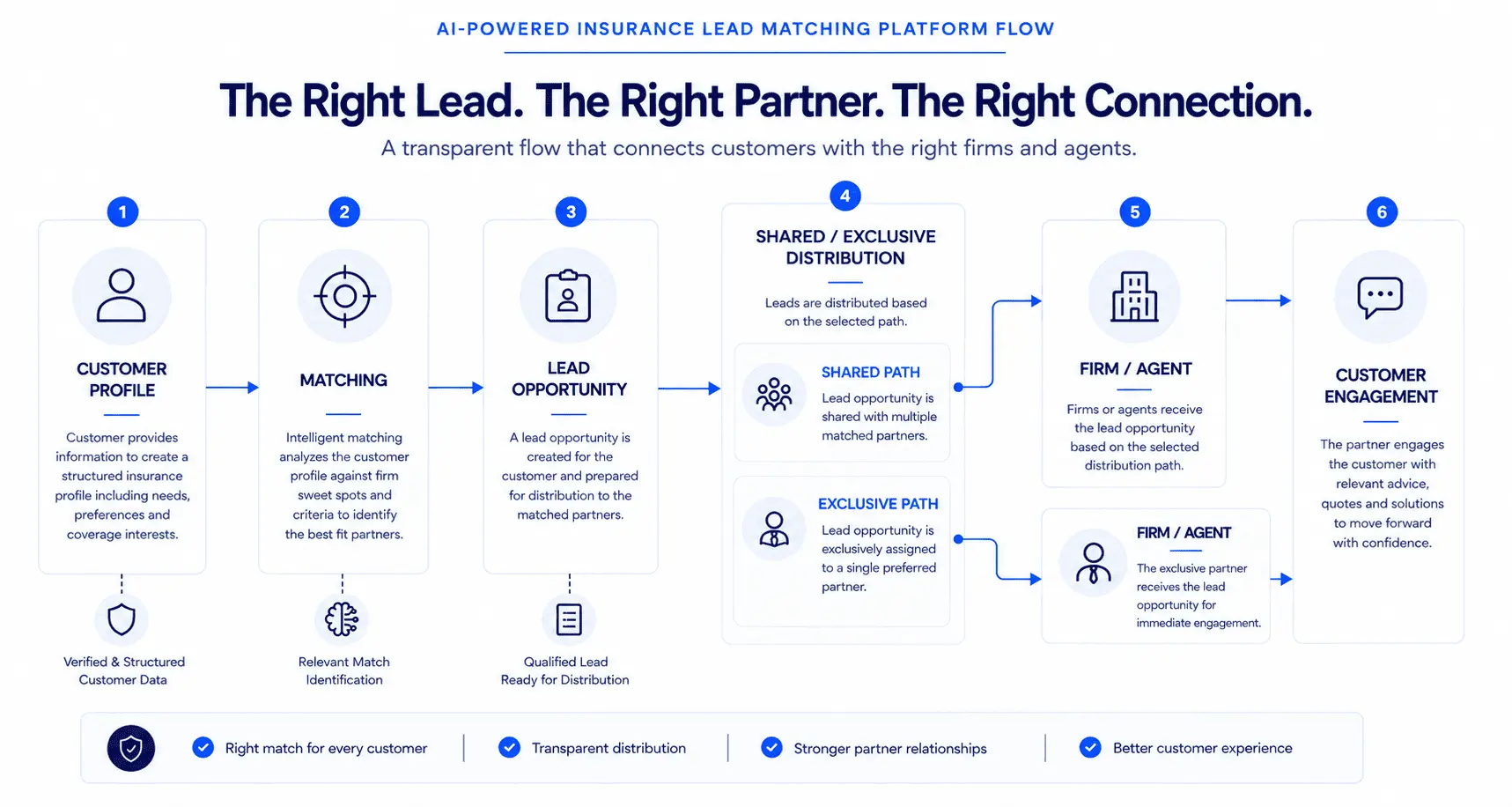
Matching identifies relevant opportunities, but the platform also needs to support how those opportunities enter the commercial workflow. The lead marketplace connects firm targeting with lead acquisition, distribution and subsequent agent activity.
- Shared Leads
Shared leads support a distribution model in which an opportunity can be made available to more than one eligible participant, subject to the applicable platform rules. This model gives firms and agents access to opportunities without treating every lead as exclusive to a single buyer.
- Exclusive Leads
Exclusive leads support a different acquisition model in which an opportunity is offered on an exclusive basis. The distinction between shared and exclusive leads allows the marketplace to accommodate different lead-purchasing arrangements.
- Firm Targeting and Lead Acquisition
Sweet Spot criteria provide the targeting context for identifying relevant opportunities. Firms can participate in the lead acquisition workflow and manage the opportunities associated with their business.
- Agent Engagement
After a lead is distributed, the relevant agent can work with the associated customer information, manage follow-up and progress the opportunity through the supported quote or proposal workflow.
- Lead Status and Downstream Activity
Lead management connects the initial opportunity with customer records and subsequent quote-related activity. This gives firms and agents a way to work with the opportunity after acquisition rather than treating the purchase or assignment of a lead as the end of the process.
The marketplace therefore serves as the commercial link between intelligent matching and day-to-day insurance lead management. Matching helps identify relevant opportunities, while distribution and management determine how those opportunities are handled.
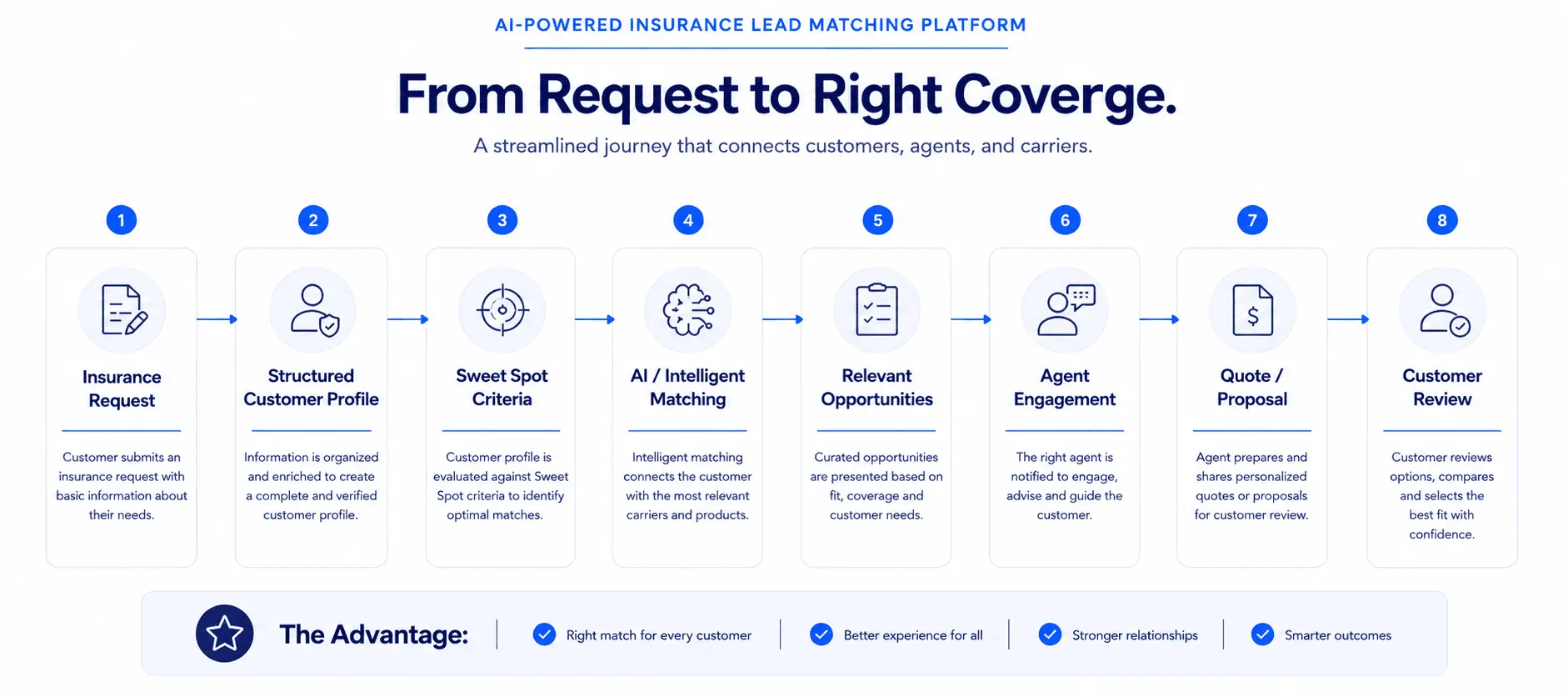
12. Customer-to-Quote Workflow
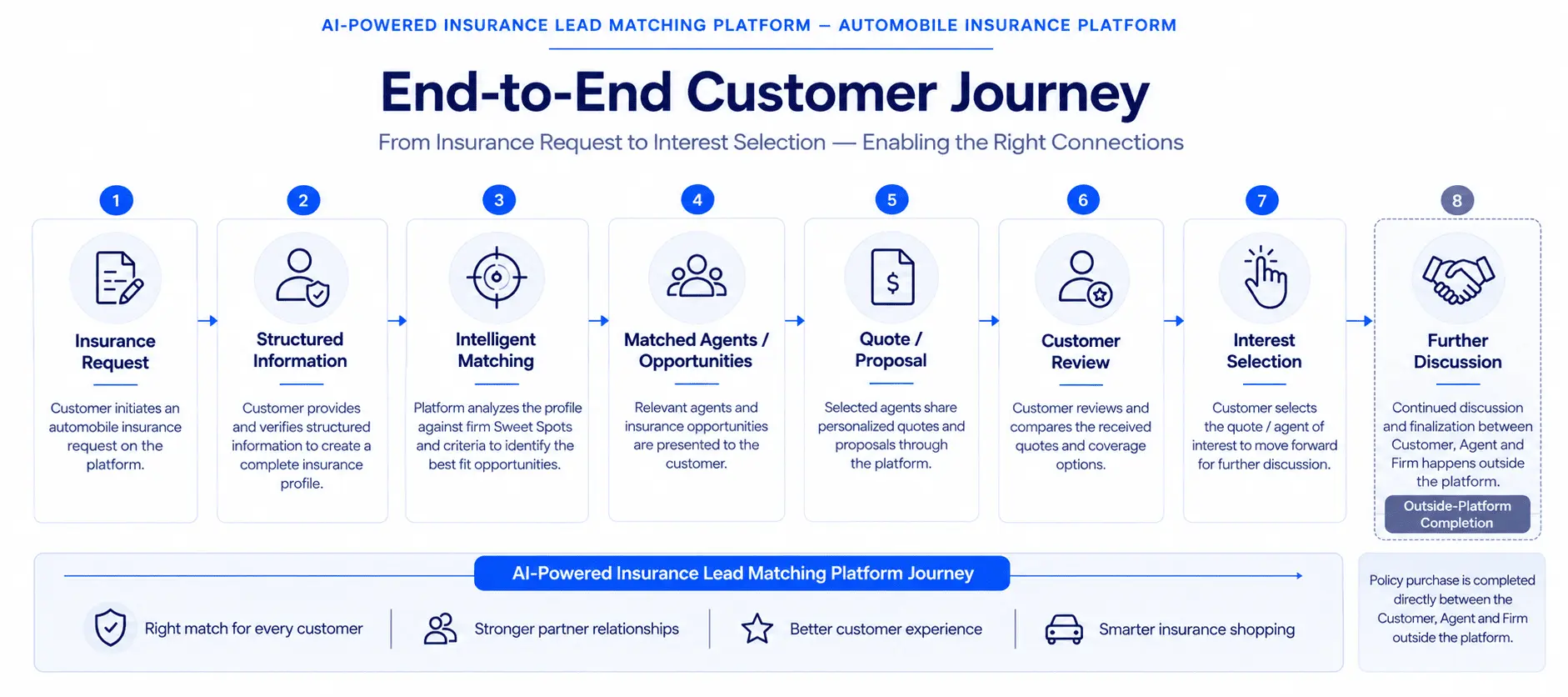
The customer-to-quote workflow connects insurance information with agent activity and customer review.
- Insurance Request: The customer begins the process by providing information about their automobile insurance requirements.
- Structured Insurance Information: Relevant details about the insured person, household, drivers, vehicles, existing coverage and other supported categories are recorded in the customer profile.
- Intelligent Matching: The platform uses AI / Intelligent Matching to connect customer information with relevant opportunities based on the configured matching criteria.
- Matched Agents and Opportunities: Relevant opportunities enter the applicable lead distribution and management workflow.
- Quote or Proposal Preparation: The agent reviews the available customer information and prepares the relevant quote or proposal through the supported workflow.
- Quote or Proposal Sharing: The quote or proposal is uploaded or shared with the customer through the platform's available functionality.
- Customer Notification: The customer receives a notification associated with the quote or proposal activity.
- Customer Review: The customer reviews the information made available by the agent.
- Customer Indicates Interest: The customer can indicate interest in the quote or proposal, allowing the discussion to continue.
- Further Discussion: The customer, agent and firm can discuss the next steps and the available insurance options.
This workflow provides continuity between the initial enquiry and quote review. Customer information collected earlier can support later interactions, while quote and proposal activity remains associated with the relevant customer and opportunity.
The platform supports the information exchange and quote-related stages of the process. It does not complete the final insurance policy purchase. That transaction and the associated decision take place outside the platform between the customer, agent and insurance firm.
13. Firm & Agent Operations
The platform separates agent-level work from firm-level management while keeping both connected to the same lead and customer workflows.
Agent Operations
Agents need to know which opportunities they are responsible for, what information is available and which activities remain to be completed. The platform supports these requirements through:
- Lead management: Access and manage assigned or available opportunities within the applicable workflow.
- Customer management: Work with customer profiles and the insurance details associated with each opportunity.
- Opportunity follow-up: Maintain activity as a lead progresses through discussions and quote-related steps.
- Quote and proposal preparation: Prepare relevant information for customer review.
- Quote sharing and uploads: Make quotes or proposals available to customers through supported platform functions.
- Customer interaction: Work with the communication and calling functionality available through the platform's integrations.
These functions give agents a more organised way to handle the work associated with a lead, from reviewing customer information to sharing a proposal and following up on the customer's response.
Firm Operations
Firm users require a broader view of the business. Their responsibilities extend beyond individual customer interactions to lead acquisition, agent oversight, licensing and financial administration.
The platform supports firm-level management of:
Business profile information
Agents and agent records
Licence records and related status information
Sweet Spot targeting criteria
Lead acquisition and lead management
Customer records
Referrals
Wallet and credit balances
Transactions
Auto-pay functionality
Disputes
Bringing these functions into the firm's operational workflow helps keep commercial activity and agent management connected. For example, a firm can manage its targeting preferences while also overseeing the agents and financial records associated with its lead acquisition activity.
14. Operational Intelligence & Administration
A platform serving multiple firms and agents needs administrative visibility beyond individual lead records. Administrators require an overview of platform activity, along with control over the reference data used across customer and business workflows.
1. Administrative Dashboard
The platform includes dashboard metrics covering:
Active customers
Active firms
Active agents
Leads
Closed leads
Revenue generated
These measures provide a view of user participation, lead activity and reported financial performance. Their value lies in making core operating information available in one administrative view rather than requiring administrators to assemble it from separate records.
2. Insurance Master Data
The platform also maintains reference data relevant to US automobile insurance workflows, including:
States
Cities
ZIP codes
Phone area codes
Accident types
Licence types
Insurance carriers
Vehicle makes
Vehicle models
Vehicle submodels
This information supports consistent data entry and configuration across the platform. Geographic classifications help organise location-specific details, while carrier, vehicle and licence reference data provide standard categories for the relevant workflows.
Centralised administration is particularly important when different firms operate with different targeting preferences but rely on common reference information. Firm-specific Sweet Spot criteria can remain distinct while the platform's underlying insurance master data is managed through the administrative layer.
15. Communication, Payments & Calling
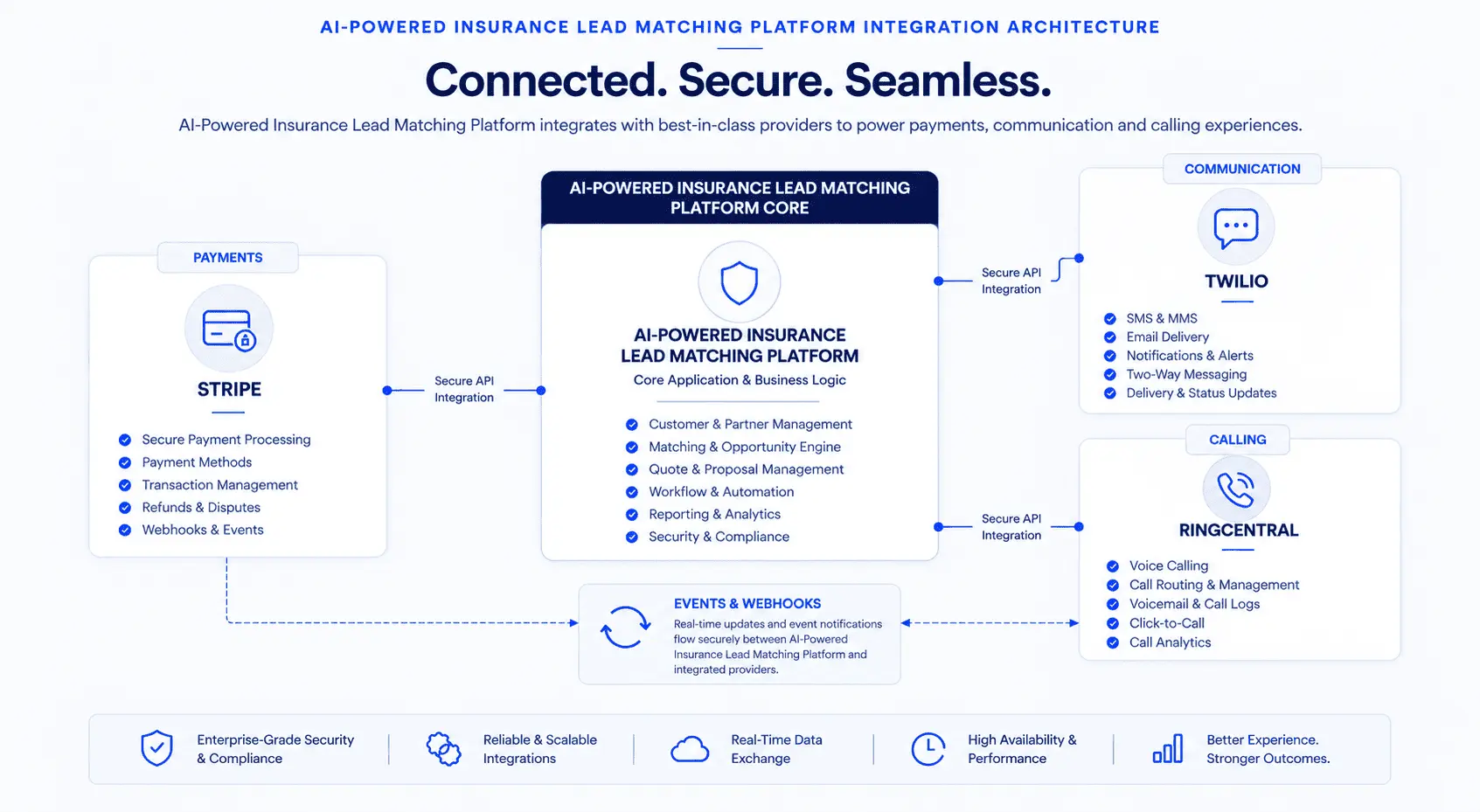
The platform integrates payment, communication and calling functionality to support activities that sit alongside insurance lead management. These integrations serve different purposes and should be understood as supporting services rather than as substitutes for the core application logic.
- Stripe: Payment Workflows
Stripe supports the platform's payment-related functionality. The associated workflow includes payment amounts, credit conversion, confirmation details, transaction dates and payment methods, along with receipt-related activity where supported.
These functions are relevant to the commercial side of lead acquisition and account management. Firms need to review their wallet or credit activity and associated transactions as part of their broader operational workflow.
- Twilio: Communication
Twilio supports the platform's communication functionality. This allows the application to connect relevant communication activity with customer and operational workflows, subject to the communication features configured for the platform.
Communication preferences and consent choices remain important when handling customer contact. Integration with a communication service does not, by itself, establish that every possible notification or messaging channel is implemented.
- RingCentral: Calling
RingCentral supports calling functionality within the platform's wider customer and agent workflows. Calling can be relevant when an agent needs to discuss an insurance request, clarify customer information or follow up on a quote or proposal.
Together, these integrations support the activities surrounding lead management and quote handling. Stripe addresses payments, Twilio addresses communication and RingCentral addresses calling, while the main application remains responsible for the platform's business workflows.
16. Validation, Governance & Controls
Insurance-related workflows involve personal information, customer communication preferences, geographic classifications and agent licensing records. The platform therefore needs defined controls around how information is configured, how leads are distributed and which users are eligible to participate in particular activities.
The platform includes support for the following control areas:
Customer consent and communication preferences: Maintain customer choices relevant to communication and related interactions.
Lead distribution rules: Apply the applicable rules governing how leads are made available.
Sweet Spot targeting criteria: Let firms define and maintain the customer characteristics used for targeting.
Insurance master-data configuration: Maintain standard reference information used throughout the platform.
State-based configuration: Support geographic distinctions relevant to the US insurance market.
Licence records: Maintain agent licence information required by the relevant workflows.
Licence expiry notifications: Support notifications associated with licence expiry.
Lead-purchasing eligibility: Apply relevant eligibility controls to lead acquisition.
Restrictions for agents whose licences are not renewed: Support restrictions when required licence conditions are no longer met.
Structured customer information: Keep insurance-related details organised for use in matching and downstream workflows.
These controls help connect platform operations with the requirements of insurance lead management. In particular, licensing records are not merely administrative details. They can affect whether an agent is eligible to participate in relevant activities, making their status important to the operational workflow.
The platform's configuration and controls should not be interpreted as a guarantee of regulatory compliance in every US jurisdiction. Firms remain responsible for their applicable licensing, insurance, privacy and communication obligations.
17. Technical Challenges & Solutions
Challenge 1: Managing Complex Insurance Profiles
Automobile insurance information spans several categories, including insured parties, household members, drivers, driving records, vehicles, existing coverage and communication preferences. Treating these details as a basic lead record would leave important context scattered across separate fields and documents.
Solution: The platform organises customer information across dedicated insurance-related categories. This gives matching, lead management and quote workflows a more consistent profile to work with and helps agents review the available details in context.
Challenge 2: Connecting Customer Profiles with Firm Preferences
Different firms may target different customer profiles. A single lead source or geographic filter cannot represent every preference a firm may use when evaluating an opportunity.
Solution: Sweet Spot criteria allow firms to define their preferred customer characteristics across supported categories. AI / Intelligent Matching connects those configured preferences with customer profiles to identify relevant opportunities.
Challenge 3: Supporting Shared and Exclusive Lead Models
Lead acquisition can follow different commercial arrangements. A platform that treats every opportunity in the same way would not adequately support the distinction between shared and exclusive leads.
Solution: The platform supports both distribution models within its lead marketplace. This allows the lead acquisition workflow to accommodate different opportunity types while connecting distributed leads with subsequent agent and customer activity.
Challenge 4: Maintaining US Automobile Insurance Reference Data
The platform needs to handle geographic information, insurance carriers, vehicle classifications, accident types and licence categories. Inconsistent reference values can make customer records harder to organise and manage.
Solution: The administrative layer maintains centralised insurance master data, including states, cities, ZIP codes, phone area codes, carriers, vehicle makes, models and submodels, accident types and licence types.
Challenge 5: Managing Licence-Related Eligibility
Agent licence information can affect eligibility for relevant insurance activities. Firms need to maintain records, identify expiry-related issues and apply appropriate restrictions when licence requirements are not met.
Solution: The platform supports licence record management, expiry notifications and restrictions associated with agents whose licences are not renewed. These controls give licence status a defined role in firm operations and lead-purchasing eligibility.
Challenge 6: Supporting Four Distinct User Roles
Customers, agents, firms and administrators use the platform for different reasons. Customers need to manage insurance information and review proposals, agents handle opportunities, firms oversee commercial operations, and administrators maintain platform-wide data and visibility.
Solution: The platform provides role-specific workflows while connecting the information used across them. This keeps customer-facing activities, agent work, firm management and administrative configuration within the same application without treating every user as having the same responsibilities.
18. Business Impact
The platform establishes a more organised workflow for automobile insurance lead matching and quote management. Its value comes from connecting customer information, firm targeting, lead distribution and downstream activity rather than relying on separate processes for each stage.
For Customers
- Insurance information can be maintained as a structured profile rather than treated solely as details collected during an individual conversation.
- Matched opportunities can connect the initial enquiry with subsequent agent activity.
- Quote and proposal information can be shared for customer review through the platform's supported workflow.
- Relevant documents, customer details and quote-related activity have a defined place in the process.
For Agents
- Structured customer profiles provide more context when reviewing an opportunity.
- Firm-defined targeting and intelligent matching support the identification of relevant leads.
- Lead and customer management activities follow a defined workflow.
- Quote and proposal preparation, sharing and follow-up can be handled through connected platform functions.
For Insurance Firms
- Sweet Spot criteria provide a configurable way to express lead-targeting preferences.
- Shared and exclusive lead models support different acquisition arrangements.
- Agent, customer and licence records can be managed through firm-level functions.
- Wallet credits, transactions, auto-pay and disputes are covered within the wider operational workflow.
For Platform Administration
- Dashboards provide visibility into customers, firms, agents, leads, closed leads and reported revenue.
- Centralised insurance master data supports consistent reference information.
- Administrative controls support platform configuration and licence-related workflows.
The confirmed impact is the availability of these connected capabilities within one platform. Quantified improvements in conversion rates, lead quality, revenue or processing time would require measured production data and are not assumed here.
19. Before vs After
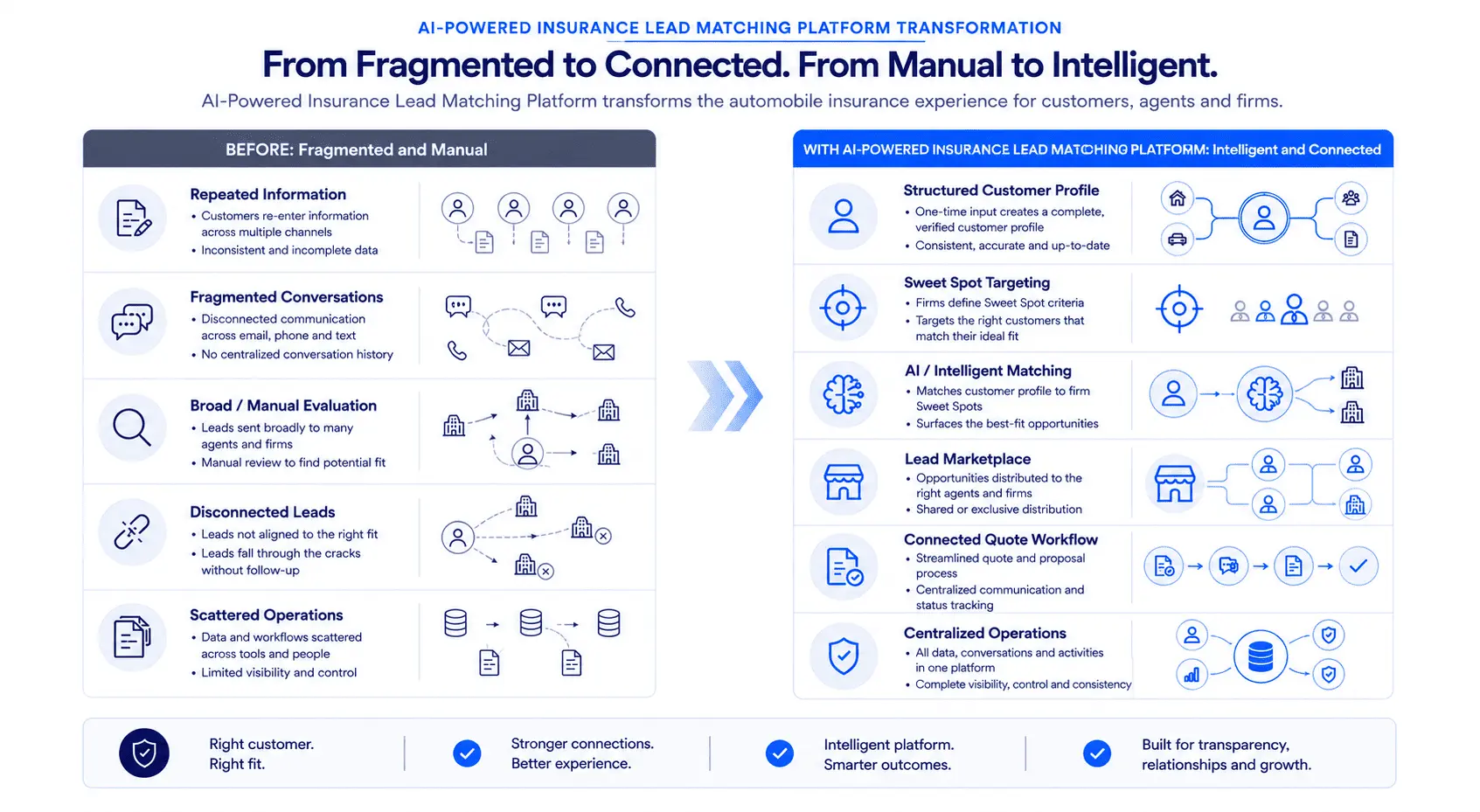
| Before the Platform |
With the Platform |
| Customer details may be collected repeatedly across separate interactions. |
Insurance information can be organised in a structured customer profile. |
| Firm targeting preferences may be difficult to connect with individual enquiries. |
Firms can define Sweet Spot criteria for their preferred customer profiles. |
| Opportunity selection may depend heavily on manual review. |
AI / Intelligent Matching supports the identification of relevant opportunities. |
| Lead acquisition and distribution may be handled separately from agent activity. |
Shared and exclusive leads are supported within the lead marketplace. |
| Customer records and quote-related discussions may be spread across different processes. |
Lead, customer and quote/proposal workflows have a defined connection. |
| Firm management may require separate handling of agents, licences and financial activity. |
Firm operations include agent, licence, wallet, transaction and related management functions. |
| Administrative reference data may be managed across separate records. |
Insurance master data is maintained through a central administrative layer. |
The difference is the relationship between the stages. Structured information supports matching, matching supports lead acquisition, and distributed opportunities can progress into agent and quote-related workflows. The platform provides the functionality to support this sequence without claiming that every external insurance activity takes place inside the application.
20. Future AI Opportunities
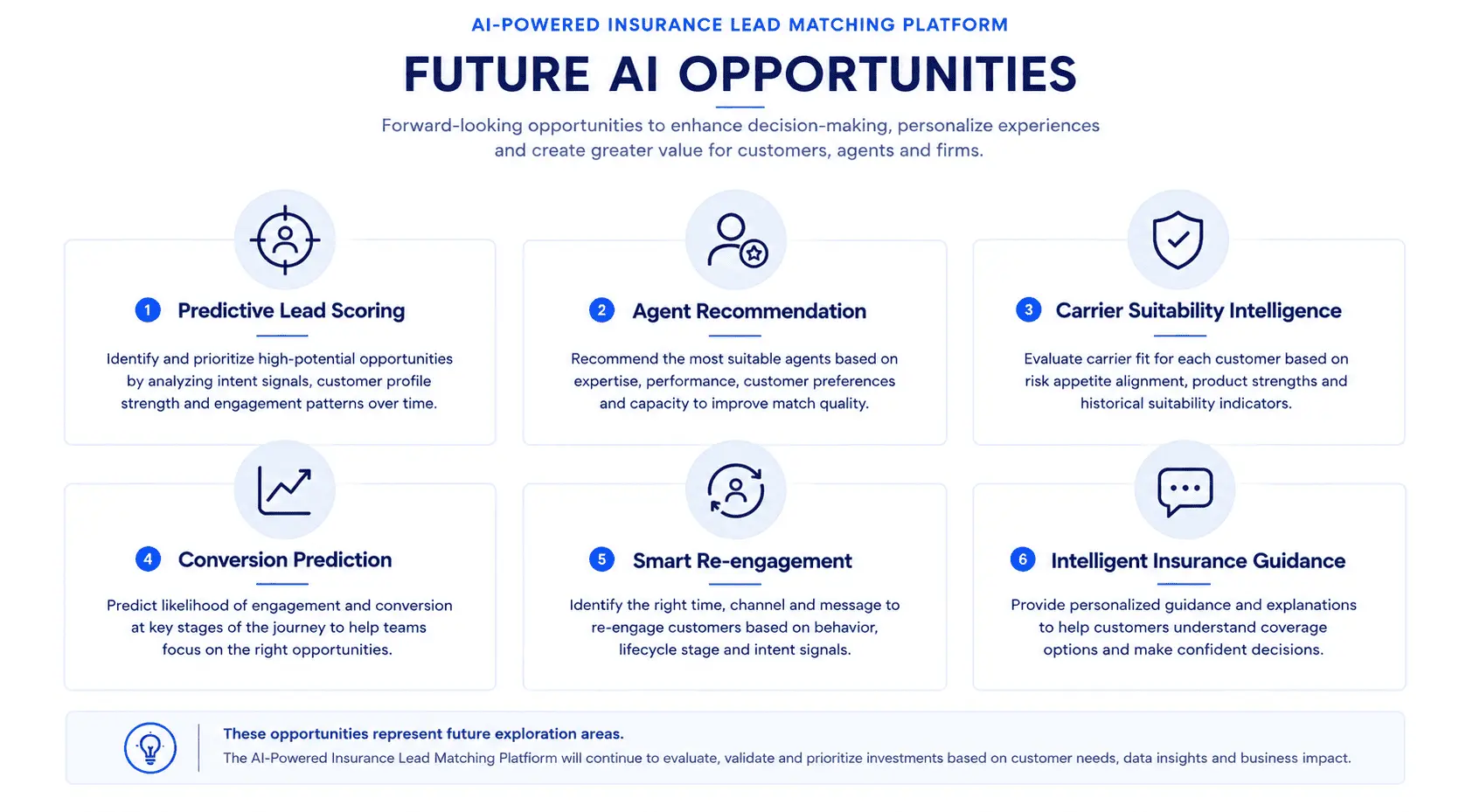
The current platform includes AI / Intelligent Matching. Further intelligence capabilities could be explored as separate enhancements, depending on available data, business requirements, technical feasibility and validation results.
- Predictive Lead Scoring
A future scoring capability could estimate the relative suitability of a lead using defined business criteria and validated historical outcomes. Its usefulness would depend on having reliable outcome data and a clear definition of lead quality.
- Agent Recommendation
An agent recommendation feature could help firms identify agents for particular opportunities based on approved criteria, agent availability and relevant experience. Any recommendation logic would need to account for licensing and applicable business rules.
- Carrier Suitability Intelligence
A future capability could help compare customer requirements with available carrier criteria, provided the relevant carrier appetite, underwriting requirements and product information are accessible and current. It would need to distinguish informational guidance from an insurer's actual underwriting decision.
- Conversion Prediction
A predictive model could estimate the likelihood of a lead progressing through defined stages, such as quote review or customer follow-up. This would require suitable historical data, clear outcome definitions and ongoing model evaluation.
- Smart Re-engagement
Future workflow intelligence could identify opportunities for follow-up based on lead status, customer activity and communication preferences. Any implementation would need to respect consent, communication rules and the customer's stated preferences.
- Intelligent Insurance Guidance
A future customer-facing assistant could help users understand the information required for an insurance enquiry or explain the purpose of common insurance terms. Such a capability would need carefully defined boundaries and should not present itself as a substitute for professional insurance advice or an insurer's underwriting decision.
These are potential enhancements, not confirmed features of the existing platform. Each would require its own scope, data assessment, validation and implementation plan.
21. Technology Stack
The platform uses a technology stack that supports its user interfaces, application workflows, structured data and integrated services.
- Angular: Frontend development for customer, agent, firm and administrator interfaces.
- .NET: Application and business logic supporting the platform's core workflows.
- Microsoft SQL Server: Structured data storage for relevant platform records and configuration.
- AI / Intelligent Matching: Matching capability connecting customer insurance profiles with firm-defined Sweet Spot criteria.
- Stripe: Payment-related functionality.
- Twilio: Communication functionality.
- RingCentral: Calling functionality.
Each component has a defined role in the solution. Angular provides the interface, .NET handles application processes, and SQL Server stores structured information. The intelligent matching capability supports opportunity identification, while the integrations support payment, communication and calling workflows.
22. Team & Agile Delivery
The project was delivered over 20 weeks using an Agile methodology, with an eight-member team covering project coordination, frontend and backend leadership, development and quality assurance.
1 Project Manager
1 .NET Lead
1 Angular Lead
3 Developers
2 QA Engineers
The team structure covered the main delivery responsibilities. Project management coordinated the work, the .NET and Angular leads guided the respective application layers, developers implemented the required functionality, and QA engineers supported testing and validation.
An Agile delivery approach allowed the team to organise implementation around the platform's separate but connected workstreams, including insurance data intake, intelligent matching, lead distribution, firm operations, quote workflows, integrations and administrative controls.
The project duration and team composition describe the delivery setup. They do not, on their own, establish specific performance improvements or production outcomes.
23. US Scalability
US automobile insurance workflows involve geographic distinctions, insurance providers, vehicle classifications and agent licensing requirements. The platform's configuration model accommodates these categories through structured reference data and firm-specific targeting preferences.
Geographic Configuration: State, city and ZIP code information supports location-related customer records and targeting criteria. Phone area codes provide an additional reference category for relevant workflows.
Insurance Carrier Data: Centralised carrier information provides a consistent reference for insurance-related records and matching criteria.
Vehicle Classification: Vehicle makes, models and submodels help organise vehicle information across customer profiles and relevant insurance workflows.
Accident and Licence Classifications: Accident types and licence types provide standard categories for the relevant records and operational controls.
Firm-Specific Targeting: Sweet Spot criteria allow firms to configure customer preferences relevant to their own lead acquisition requirements. These preferences can differ between firms while relying on the platform's shared reference data.
Together, these capabilities provide a configuration foundation for US automobile insurance operations. Supporting additional jurisdictions, carrier-specific rules or new insurance lines would still require validation of the applicable data, workflows and business requirements.
24. Key Takeaways
The platform addresses a specific operational problem in automobile insurance: connecting customer information with relevant lead opportunities and the activities that follow.
Its key capabilities include:
-
Structured customer insurance profiles covering insured parties, household details, drivers, vehicles, existing coverage and related information.
-
Firm-defined Sweet Spot criteria that express the customer profiles firms want to target.
-
AI / Intelligent Matching to connect customer profiles with relevant insurance opportunities.
-
Shared and exclusive lead distribution supporting different lead acquisition arrangements.
-
Agent and firm operations covering leads, customers, licensing, referrals and related business activity.
-
Quote and proposal workflows connecting agent preparation and sharing with customer review and interest.
-
Communication, payment and calling integrations supporting activities around the main workflow.
-
Centralised administration and insurance master data supporting operational visibility and consistent reference information.
The defining feature is not any single module. It is the way customer information, firm preferences, matching, lead distribution and quote-related activity are connected. That gives customers, agents, firms and administrators distinct workflows within a shared automobile insurance platform.
25. Final Outcome & CTA
Final Outcome
Rushkar Technologies developed an AI-powered insurance lead matching and quote management platform for the US automobile insurance market. The solution connects structured customer insurance information with firm-defined Sweet Spot criteria, intelligent matching, shared and exclusive lead distribution, agent operations and quote/proposal workflows.
The platform also supports firm-level management of agents, licences, customer records, referrals and financial activity, alongside administrative dashboards and insurance master data. Stripe, Twilio and RingCentral provide the associated payment, communication and calling functionality.
The resulting platform gives each user group a defined way to work with insurance information and opportunities. Customers can manage their details and review shared quotes or proposals, agents can handle leads and customer follow-up, firms can manage targeting and commercial operations, and administrators can oversee platform activity and reference data.
The final insurance policy purchase remains outside the platform, between the customer, agent and insurance firm.
