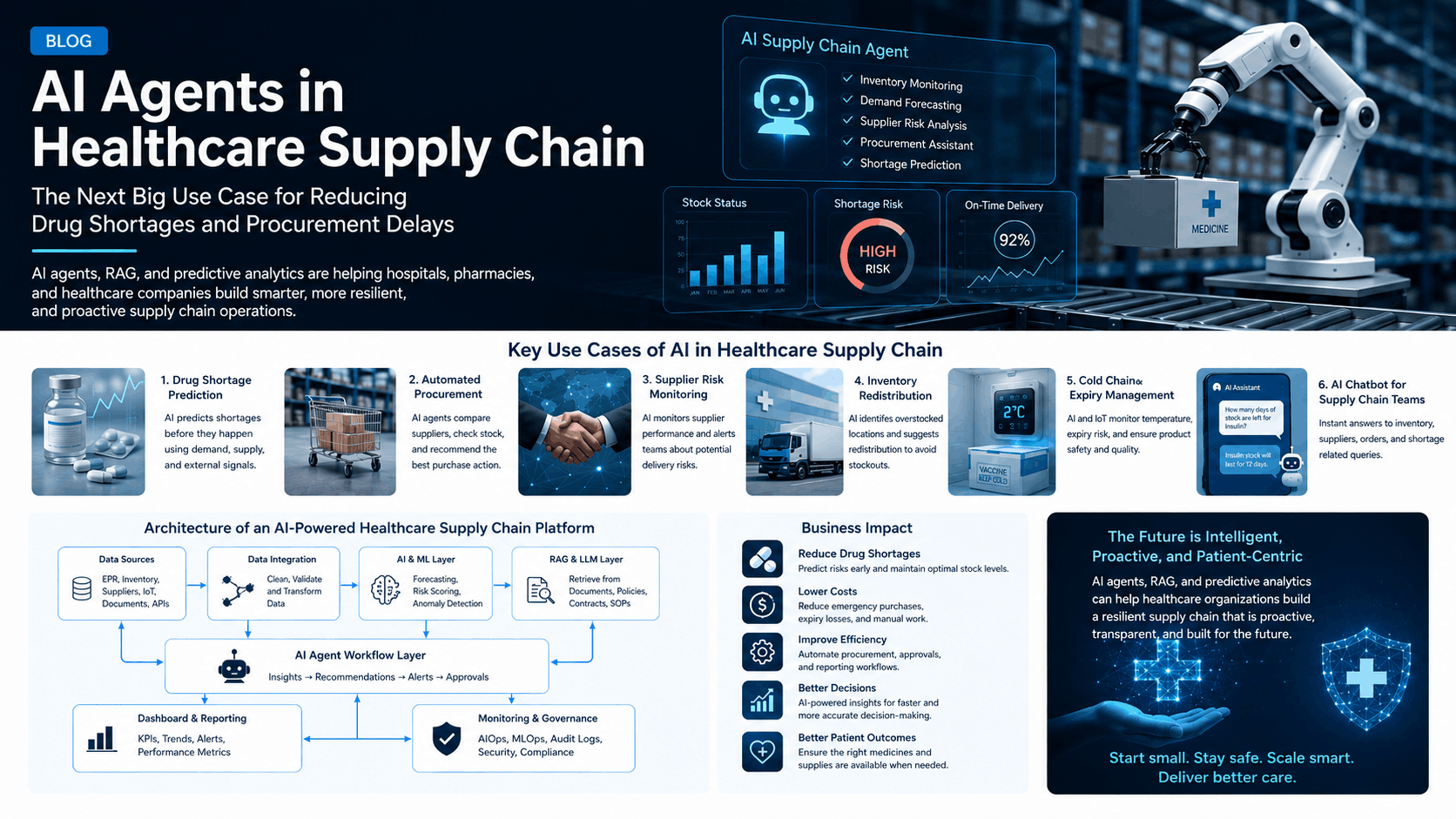
What if an e-commerce platform hits a logistics snag, and someone’s designer sneakers arrive a week late? It is a minor nuisance, a flurry of angry customer service emails, and maybe a tiny fraction of a percent shaved off the quarterly revenue.
But when a hospital pharmacy faces a logistics bottleneck, the situation shifts from profit margins to patient vitals.
Missing an oncology drug, a critical IV line, or a rare anaesthetic does not just cause operational headaches. It forces doctors to rapidly switch up treatment protocols on the fly. It means pharmacists spend half their shifts frantically calling alternative vendors. It drops a heavy load of manual troubleshooting onto procurement teams, and, worst of all, it introduces terrifying variables into patient care.
The traditional, reactive way we handle medical logistics, waiting around for an inventory alert to flash red before scrambling to fix it, is completely inadequate. The solution is not more complicated spreadsheets or basic, rigid automation rules.
True operational resilience happens when you partner with a trusted AI development company to construct intelligent, deeply integrated systems that turn brittle, vulnerable supply lines into proactive networks.
The Chaos Behind the Clinic Walls
Why is medical procurement such a nightmare to manage? It is an incredibly complex web of moving pieces, variables, and fragile dependencies. Unlike retail logistics, you cannot just stack boxes in a warehouse and forget about them.
Healthcare logistics operations must constantly juggle a massive list of priorities:
- Manufacturers dealing with their own raw material delays
- Regional and national medical distributors
- Local hospital procurement and pharmacy management teams
- Real-time clinical shifts and sudden emergency patient spikes
- Constantly evolving regulatory frameworks and safety updates
- Cold-chain logistics requirements and tight product expiration timelines
Right now, in most medical networks, the data needed to manage these variables is completely isolated. Your current inventory counts live inside a decades-old legacy ERP system. Your supplier communication is buried inside hundreds of messy email chains. Updates on nationwide drug shortages live on external government portals.
When your data is that scattered, you are forced into a reactive posture. You only figure out a drug is missing after a clinician requests it and finds an empty shelf.
- [Legacy Logistics Framework: Reactive Approach]
Stock Drops ➔ Stockout Hits ➔ Manual Scramble for Substitutes ➔ Care is Delayed
- [Agentic AI Framework: Proactive Intelligence]
Predictive Signals ➔ AI System Evaluates Alternative Channels ➔ Human Signs Off ➔ Inventory Maintained
To break out of this cycle, forward-thinking medical groups are actively leveraging AI consulting services to design smarter workflows. We need to stop asking "Why did we run out of this antibiotic yesterday?" and start asking better questions:
- Which primary medical suppliers are showing early indicators of transit delays?
- What clinically approved alternative molecules are already present in our formulary?
- Can we move near-expiry inventory from a quiet outpatient clinic to a high-volume emergency department before it spoils?
Defining AI Agents in Healthcare Operations
Let’s cut through the tech-bro buzzwords and sci-fi hyperbole. An AI agent is not a digital robot that autonomously spends your company's money or makes high-risk medical decisions on its own.
In a healthcare environment, an AI agent functions as a highly specialized digital assistant designed for decision support. It sits on top of your existing software systems, monitors data feeds in real time, alerts you when a risk surfaces, and lays out pre-calculated options for human review.
This is where working with an experienced AI agent development company changes things. Instead of a basic notification that says "Inventory Low", a tailored procurement agent monitors your entire data landscape to deliver an actual, actionable briefing.
- System Notification: "Stock levels for intravenous paracetamol are projected to breach safety margins in 12 days. Our primary supplier has missed their last three delivery windows. An alternative verified vendor has ample stock immediately available, though at an 8% higher acquisition cost.
- Suggested Action: Draft a purchase request for 2,000 units from the alternative vendor to bridge the gap and route to the pharmacy director for digital sign-off."
This is a practical, controlled approach. By integrating AI software development services, organisations implement a strict "AI proposes, human decides" system that keeps your medical and procurement professionals in total control.
Protecting Truth with RAG Architecture
The single biggest concern healthcare executives raise about large language models (LLMs) is the risk of hallucinations. If a consumer chatbot invents a fake fact during a casual conversation, nobody gets hurt. If an operational system hallucinated a contract term, an alternative drug substitute, or a supplier rule, it could compromise patient safety or trigger a massive regulatory compliance violation.
Because of this risk, generic chatbots are completely useless in medical logistics. You need advanced RAG development services (Retrieval-Augmented Generation) to ground the intelligence layer.
RAG shifts how an AI model generates responses. Instead of relying on its general training data, the model is strictly limited to querying your specific, verified corporate records.
|
Corporate Data Layer
|
Live Operational Inputs Ingested by RAG
|
|
Internal Records
|
Live ERP logs, historical purchase orders, and localized inventory minimums.
|
|
Clinical Guidelines
|
Hospital formulary documents and pre-approved therapeutic substitution lists.
|
|
External Signals
|
Active FDA shortage registries, local disease trends, vendor transit data.
|
When you utilize specialized LLM development services, the underlying system stops guessing. If an employee asks the interface how to resolve a bottleneck for a rare oncology drug, the system reads your internal operational playbooks, cross-references active supplier contracts, finds the nearest sister hospital with excess inventory, and drafts the exact transfer paperwork required.
This level of precision is exactly why corporate leaders are investing heavily in generative AI development services that are built from the ground up for data verification.
Practical AI Applications for Healthcare Supply Chains
1) Real-Time Shortage Predictions
By combining historical usage patterns with live market data, specialized machine learning development services can identify supply deficits weeks before they cause problems on the clinic floor. This gives your procurement team a clean window of opportunity to lock in alternative sourcing options before market panics drive up prices.
2) Intelligent Automated Procurement Support
Manual data entry and comparison work eat up countless hours for sourcing teams. Custom AI integration services link your communication tools directly to your databases, allowing an assistant to read internal purchase requests, verify current stock thresholds, compare vendor pricing tiers, and flag unexpected cost spikes automatically.
3) Evaluating Supplier Risk
Medical networks rely entirely on vendor consistency. A single hiccup from a major pharmaceutical distributor can trigger ripples across multiple operating rooms.
By building AI analytics solutions directly into your data pipelines, management teams can instantly view dynamic risk scores for every supplier. The system evaluates fulfillment rates, delivery delays, contract compliance, and regional transit disruptions so you can see a problem coming from miles away.
- [Supplier X: 4 Delayed Shipments] ───(System Risk Alert)───> [Procurement: Orders Split with Supplier Y]
4) Expiration and Cold-Chain Protection
Biologics, vaccines, and insulin require incredibly strict temperature-controlled storage environments. If an IoT sensor in a transport truck registers an abnormal temperature spike, the system can instantly alert the logistics desk, ensuring compromised medications are caught and replaced long before they ever reach a patient.
5) System Optimization via MLOps
An enterprise-grade tool is only as reliable as the digital infrastructure holding it together. Advanced AIOps & MLOps development services work quietly in the background to monitor system health, check data quality, evaluate model performance, and ensure that your automated guardrails do not degrade over time.
Breaking Down Complex Workflows: Prompt Chaining
To ensure absolute reliability and safety, enterprise systems avoid relying on a single, massive prompt to handle everything. Instead, they leverage prompt-chaining AI services to break a complex business workflow into small, verifiable blocks.
[Step 1: Parse raw inventory logs]
│
▼
[Step 2: Identify items dropping below safety minimums]
│
▼
[Step 3: Scan external shortage registries and supplier logs]
│
▼
[Step 4: Check internal hospital compliance and substitution rules]
│
▼
[Step 5: Generate a structured action plan for human review]
This step-by-step approach keeps the system entirely transparent. If your team ever encounters an odd recommendation, your data engineers can look back through the audit trail, see exactly which sub-task caused the issue, and tune the system with total precision.
A Phased Roadmap for Deployment
Completely rewriting your healthcare network's logistics framework in a single weekend is an easy way to cause complete operational gridlock. Moving toward an intelligent supply chain requires a steady, phased strategy.
Phase 1: Assess Data Readiness
Before you build anything, evaluate the current state of your data. Are your inventory systems updated daily? Are your vendor contracts stored cleanly, or are they scattered across random PDFs and physical filing cabinets? Having clean, digital, accessible data is the foundational requirement for any advanced automation.
Phase 2: Launch a Targeted Pilot
Pick one high-friction, low-risk problem statement to solve first. For example, you could build a minor pilot system focused entirely on tracking stockout risks for your top five most critical emergency medications. Use this initial project to prove your return on investment, iron out system bugs, and get your staff comfortable with the software.
Phase 3: Integrate Internal Knowledge Tools
Once your core data lines are stable, introduce internal RAG-driven communication tools. This allows your pharmacists, administrative leads, and warehouse managers to look up contract details, find compliance rules, and pull inventory metrics using simple, conversational questions.
Phase 4: Deploy Active Agents
With a solid data foundation in place, turn your passive search tools into active operational assistants. Give your systems the software integrations required to handle cross-platform actions, such as drafting purchase orders, sending out manager alerts, and tracking stock movements between locations.
Common Implementation Mistakes to Evade
- Removing Human Safeguards: Trying to let an AI system completely automate purchases and logistics with zero human oversight is incredibly risky in a compliance-driven field like healthcare. Always keep your human experts at the center of the decision-making loop.
- Operating in Silos: Building a fancy new AI tool that cannot communicate with your existing pharmacy software or inventory databases is a waste of time. True efficiency requires deep, native system integrations.
- Neglecting the Audit Trail: In medical logistics, every single operational shift must be fully traceable. Ensure your software records a clean, unambiguous history of why every recommendation was made and who signed off on it.
Building a Resilient Future
True modernization in healthcare logistics is about breaking out of the constant cycle of fighting daily fires. It means putting modern infrastructure in place that identifies operational bottlenecks and neutralizes them before they ever touch a clinical environment.
By strategically weaving together smart decision-support layers, accurate data grounding, and structured machine learning pipelines, healthcare organizations can step away from chaotic, manual inventory management. You end up with a lean, resilient supply chain that protects your operational budget, keeps your administrative teams happy, and ensures patient care remains uncompromised.
Ready to Modernize Your Supply Chain Operations?
Let’s help you move your corporate data out of static, hard-to-read dashboards and turn it into active operational intelligence. Rushkar partners with medical networks and enterprise logistics organizations to design, build, and deploy custom intelligent systems, tailored RAG architectures, and secure workflow automation frameworks.
Whether you need strategic AI consulting services, deep system-wide AI integration services, or a dedicated engineering squad to take a custom software concept from prototype to production, our experts deliver clean, high-performance tools that solve real-world logistical challenges. Drop our engineering team a line today, and let’s discuss how we can build a practical, high-impact pilot for your business.