
Software drives growth in almost every industry. Whether you're launching a SaaS platform, modernising internal operations, developing AI-powered products, or creating customer-facing applications, one constant challenge is finding the right development talent.
For many organisations, it is a choice between an in-house or offshore development team.
Building an in-house engineering department? Do you need to hire offshore developers? Or is there a better middle ground?
It’s not a matter of comparing hourly rates or headcount costs. The right model affects delivery speed, access to talent, product quality, scalability, innovation, and ultimately your return on investment.
With demand for software growing across the US, companies are rethinking how they build and scale engineering teams. In fact, today, many successful organisations are combining internal leadership with global engineering talent to speed delivery and stay competitive.
This guide will help business leaders, CTOs, founders, and product owners make smarter hiring decisions in 2026 and beyond by exploring the key differences between an in-house vs offshore development team.

Why This Decision Impacts More Than Development Costs
Most companies begin with a cost comparison.
We get that.
In the major US markets, developer salaries are still climbing, and the competition for experienced engineers has never been more intense. But looking only at cost means businesses often miss more important things.
The question really is:
Which model helps your company innovate faster, scale efficiently, and achieve business goals with less risk?
When evaluating an engineering strategy, leaders should consider:
- Time-to-market
- Access to specialized expertise
- Team scalability
- Product quality
- Long-term operational efficiency
- AI and emerging technology capabilities
- Internal management overhead
A slower product launch may cost much more than a higher developer salary. Similarly, a slow hiring process can delay revenue streams, customer wins, and competitive advantages.
This is why many companies that are considering a software outsourcing company USA partner are looking for more than just cost savings. They want speed, flexibility and access to expertise that can be hard to find locally.
What Is an In-House Development Team?
An in-house development team is a team of software professionals hired directly by your organisation.
These people work only on company projects and tend to get very integrated into internal processes, culture, and long-term business goals.
A typical in-house team may include:
- Software Developer
- Product Management
- QA Engineers
- UI / UX Designers
- DevOps experts
- Solution Architects
- Data Engineers
This model is preferred by many organisations for direct supervision and close working.
Advantages of In-House Teams
- Strong alignment to business goals
- Complete control of priorities and workflow
- Good knowledge of the organisation
- Easier face-to-face collaboration
- Longer product life cycle
Challenges of In-House Teams
It takes a lot of time and money to build and maintain an internal engineering department.
Common challenges include:
- Prolonged recruitment cycles
- Higher salary expectations
- High employee turnover
- Limited access to skilled expertise
- Needs for continuous training
- Cost of equipment and infrastructure
For growing companies, scaling an internal team can quickly become a significant operational challenge.
What Is an Offshore Development Team?
An offshore development team is a group of software professionals who are located in another country and work on your projects remotely.
The offshore teams of today are a far cry from the old outsourcing of yesterday.
Today’s offshore engineers are an extension of internal teams, participating in sprint planning, code reviews, product discussions, daily standups, and strategic initiatives.
Organisations can leverage offshore talent by:
Focused Development Team: A dedicated team exclusively for your business, for the long term.
Team Extension Model: Developers integrate with existing internal teams.
Managed Software Development Services: The vendor manages the execution of the project, and the client focuses on the business strategy.
Hiring a Dedicated Development Team (DDT) provides companies with access to niche talent, quicker onboarding, and scalability without the headaches of traditional hiring.
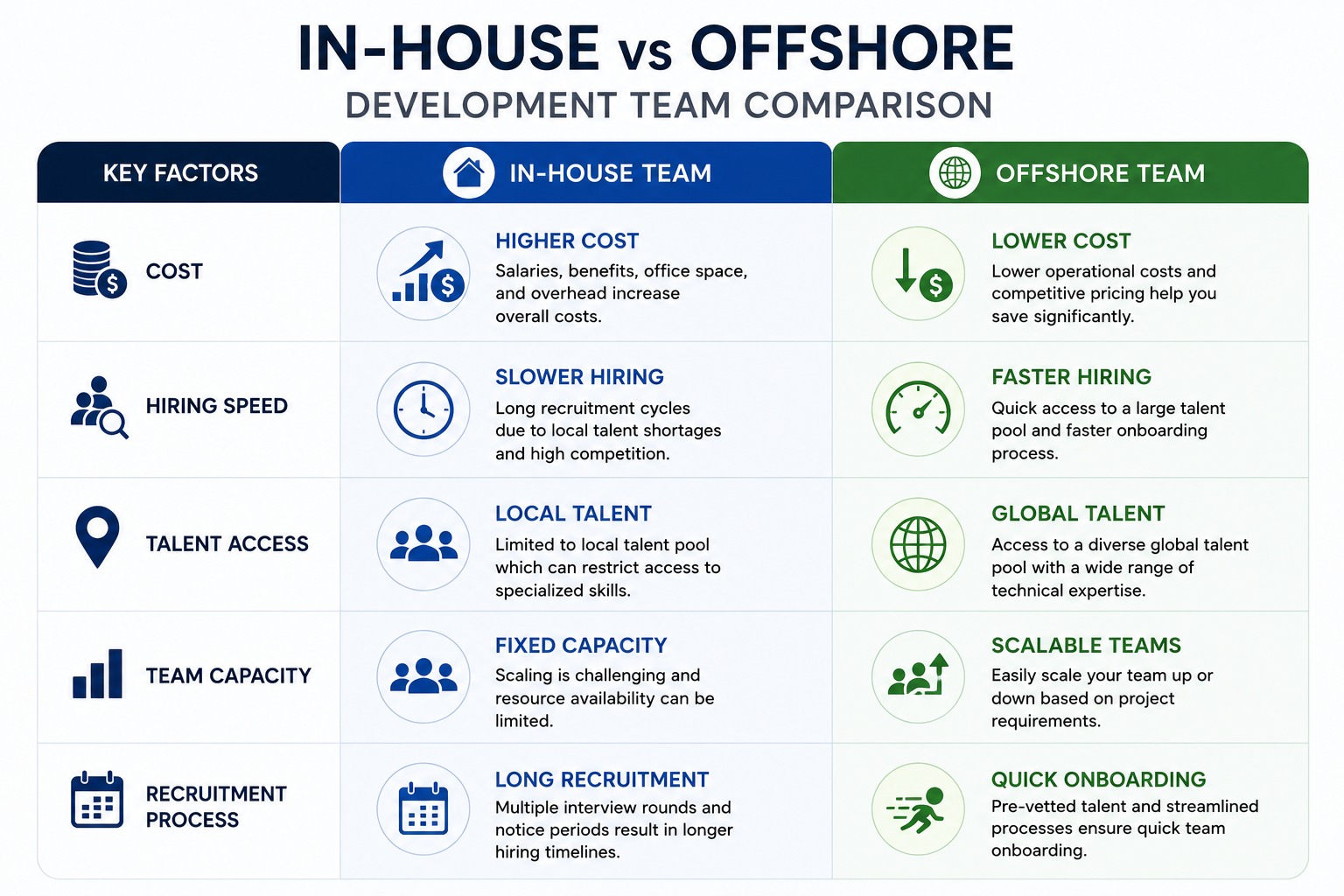
In-House vs Offshore Development Team: Side-by-Side Comparison
|
Factor
|
In-House Team
|
Offshore Development Team
|
|
Hiring Speed
|
Slow
|
Fast
|
|
Cost Efficiency
|
Lower
|
Higher
|
|
Team Scalability
|
Moderate
|
High
|
|
Talent Pool
|
Local
|
Global
|
|
AI Expertise Access
|
Limited
|
Extensive
|
|
Recruitment Overhead
|
High
|
Minimal
|
|
Infrastructure Cost
|
High
|
Low
|
|
Flexibility
|
Moderate
|
High
|
|
Operational Management
|
Internal
|
Shared
|
Both models can produce successful results, but their advantages differ significantly based on business goals.
Cost Comparison: What US Companies Actually Spend
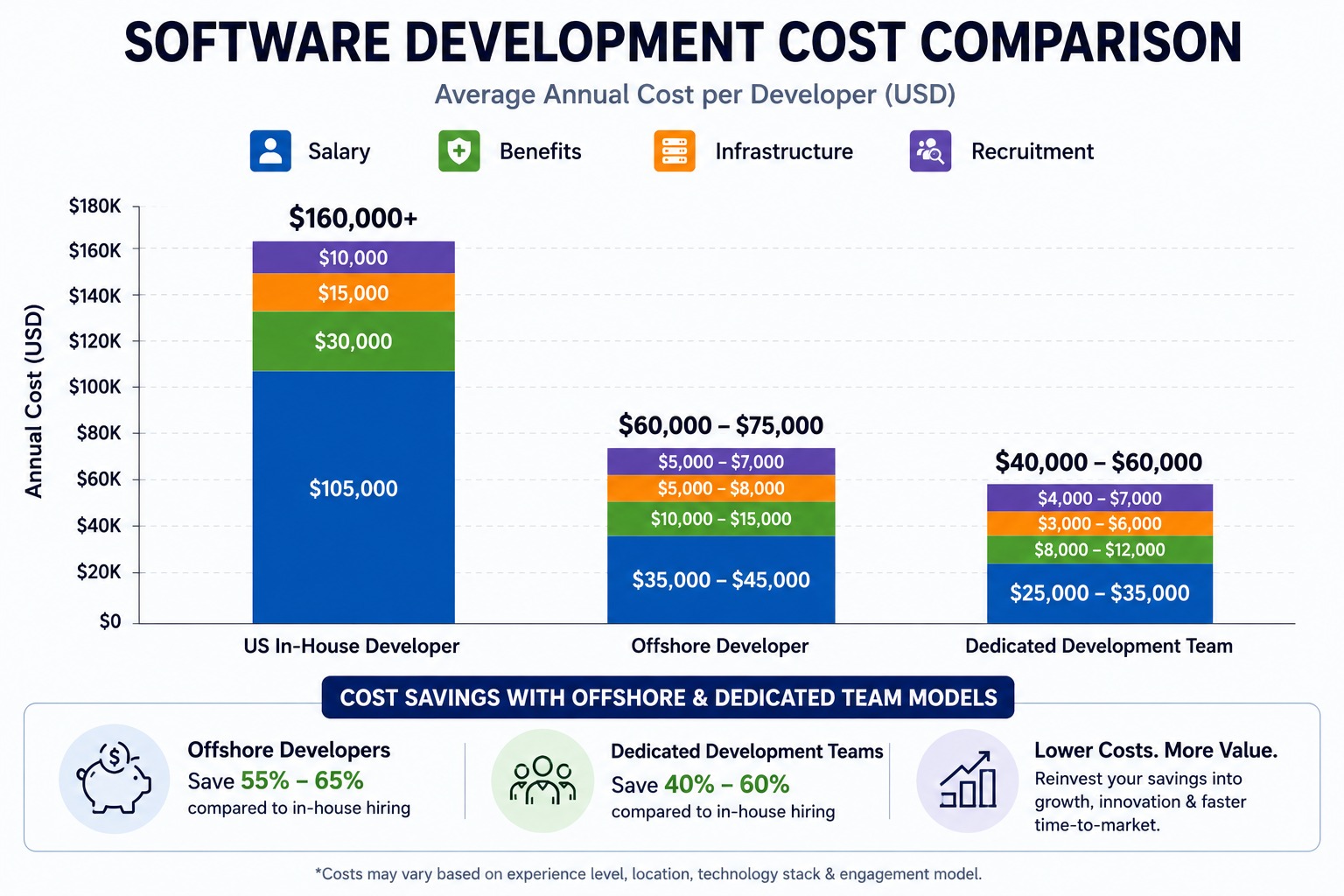
Cost is still one of the main reasons why companies think about outsourcing software development.
The median salary of a senior software developer in the USA is usually well above the base salary.
Organisations should consider the following:
- Recruitment costs
- Benefits and insurance
- Payroll tax
- Gear
- Software Licences
- Training
- Retention initiatives
For instance, hiring a senior engineer can easily cost more than six figures a year before indirect expenses are taken into account.
In contrast, businesses that hire offshore developers frequently have access to skilled workers thanks to adaptable engagement models that lower operating costs without sacrificing delivery quality.
The advantage isn't simply spending less.
It's maximizing development output for every dollar invested.
A company may be able to build a larger engineering team, launch faster, and accelerate innovation using the same budget allocated for a smaller local team.
Hiring Speed: The Hidden Growth Bottleneck
Many businesses undervalue how hiring delays affect their bottom line.
Internal hiring frequently entails:
- Sourcing candidates
- Several interviews
- Technical evaluations
- Salary discussions
- Notice periods
- Onboarding
It may take several months to complete.
For aggressive roadmap orgs, every month spent on recruiting is a month not spent building.
This is one of the reasons why many businesses prefer a dedicated software development team model.
Experienced engineers are available within the pools of mature offshore providers who can often bring value in weeks, not months.
Faster hiring means:
- Quicker releases
- Quicker customer feedback
- More rapid revenue growth
- Competitive positioning faster
In software development, speed is often equal to business value.
Access to Specialized Skills and Emerging Technologies
Experienced software engineers are hard to find.
And finding specialised engineers is even harder.
Many organizations struggle to hire professionals with expertise in:
- .NETT Developments
- React Developer
- Angular Development Services
- Cloud Architectures.
- DevOps Engineering
- Cybersecurity
- Data Engineering
It’s even harder when businesses are pursuing artificial intelligence initiatives.
A global talent strategy allows you to access skills that are not available or are too expensive to hire in local markets.
Working with a custom software development team allows companies to gain access to a wider pool of technical expertise, no matter where it is located.
As technology stacks evolve, such flexibility becomes more and more important.
Why AI Talent Changes the Conversation
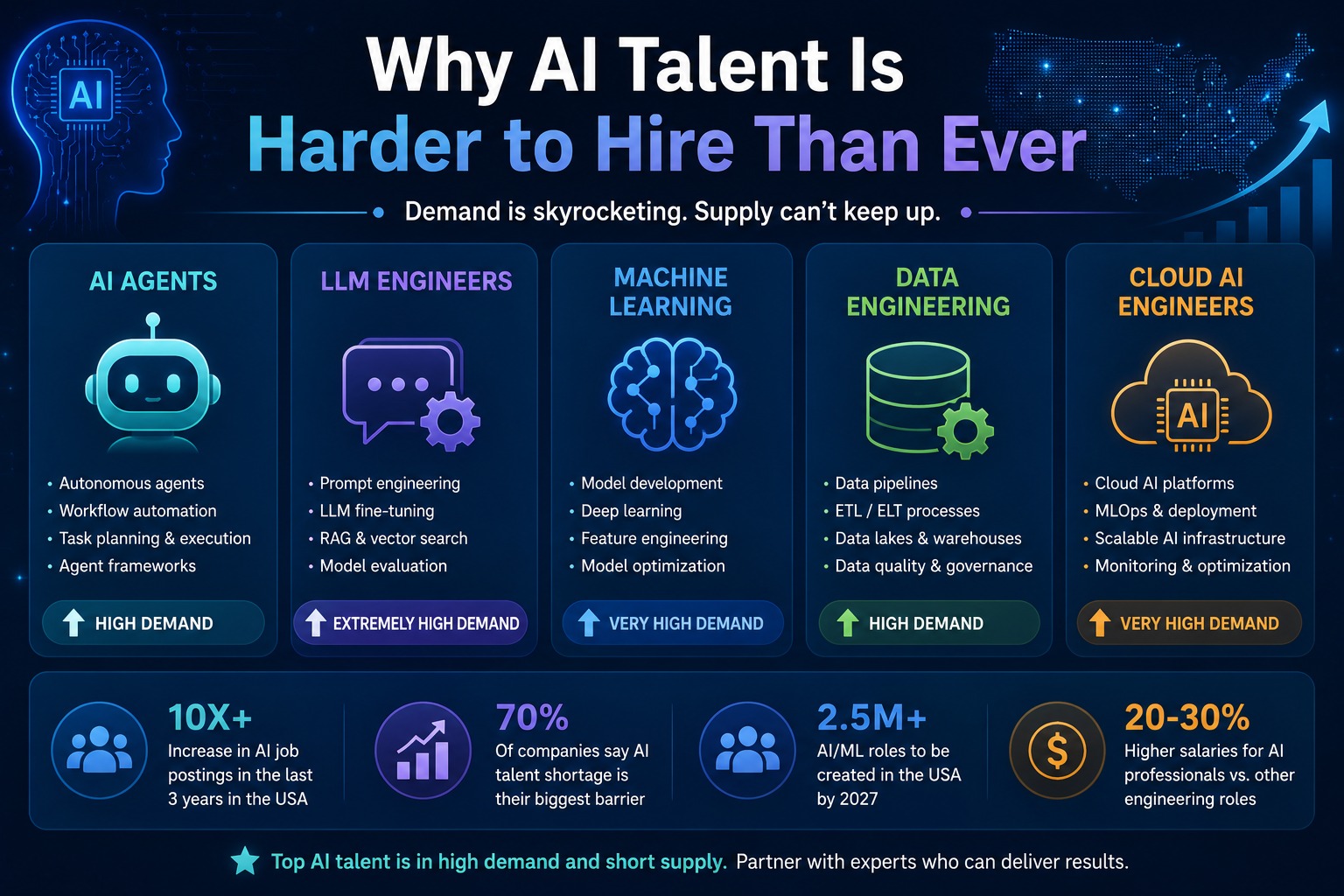
Artificial intelligence has become a major driver of software investment across the United States.
Organizations are exploring the following:
- AI Agents
- Machine Learning Models
- Generative AI Applications
- Retrieval-Augmented Generation (RAG)
- Predictive Analytics
- Intelligent Automation
The challenge?
Experienced AI engineers are among the most sought-after professionals in today's market.
Building an internal AI team often requires months of recruiting and significant investment.
Businesses increasingly turn to specialised partners offering the following:
- AI Development Services
- Hire AI Developers
- AI Integration Services
- LLM Development
- AI Software Services
This allows organizations to accelerate AI adoption without waiting for lengthy recruitment cycles.
For companies engaged in AI initiatives, access to specialised expertise could be a deciding factor in the decision of whether to build in-house or offshore development teams.
Communication and Collaboration: The Biggest Offshore Myth
One of the biggest concerns when it comes to offshore development is communication.
Those concerns were valid years ago.
Modern collaboration tools turn the landscape upside down today.
High-performing offshore teams use:
- Microsoft Teams
- Slack
- Jira
- Azure DevOps
- GitHub
- Confluence
Combined with Agile methodologies, these platforms create transparency and accountability throughout the development lifecycle.
Successful offshore partnerships typically include:
- Daily standups
- Sprint reviews
- Planning sessions
- Progress reporting
- Shared documentation
- Dedicated project management
The quality of communication depends far more on processes and leadership than geographic location.
Security and Intellectual Property Protection
Security remains a critical consideration when evaluating offshore vs onshore software development.
Business leaders understandably want assurance that:
- Source code remains protected
- Intellectual property remains secure
- Sensitive data is safeguarded
- Compliance requirements are met
Professional offshore providers address these concerns through:
- NDA agreements
- Secure repositories
- Role-based access controls
- Audit trails
- Compliance-focused processes
- Secure development environments
When evaluating partners, businesses should focus on governance, security maturity, and delivery standards rather than location alone.
When an In-House Development Team Makes Sense
An internal team may be the right choice when:
Your Product Is Your Core Competitive Advantage: Continuous ownership and deep business integration are critical.
Daily Internal Collaboration Is Required: Stakeholders need frequent interaction with engineering teams.
You Have Strong Hiring Infrastructure: Recruitment, onboarding, and retention capabilities already exist internally.
Long-Term Team Building Is a Strategic Priority: The business intends to invest heavily in internal engineering capabilities.
For these scenarios, an in-house model can provide strong long-term value.
When an Offshore Development Team Makes Sense
An offshore development team often becomes the preferred option when:
You Need to Scale Quickly: Product roadmaps are growing faster than internal hiring can support.
Specialized Skills Are Difficult to Find: You require expertise in AI, cloud engineering, DevOps, or emerging technologies.
Efficiency Matters: You want to maximize engineering capacity without increasing operational overhead.
Time-to-Market Is Critical: Product launches and modernization initiatives require rapid execution.
You Need Flexible Team Expansion: Development needs may change throughout the project lifecycle.
For many growing businesses, offshore partnerships provide the speed and flexibility needed to stay competitive.
Why Hybrid Teams Are Becoming the New Standard
Increasingly, organizations are discovering that the best answer isn't choosing one model over the other.
It's combining both.
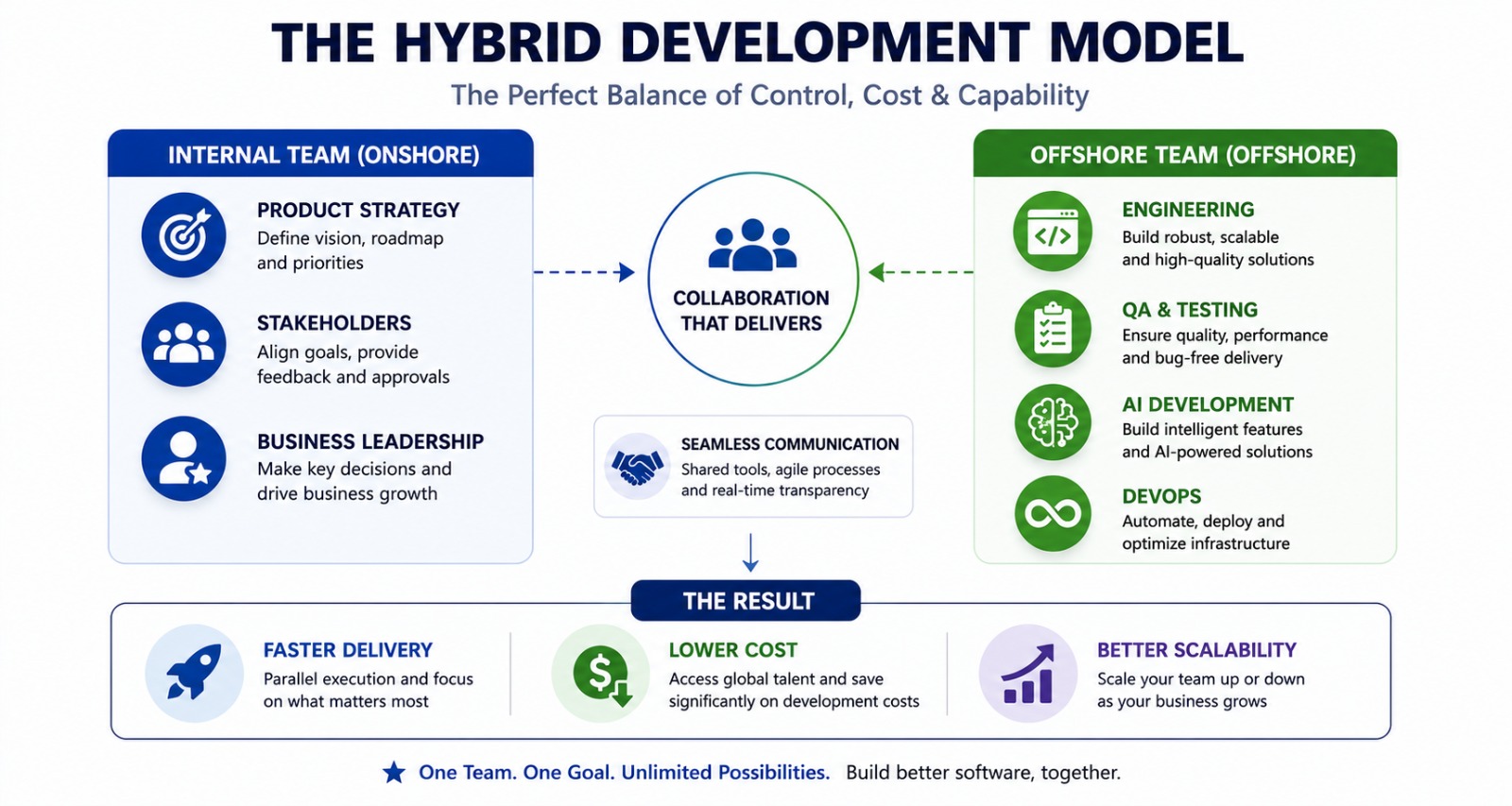
A hybrid structure allows companies to retain strategic leadership internally while leveraging offshore expertise for execution.
Internal Team Responsibilities
- Product Vision
- Stakeholder Management
- Business Strategy
- Roadmap Prioritization
Offshore Team Responsibilities
- Software Development
- QA and Testing
- DevOps
- Cloud Engineering
- AI Development
- Platform Maintenance
This model combines control, scalability, and cost efficiency while reducing hiring challenges.
Many successful SaaS companies, startups, and enterprise organizations now operate using hybrid engineering structures.
Real-World Scenario: Scaling a Product Team Without Expanding Headcount
A growing US SaaS company planned to launch several major product enhancements within six months.
Its internal engineering team was already operating at capacity.
Hiring locally presented challenges:
- Long recruitment timelines
- Limited availability of specialized talent
- Increasing salary expectations
Instead of expanding internally, the company partnered with a dedicated offshore engineering team.
Solution
The offshore team included:
- Backend Developers
- Frontend Developers
- QA Engineers
- DevOps Specialists
Outcome
- Faster release cycles
- Increased development capacity
- Reduced hiring overhead
- Improved roadmap execution
Most importantly, internal leadership remained focused on product strategy rather than recruitment and resource management.
Which Development Model Is Right for Your Business?
The debate around in-house vs offshore development team isn't really about choosing one model over another. It's about choosing the model that best supports your business goals, growth plans, budget, and product roadmap.
If your organization requires daily face-to-face collaboration, has the resources to recruit and retain engineering talent, and views software as a core strategic asset, an in-house team can provide strong long-term value.
If speed, scalability, specialized expertise, and cost efficiency are priorities, an offshore development team often delivers a significant advantage. Businesses can access experienced engineers, AI specialists, cloud architects, and product development teams without lengthy hiring cycles or increased operational overhead.
For many US companies, the most effective approach is a hybrid model. Internal teams focus on product strategy, business objectives, and stakeholder management, while offshore teams accelerate execution, innovation, and software delivery.
The goal is not simply to build a team.
The goal is to build better software, launch faster, innovate consistently, and create sustainable business growth.
Whether you're planning a new SaaS product, modernizing enterprise applications, expanding engineering capacity, or exploring AI-driven software solutions, selecting the right development model can have a lasting impact on business outcomes.
Build the Right Team Without the Hiring Bottleneck
Rushkar helps startups, SaaS companies, and enterprise organizations scale software delivery through dedicated development teams, software development outsourcing, AI engineering services, and custom software development solutions.
Whether you need to hire offshore developers, build a dedicated software development team, or accelerate product delivery through a flexible engagement model, our experts can help you identify the right approach for your business.
CTA: Schedule a Free Consultation | Request Developer Profiles
Frequently Asked Questions
Is an offshore development team cheaper than hiring developers in the USA?
In most cases, yes. An offshore development team can significantly reduce recruitment, infrastructure, employee benefits, and operational costs. However, the biggest advantage is often increased productivity and faster team scaling rather than cost savings alone. Many US businesses use software development outsourcing to access specialized expertise while optimizing development budgets.
What is the difference between a dedicated development team and staff augmentation?
A dedicated software development team works exclusively on your project and functions as a long-term extension of your business. Staff augmentation typically involves adding individual developers to your existing team to fill skill gaps or increase capacity. The right model depends on project complexity, duration, and internal management capabilities.
Why do US companies hire offshore developers?
US businesses choose to hire offshore developers to gain access to a larger talent pool, reduce hiring timelines, improve scalability, and access specialized skills such as AI development, cloud engineering, DevOps, and enterprise software development. Offshore teams also help organizations accelerate product delivery without expanding internal headcount.
How do offshore development teams handle communication and collaboration?
Modern offshore teams use Agile development practices and collaboration tools such as Jira, Azure DevOps, Microsoft Teams, Slack, and GitHub. Most dedicated teams establish overlapping working hours with US clients, conduct regular sprint reviews, and provide transparent progress reporting to ensure smooth communication throughout the project lifecycle.
Is software development outsourcing secure?
Yes, when working with an experienced technology partner. Reputable providers implement NDA agreements, secure development environments, source code ownership protections, role-based access controls, compliance frameworks, and structured governance processes to protect intellectual property and business data.
Can I scale a dedicated development team up or down?
Absolutely. One of the biggest advantages of a dedicated development team is flexibility. Businesses can increase or decrease team size based on project requirements, roadmap priorities, and business goals. This allows organizations to scale efficiently without the challenges of traditional recruitment.
What industries benefit most from offshore software development?
Industries including healthcare, finance, logistics, retail, SaaS, manufacturing, education, and professional services frequently use software development outsourcing and offshore development teams. These sectors often require specialized technical expertise, faster delivery timelines, and scalable engineering support to stay competitive in rapidly evolving markets.