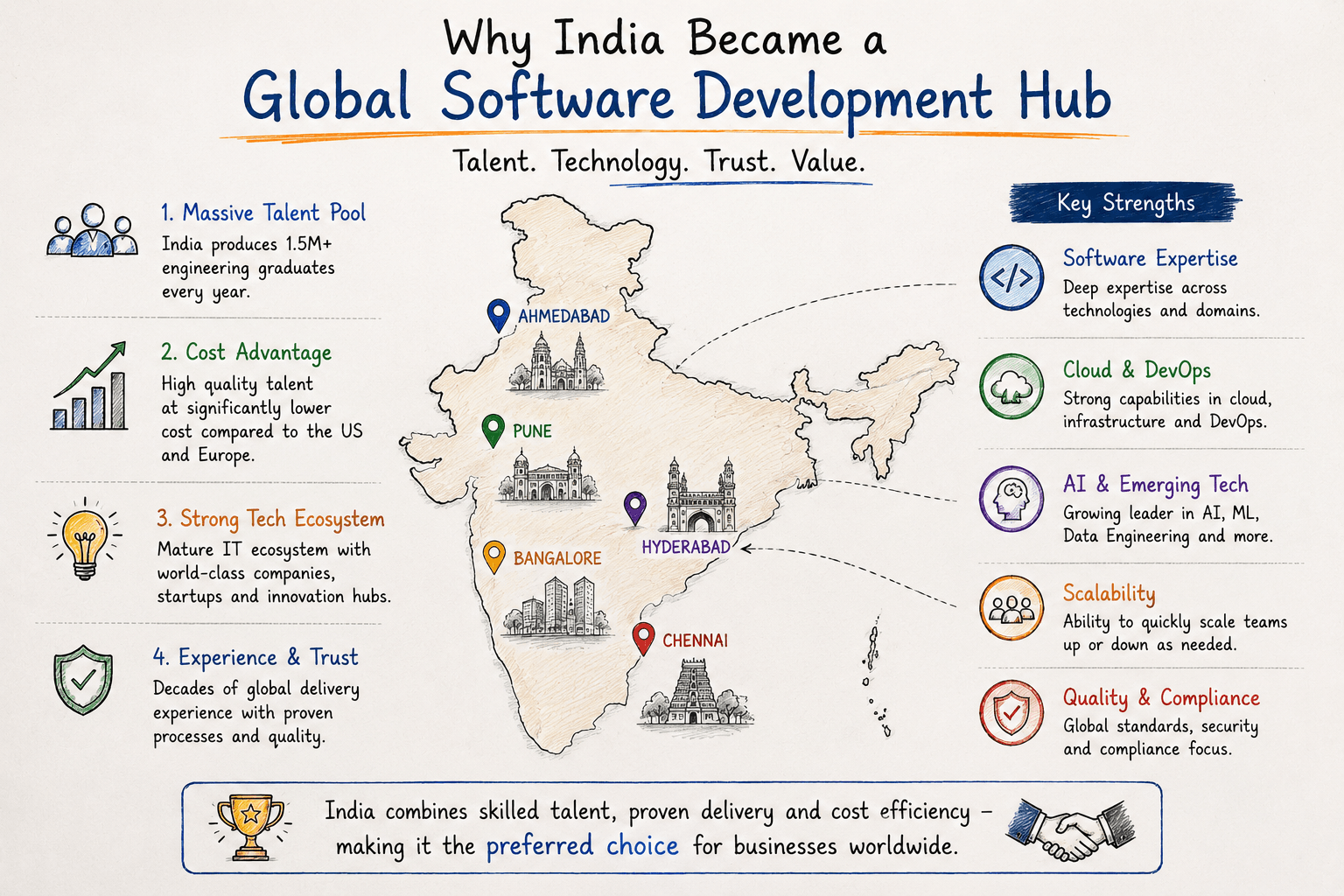
Software is no longer only a means of operation. For many companies, it has become the foundation of growth, customer experience, innovation, and competitive advantage.
If you’re building a SaaS platform, launching a mobile application, modernising legacy systems, integrating artificial intelligence, or automating internal workflows, software development has become one of the most important business investments that organisations make.
Simultaneously, the cost of development is going up. The struggle to find talented engineering talent continues, the need for AI proficiency is high, and the pressure on businesses to ship faster products without increasing operational costs remains.
That is why the software development cost USA vs India has become a hot topic for founders, CTOs, CIOs, product leaders, and technology executives across the United States.
That’s where many companies fall.
They only care about hourly rates.
The truth is that the economics of software development are far more complex than a simple comparison of salaries in two countries. The real question is not
"Where are the cheapest developers?"
The correct question is the following:
“How do we accelerate the delivery of high-quality software, acquire the right expertise, and maximise engineering capacity without increasing development costs?”
That difference matters.
The best organisations don't optimise for the lowest rates. They optimise for speed of delivery, product quality, scalability, technical expertise, and long-term ROI.
At Rushkar, we’ve partnered with startups, scaling companies, and enterprise organisations that initially sought outsourcing for the purpose of cutting costs. Many found something more valuable, quickly. The biggest benefit was more than just cost savings. It was access to experienced engineering teams to accelerate product development and scale faster than traditional hiring models allowed.
Before selecting a development model, every US company should be aware of the full picture of outsourcing software development to India, including cost structures, talent availability, project economics, AI development considerations, quality expectations, hidden costs, and strategic decision-making factors.
Why Software Development Costs Matter More Than Ever
Spending on technology is still rising in almost every sector.
Digital patient experiences are being invested in by healthcare organisations. Customer platforms are being updated by financial institutions. Retail companies are increasing their capacity for omnichannel commerce. Automation and predictive analytics are being adopted by manufacturing companies. Startups are in a race to launch cutting-edge products ahead of rivals.
Software is the common denominator.
The demand for software developers is predicted to increase dramatically over the next ten years as companies continue their digital transformation projects, according to research from the U.S. Bureau of Labour Statistics.
Demand, however, is not the only factor.
The quick development of cloud-native apps, automation, data engineering, machine learning, and artificial intelligence has led to new hiring difficulties. These days, companies are vying for a limited number of highly qualified engineers, architects, DevOps experts, AI developers, and product teams.
Development expenses are rising as a result in several areas:
- Recruitment of talent
- Retention of employees
- Tools and infrastructure
- Compliance and security
- Cloud-based operations
- Implementation of AI
- Upkeep of the product
This makes striking a balance challenging.
Business leaders need to deliver innovation quickly while maintaining budget discipline.
For this reason, a lot of companies are looking into global engineering models and software development outsourcing. The goal goes beyond just cutting expenses. It is boosting delivery capacity and engineering efficiency.
The True Cost of Software Development
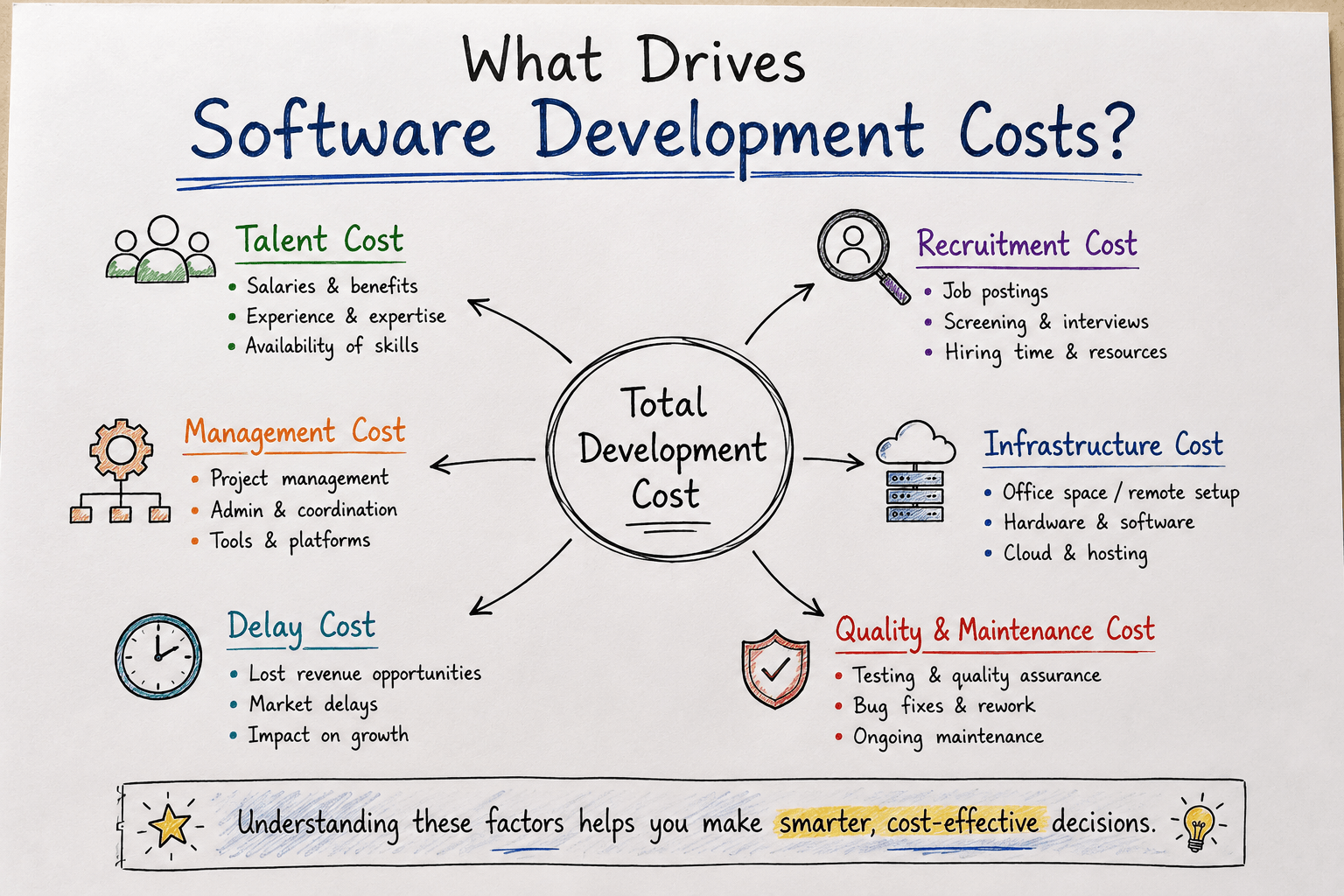
One of the biggest misconceptions in the industry is that software costs are driven by developer salaries.
“Salary is part of the investment."
We advise businesses to look at the bigger picture when they are contemplating software development cost USA vs India.
1) The Total Development Cost Framework
Total Development Cost = Talent Cost + Recruitment Cost + Infrastructure Cost + Management Cost + Delay Cost
Let's dissect this.
2) Cost of Talent
This includes developer salaries, contractor costs, specialist knowledge, QA resources, architects, project managers and DevOps engineers.
3) Cost of recruitment
It's a big investment to get experienced engineers on board.
Companies can spend months finding candidates, doing technical interviews, negotiating offers and onboarding new people.
4) Cost of infrastructure
Development environments need:
- Hardware
- Software licenses
- Cloud resource
- Security tools
- Collaboration Tools
- Monitoring solutions.
5) Cost of Management
Engineering teams need leadership, coordination, planning, quality assurance, sprint management and performance oversight.
6) Cost of delay
This is most often the least considered factor.
A delayed product launch can postpone revenue generation, customer acquisition, market expansion, and competitive advantage.
The cost of late delivery is often much higher than the salary savings that many organisations are trying to achieve.
Together these components paint a more accurate picture of development economics than hourly rates alone.
What Drives Software Development Costs in the United States?
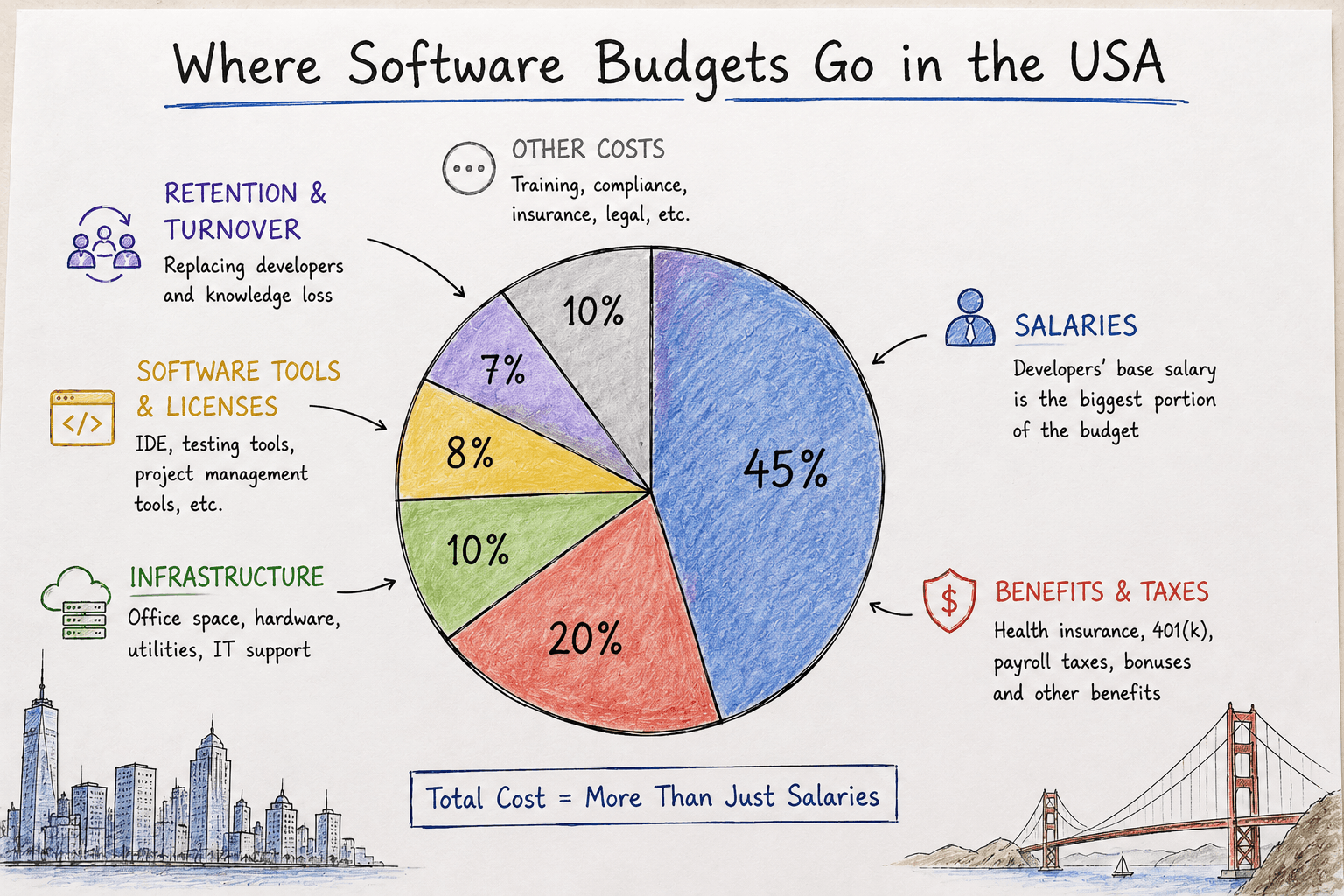
The US is still one of the world’s leading technology markets.
Our engineering ecosystem has great talent, has advanced innovation and strong product leadership capabilities.
However, these advantages come with significant cost considerations.
1) High Demand for Engineering Talent
Software engineers remain among the most sought-after professionals in the market.
Experienced developers, architects, AI specialists, cloud engineers and DevOps professionals are in high demand and companies compete hard to hire them.
This competition naturally drives up the pay.
2) Employee Benefits and Operational Expenses
Besides salaries, businesses need to consider:
- Health benefits
- Retirement contributions
- Paid Time Off
- Incentives
- Payroll tax
- Equipment costs
- Office supplies.
These additional costs can substantially increase total employment investment.
3) Talent Retention Challenges
Replacing an experienced engineer is rarely inexpensive.
Knowledge transfer, onboarding, productivity gaps, and recruitment efforts all contribute to additional costs when turnover occurs.
4) Specialized AI Expertise
The emergence of AI has created a new layer of demand.
Organisations are actively looking for:
- AI Developers
- ML Engineers.
- Specialists LLM
- Experts in AI Integration
- MLOps Engineer
As demand continues to outpace supply, hiring these professionals locally has become increasingly expensive.
For many organisations, these factors make traditional hiring slower, more competitive and more expensive than in years gone by.
Why India Became a Global Software Development Hub
India's position in the global technology ecosystem did not happen overnight.
Over the last two decades, the country has transitioned from being a destination for support services to one of the world's largest software engineering and digital innovation hubs. Today, engineering teams in India are trusted by companies from venture-backed startups to Fortune 500 companies to build products, modernise platforms, build AI solutions and drive digital transformation initiatives.
If you're a US company considering outsourcing your software development to India, you need to understand the benefits behind it.
1) Access to a Large Engineering Talent Pool
One of India's greatest strengths is scale.
The country produces a large number of engineering graduates every year in the software engineering, computer science, information technology, data science, artificial intelligence and cloud computing fields.
This provides access to specialised talent in areas such as the following:
- .NET Developments
- React Developer
- Angular Development Services
- Mobile Application Development
- Cloud Engineer
- DevOps
- AI / Machine Learning (ML)
- Enterprise Software Development
For businesses struggling to hire locally, access to a broader talent pool can significantly reduce hiring timelines.
2) Mature Software Development Ecosystem
India has supported global software projects for decades.
As a result, many development companies have built mature delivery frameworks around:
- Agile methodologies
- DevOps practices
- Sprint planning
- Automated testing
- Quality assurance
- Security compliance
- Continuous delivery
This operational maturity often allows businesses to scale projects faster without building internal delivery structures from scratch.
3) Strong English Communication
Communication remains one of the most important success factors in software development.
Indian engineering teams have extensive experience working with US, UK, European, and Australian organizations. English is widely used throughout the technology industry, making collaboration more efficient across distributed teams.
4) Cost Efficiency Through Operational Advantages
Contrary to popular belief, lower development costs are not driven by lower quality.
They are largely driven by differences in operational economics, infrastructure expenses, employment costs, and regional market conditions.
This allows organizations to access experienced engineering talent while maintaining budget flexibility.
USA vs India: Developer Cost Comparison by Role
One of the most common questions we hear from business leaders is the following:
"How much can we realistically save by outsourcing software development to India?"
The answer depends on the team structure, project complexity, and required expertise.
However, role-based comparisons provide useful context.
|
Role
|
USA Monthly Cost
|
India Monthly Cost
|
|
Software Developer
|
$8,000 – $14,000
|
$1,800 – $3,500
|
|
Senior Developer
|
$10,000 – $18,000
|
$2,500 – $4,500
|
|
QA Engineer
|
$6,000 – $10,000
|
$1,500 – $3,000
|
|
DevOps Engineer
|
$9,000 – $16,000
|
$2,500 – $5,000
|
|
Project Manager
|
$8,000 – $15,000
|
$2,000 – $4,500
|
|
AI Engineer
|
$12,000 – $22,000
|
$3,500 – $7,000
|
The numbers tell only part of the story.
What's often more important is the engineering capacity created from the same budget.
For example, the annual investment required for a small internal team in the United States may support a larger cross-functional engineering squad through a dedicated development model.
That expanded capacity often translates into faster releases, shorter backlogs, and accelerated product innovation.
The Hidden Cost Most Businesses Ignore: Hiring Delays
When evaluating software development cost USA vs India, most comparisons focus on salaries.
Few discuss the financial impact of delayed hiring.
This can be a costly oversight.
Imagine a SaaS company preparing to launch a new platform.
The roadmap requires:
- Two Backend Developers
- One Frontend Developer
- One QA Engineer
- One DevOps Specialist
If hiring takes four to six months, the product launch may be delayed by the same period.
The result?
Potential consequences include the following:
- Lost recurring revenue
- Slower customer acquisition
- Delayed market validation
- Increased competitive pressure
- Reduced investor confidence
In many situations, the cost of waiting exceeds the cost of development itself.
This is one reason businesses increasingly adopt a Dedicated Development Team model. Instead of spending months recruiting, companies can rapidly access experienced engineers and begin development almost immediately.
The Difference Between Engineering Talent and Engineering Capacity
Many organizations optimize for talent acquisition.
Fewer optimize for engineering capacity.
There is a difference.
Engineering talent focuses on individual contributors.
Engineering capacity focuses on how much value a team can produce over time.
A single exceptional developer is valuable.
A structured team with developers, QA engineers, DevOps specialists, architects, and project leadership can create significantly greater business outcomes.
This shift in thinking is changing how technology leaders approach software delivery.
Instead of asking:
"How much does a developer cost?"
Progressive organizations ask:
"How much engineering capacity can we create within our budget?"
That question often leads to different strategic decisions.
For businesses pursuing growth, capacity frequently matters more than headcount.
Project Cost Comparison: USA vs India
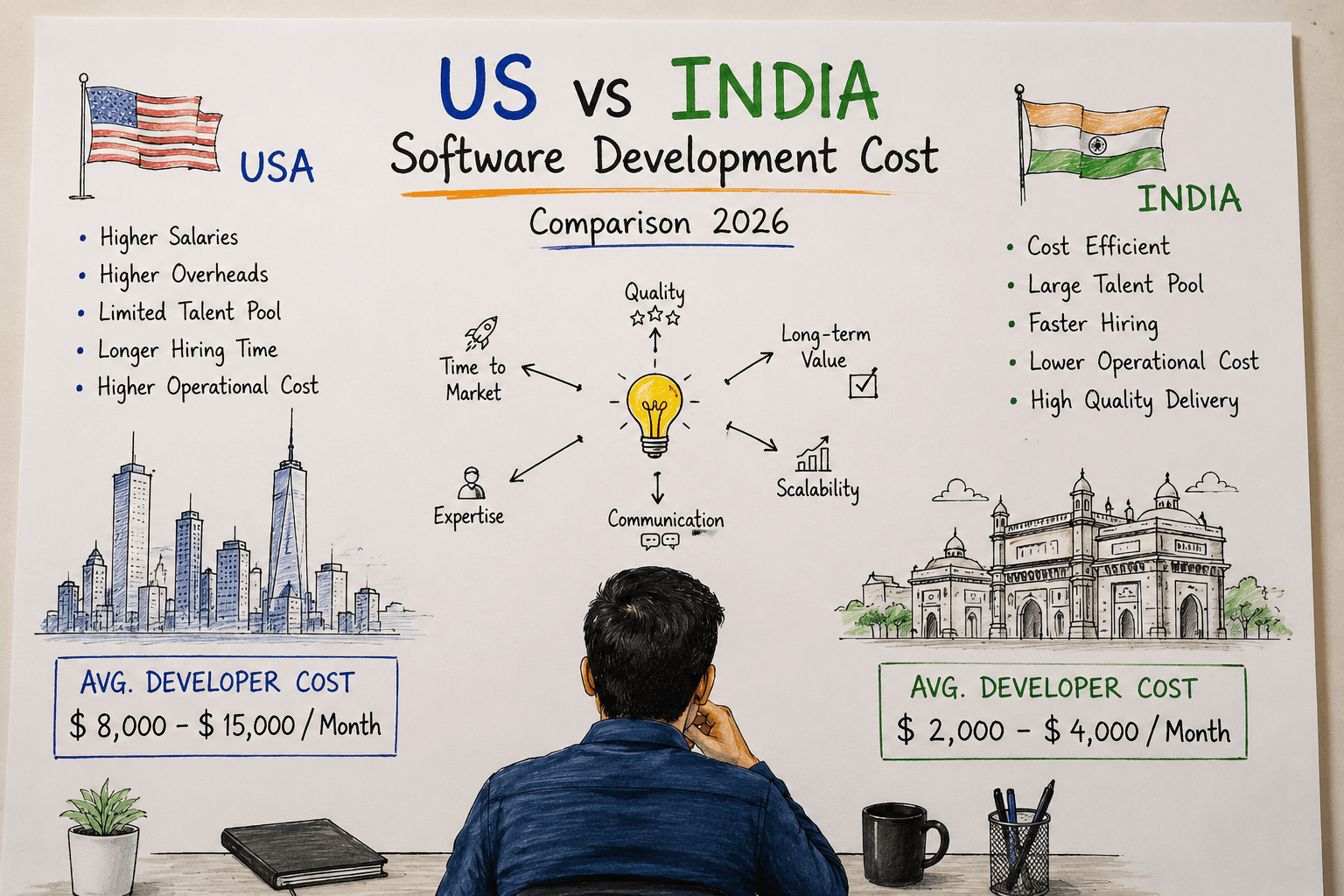
Development costs also vary significantly depending on the type of software being built.
1) MVP Development
Startups often begin with a Minimum Viable Product to validate market demand before investing heavily in a full-scale platform.
Typical Cost
USA:
$60,000 – $180,000+
India:
$20,000 – $70,000+
2) SaaS Platform Development
SaaS applications require:
- User management
- Billing systems
- APIs
- Reporting dashboards
- Security controls
- Cloud infrastructure
Typical Cost
USA:
$150,000 – $500,000+
India:
$50,000 – $180,000+
3) Enterprise Software Development
Enterprise applications often include:
- Workflow automation
- ERP integrations
- Role-based permissions
- Advanced reporting
- Compliance controls
Typical Cost
USA:
$250,000 – $1M+
India:
$80,000 – $400,000+
4) Mobile Application Development
Mobile projects may involve:
- iOS development
- Android development
- Cross-platform frameworks
- Backend integrations
- Analytics systems
Typical Cost
USA:
$50,000 – $300,000+
India:
$15,000 – $120,000+
The goal isn't to choose the lowest number.
The goal is identifying where the best balance of quality, speed, expertise, and investment exists for your business.
Why AI Is Changing Software Development Economics
Artificial intelligence is reshaping how businesses build, scale, and operate software.
Just a few years ago, most software projects required traditional development teams focused on web applications, mobile platforms, APIs, and enterprise systems. Today, organizations are investing in AI-powered products, intelligent automation, predictive analytics, conversational interfaces, recommendation engines, and AI agents that can streamline operations and improve decision-making.
As a result, the conversation around software development cost USA vs India has evolved.
Businesses are no longer comparing only software developers. They are also evaluating the cost and availability of highly specialized AI talent.
1) The Growing Demand for AI Specialists
Organizations across healthcare, finance, logistics, retail, education, and professional services are actively seeking the following:
- AI Developers
- Machine Learning Engineers
- LLM Specialists
- AI Integration Experts
- Data Engineers
- MLOps Engineers
- Prompt Engineers
- RAG Architects
Demand for these skills continues to grow faster than supply.
According to industry reports from major consulting and research organizations, AI-related roles are among the fastest-growing positions in technology today. This talent shortage has increased competition across the United States, driving compensation levels significantly higher than traditional software engineering roles.
2) AI Talent Cost Comparison
|
Role
|
USA Monthly Cost
|
India Monthly Cost
|
|
AI Engineer
|
$12,000 – $22,000
|
$3,500 – $7,000
|
|
Machine Learning Engineer
|
$10,000 – $20,000
|
$3,000 – $6,500
|
|
LLM Specialist
|
$12,000 – $25,000
|
$4,000 – $8,000
|
|
MLOps Engineer
|
$10,000 – $18,000
|
$3,000 – $6,000
|
|
Data Engineer
|
$9,000 – $16,000
|
$2,500 – $5,500
|
These figures illustrate why many organizations evaluating AI initiatives are increasingly exploring global delivery models.
The challenge isn't simply cost.
It's availability.
Finding experienced AI professionals locally often requires lengthy recruitment cycles, while project timelines continue to move forward.
3) The Rise of AI-Enabled Development Teams
Modern software teams increasingly combine traditional engineering expertise with AI capabilities.
For example, businesses building intelligent applications may require the following:
- Software Developers
- AI Engineers
- Data Engineers
- Cloud Architects
- DevOps Specialists
- Product Managers
Instead of building these capabilities internally over several months, organizations can accelerate delivery through experienced offshore teams that already possess the required expertise.
This is one reason services such as AI Development, AI Integration Services, LLM Development, RAG Development, and AI Software Services continue to experience significant growth.
The future of software development will increasingly belong to organizations that can combine engineering excellence with AI innovation.
Does Lower Cost Mean Lower Quality?
One of the most common misconceptions surrounding offshore development is that lower cost automatically means lower quality.
In practice, quality is determined by processes, engineering standards, governance, communication, and leadership, not geography.
A poorly managed local team can produce poor results.
A well-structured offshore team can produce exceptional results.
What Actually Impacts Software Quality?
Successful software projects typically depend on several key factors:
1) Clear Requirements
Strong projects begin with clearly defined objectives, priorities, and business outcomes.
2) Architecture Decisions
Scalable software requires thoughtful technical architecture and long-term planning.
3) Development Practices
Modern engineering teams rely on:
- Agile methodologies
- Code reviews
- CI/CD pipelines
- Automated testing
- Version control
- Continuous improvement
4) Quality Assurance
Dedicated testing and validation processes help reduce production issues and improve user experience.
5) Communication
Transparent communication remains one of the strongest predictors of project success.
When evaluating an offshore development partner, businesses should focus less on location and more on delivery maturity, technical expertise, and operational processes.
Communication and Collaboration in Distributed Teams
Remote software development is no longer unusual.
It has become standard practice.
Today, many successful software products are built by distributed teams operating across multiple countries and time zones.
The key is establishing effective collaboration structures.
1) Modern Collaboration Tools
High-performing development teams typically use:
- Microsoft Teams
- Slack
- Jira
- Azure DevOps
- GitHub
- Confluence
- Google Workspace
These platforms create transparency across planning, development, testing, and deployment activities.
2) Best Practices for Distributed Development
Successful teams often implement the following:
- Daily standups
- Sprint planning sessions
- Weekly stakeholder reviews
- Product demonstrations
- Shared documentation
- Transparent reporting
When communication frameworks are established properly, distributed teams can operate with the same level of visibility and accountability as internal teams.
Risks of Outsourcing Software Development and How to Avoid Them
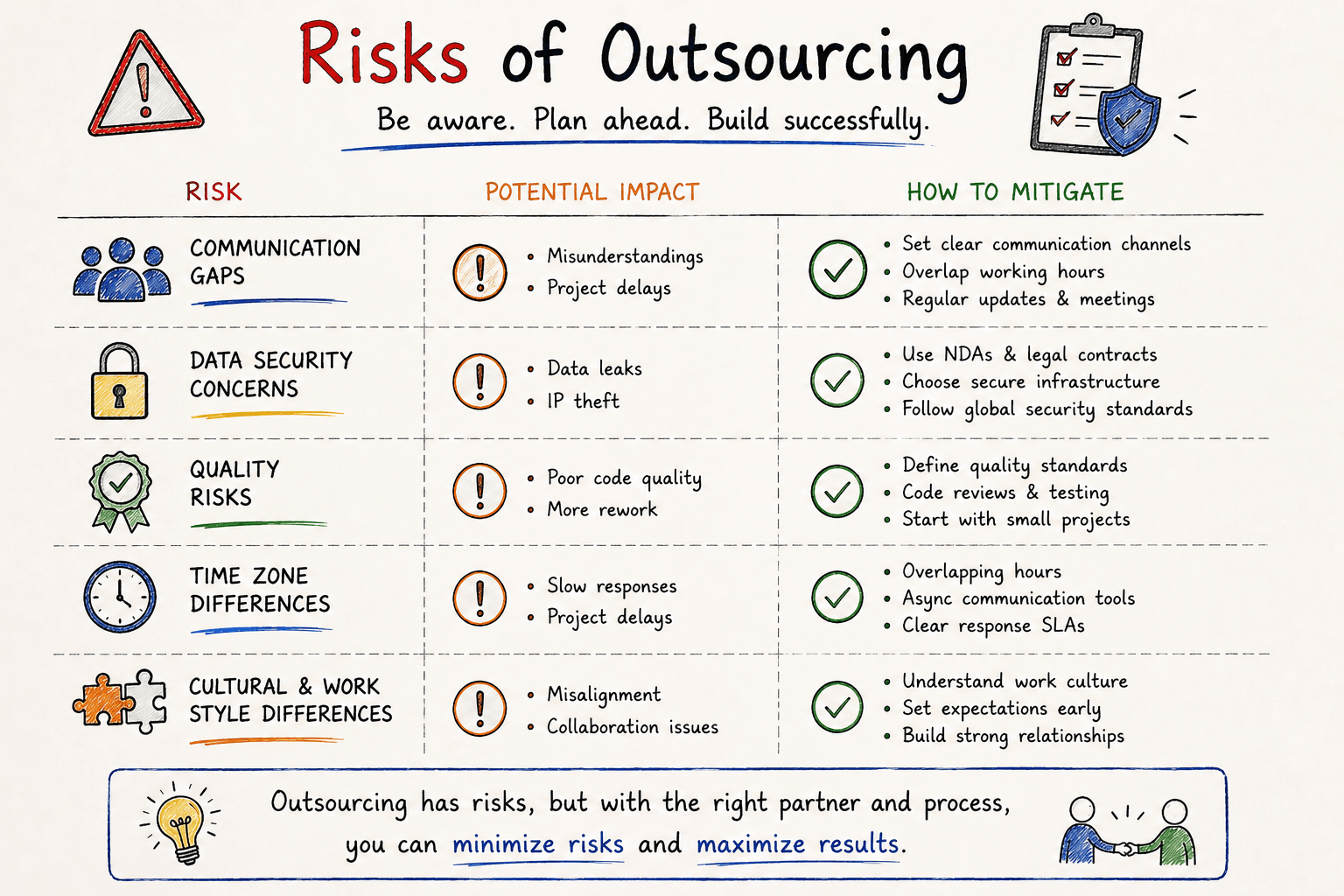
Every business decision carries risk.
Software outsourcing is no exception.
The goal is not to avoid risk entirely.
The goal is to identify potential challenges and proactively manage them.
Risk 1: Choosing the Wrong Partner
The lowest proposal is rarely the best option.
Businesses should evaluate the following:
- Technical expertise
- Industry experience
- Delivery maturity
- Portfolio quality
- Client references
Risk 2: Unclear Project Requirements
Poorly defined requirements often lead to scope changes, delays, and budget overruns.
A structured discovery phase helps reduce this risk significantly.
Risk 3: Lack of Governance
Without clear reporting, sprint planning, and stakeholder alignment, even talented teams can struggle.
Strong governance creates accountability throughout the development lifecycle.
Risk 4: Limited Scalability
Some vendors struggle to scale resources as projects grow.
Businesses should verify team expansion capabilities before engagement begins.
The good news is that these risks are manageable when the right processes and partner selection criteria are in place.
How to Choose a Reliable India Outsourcing Partner
Not every software development company is equipped to support long-term business growth.
Before selecting a partner, we recommend evaluating the following areas.
1) Technical Capability
Review:
- Technology stack expertise
- Architecture experience
- AI capabilities
- Cloud engineering experience
- Enterprise development expertise
2) Industry Knowledge
A partner familiar with your industry often understands business requirements faster.
Delivery Methodology
Look for:
- Agile delivery
- Sprint planning
- Dedicated project management
- Transparent reporting
- Quality assurance frameworks
3) Scalability
The ability to scale developers, QA engineers, DevOps specialists, and AI experts can become critical as products evolve.
4) Long-Term Partnership Potential
Software development should not be viewed as a one-time transaction.
The best partnerships support ongoing innovation, maintenance, optimization, and growth.
Final Verdict: USA vs India Software Development Cost
When evaluating software development cost USA vs India, focusing exclusively on salaries provides an incomplete picture.
The most successful businesses evaluate software investment through a broader lens.
They consider:
- Delivery speed
- Talent availability
- Engineering capacity
- Product quality
- AI expertise
- Long-term scalability
- Return on investment
For many organizations, outsourcing software development to India creates a strategic advantage because it combines access to experienced engineering talent, faster team scaling, and cost-efficient delivery models.
At the same time, outsourcing is not simply about reducing expenses.
It is about increasing the amount of innovation your business can deliver within the same budget.
The companies that succeed over the next decade will not necessarily be those with the largest engineering budgets.
They will be the organizations that build, adapt, and innovate faster than their competitors.
Build More Software Without Increasing Development Costs
At Rushkar, we help US businesses scale engineering capacity through dedicated development teams, custom software development services, AI specialists, cloud engineers, and long-term technology partnerships.
Whether you're evaluating a Dedicated Development Team, exploring Software Development Outsourcing, planning a SaaS product, or building AI-powered solutions, our team can help you move from idea to execution with confidence.
Schedule a Free Consultation
Request Developer Profiles
Frequently Asked Questions
Is outsourcing software development to India still worth it in 2026?
Yes, but only when you partner with an experienced software development company that follows mature engineering processes, strong communication practices, and proven delivery frameworks. Today, businesses choose outsourcing software development to India not only for cost efficiency but also for faster scaling, broader technical expertise, and access to specialized skills in cloud, AI, and enterprise software development.
How much can US companies save by outsourcing software development to India?
The savings vary depending on team size, project complexity, and required expertise. However, many businesses reduce overall development expenses while gaining access to a larger engineering team. The real advantage is often increased development capacity, faster delivery cycles, and improved ROI rather than simply lower hourly rates.
Does a lower offshore software development cost mean lower quality?
Not necessarily. Software quality depends on architecture, engineering standards, QA processes, project management, and communication. A well-managed offshore team can deliver the same level of quality as an internal team when supported by agile development practices, code reviews, automated testing, and transparent reporting.
What types of projects are best suited for offshore software development?
Offshore development works particularly well for SaaS platforms, enterprise applications, mobile apps, workflow automation systems, cloud modernization projects, AI-powered solutions, and long-term product development. Businesses often use a dedicated development team model when they need continuous development and ongoing feature enhancements.
How do I choose the right software outsourcing partner in India?
Look beyond pricing. Evaluate technical expertise, portfolio quality, client references, communication practices, industry experience, scalability, security standards, and delivery methodology. A reliable partner should demonstrate strong engineering capabilities, transparent processes, and the ability to support long-term business goals.
What is the biggest hidden cost in software development?
One of the most overlooked costs is delayed hiring. Lengthy recruitment cycles can postpone product launches, slow innovation, and delay revenue opportunities. Many companies find that gaining immediate access to experienced engineers through a dedicated software development team creates greater business value than waiting months to hire internally.
Is a dedicated development team better than hiring individual developers?
For long-term projects, a dedicated team often provides better outcomes. Instead of managing individual contributors, businesses gain access to a structured team that may include developers, QA engineers, DevOps specialists, project managers, and AI experts. This improves collaboration, accountability, delivery speed, and overall engineering capacity.
Why are US companies increasingly combining AI and offshore development teams?
AI talent remains one of the most competitive areas in technology. Businesses are increasingly using offshore teams to access AI Developers, Machine Learning Engineers, LLM Specialists, and AI Integration Experts without facing extended recruitment timelines. This approach helps organizations accelerate AI adoption while maintaining budget flexibility and delivery momentum.