Finding skilled software engineers has become one of the biggest challenges facing technology leaders today.
Whether you're building a SaaS platform, modernizing legacy systems, developing enterprise applications, integrating AI capabilities, or scaling an internal product team, access to experienced engineering talent often determines how quickly your business can innovate and grow.
For organizations that rely on Microsoft technologies, the challenge becomes even more specific. The demand for experienced C#, ASP.NET Core, Azure, and cloud-native engineers continues to rise, while the pool of highly qualified candidates remains competitive.
This is why more companies are looking to hire remote .NET developers instead of relying exclusively on local recruitment.
The conversation has evolved far beyond cost savings.
Today's businesses are seeking engineering capacity, specialized expertise, faster onboarding, and the flexibility to scale development teams without lengthy hiring cycles.
At Rushkar, we've seen startups, mid-sized businesses, and enterprise organizations adopt remote and offshore development models to accelerate product delivery, modernize applications, and access skills that can be difficult to hire locally.
However, hiring the right developer requires more than reviewing a resume.
Modern .NET engineers are expected to contribute across application development, cloud architecture, APIs, DevOps, security, performance optimization, and increasingly, AI integration.
This guide explains how US businesses can evaluate, hire, and scale high-performing .NET teams while avoiding common hiring mistakes.
Why .NET Continues to Power Enterprise Software Development
Despite the emergence of countless frameworks and programming languages, .NET remains one of the most trusted platforms for enterprise software development.
Organizations across healthcare, finance, insurance, logistics, manufacturing, retail, and government sectors continue to invest heavily in .NET because of its scalability, security, performance, and long-term support ecosystem.
Microsoft's continued investment in modern .NET has transformed the platform into a powerful foundation for the following:
- Enterprise Applications
- SaaS Platforms
- Customer Portals
- ERP Systems
- CRM Solutions
- Cloud-Native Applications
- AI-Powered Business Solutions
- Workflow Automation Platforms
For businesses planning long-term technology investments, .NET provides a mature ecosystem backed by Microsoft, extensive developer tooling, and seamless integration with Azure cloud services.
This is one reason many organizations actively seek dedicated .NET developers who can support ongoing product development and modernization initiatives.
Modern .NET Is Different From Legacy .NET
One mistake many hiring managers make is evaluating candidates based on outdated assumptions.
Modern .NET development extends far beyond traditional desktop or monolithic applications.
Today's top-performing developers should understand:
- .NET 8 and newer frameworks
- ASP.NET Core
- Microservices
- Cloud Architecture
- Containerization
- REST APIs
- DevOps Pipelines
- Azure Services
- AI Integrations
Hiring developers with modern engineering capabilities ensures your technology stack remains scalable and future-ready.
When Does Hiring Remote .NET Developers Make Sense?
Not every company needs a full internal development department.
In many situations, remote hiring offers a more practical and scalable solution.
1) Product Development and SaaS Platforms
Many startups and growing businesses need experienced engineers to build and evolve software products.
Hiring remote talent allows organizations to accelerate development without waiting months to recruit locally.
2) Legacy Application Modernization
Older .NET applications often require upgrades to improve performance, security, scalability, and maintainability.
Experienced remote developers can help modernize systems while minimizing operational disruption.
3) Team Extension
Many organizations already have internal engineering teams but require additional capacity.
In these situations, businesses often choose to hire offshore .NET developers who can work alongside existing teams and accelerate delivery timelines.
4) Enterprise Digital Transformation
Large-scale initiatives often require specialized expertise across the following:
- Cloud Migration
- Application Modernization
- Data Integration
- Security Improvements
- API Development
Remote engineering teams provide flexibility when workloads increase.
5) AI Integration Projects
As businesses increasingly adopt artificial intelligence, many .NET applications now require:
- OpenAI Integration
- Azure OpenAI Services
- AI Agents
- Intelligent Automation
- Predictive Analytics
Organizations seeking these capabilities often benefit from developers who understand both modern .NET architecture and emerging AI technologies.
Essential Technical Skills Every .NET Developer Should Have
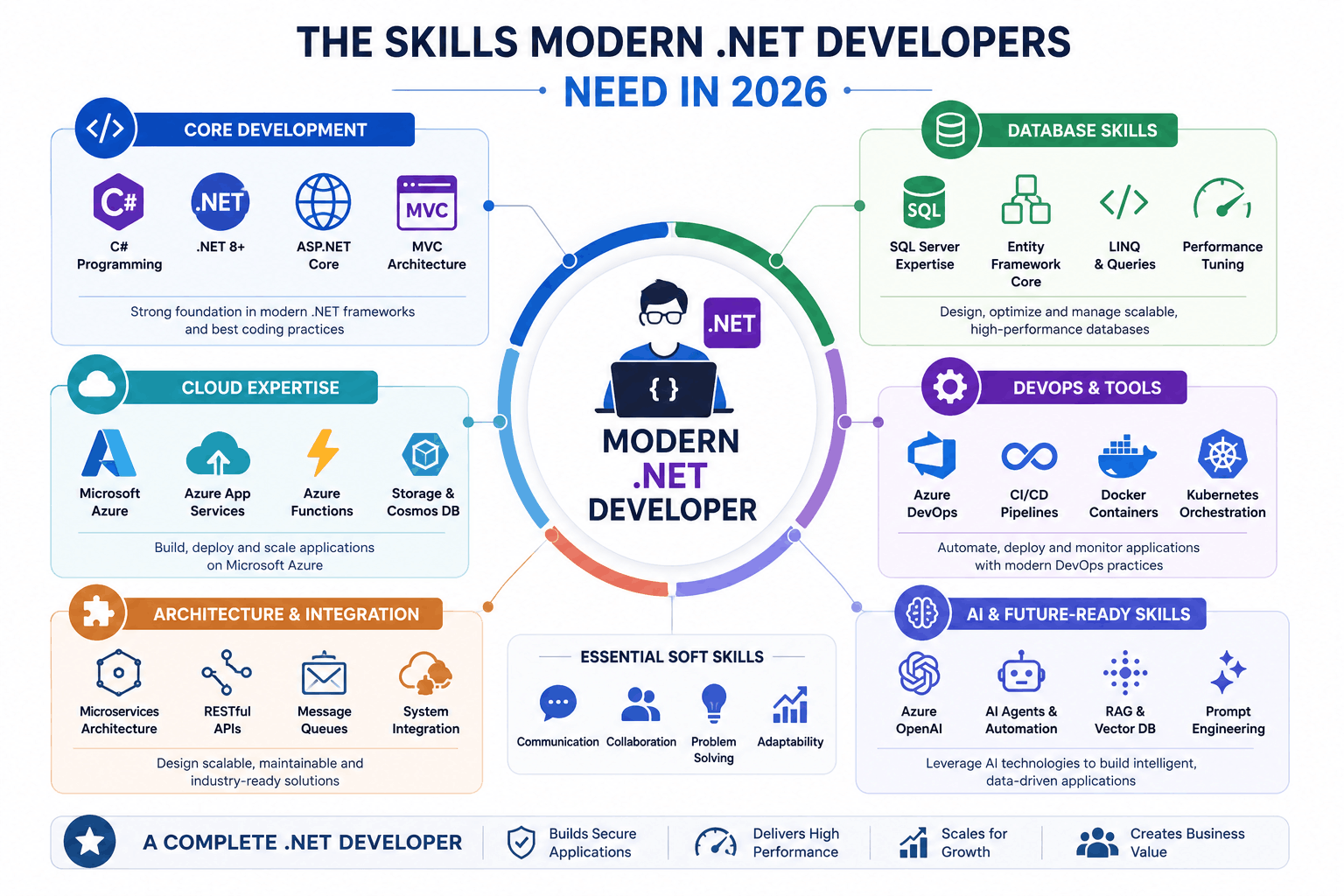
The best hiring decisions are based on skills, not simply years of experience.
When evaluating candidates, focus on practical expertise across the technologies your business actually uses.
1) C# and Modern .NET Development
C# remains the foundation of the .NET ecosystem.
Strong developers should demonstrate expertise in:
- Object-Oriented Programming
- Asynchronous Programming
- Dependency Injection
- Design Patterns
- Memory Management
- Performance Optimization
Beyond writing code, developers should understand how to create maintainable and scalable software architectures.
2) ASP.NET Core and MVC Expertise
If you're building web applications, ASP.NET developers should possess strong knowledge of:
- ASP.NET Core
- MVC Architecture
- Razor Pages
- Authentication and Authorization
- Middleware
- Application Security
- Session Management
These technologies remain essential for enterprise-grade web development.
3) Entity Framework and LINQ
Database interaction is a critical part of most applications.
Developers should be comfortable with:
- Entity Framework Core
- LINQ Queries
- Database Migrations
- Query Optimization
- Data Modeling
Poor database practices often become a major source of performance issues later in the software lifecycle.
4) Problem-Solving Ability
Technical knowledge alone is not enough.
Great developers consistently demonstrate:
- Analytical Thinking
- Troubleshooting Skills
- Architectural Decision-Making
- Communication Skills
- Business Understanding
The ability to solve real-world problems often matters more than memorizing framework features.
Database Expertise That Separates Good Developers From Great Ones
Many businesses focus heavily on application development skills during the hiring process.
However, database performance often determines how well an application scales under real-world usage.
A poorly optimized database can create bottlenecks that impact user experience, reporting capabilities, and overall system performance regardless of how well the application itself is written.
When you hire remote .NET developers, database expertise should be a key evaluation criterion.
1) SQL Server Experience
Most enterprise .NET applications rely on Microsoft SQL Server.
Developers should demonstrate practical experience with:
- SQL Server Management Studio (SSMS)
- Stored Procedures
- Views
- Functions
- Triggers
- Transactions
- Query Optimization
Understanding how applications interact with databases is essential for building reliable software.
2) Database Design and Architecture
Strong developers don't simply write queries.
They understand how to structure data for long-term scalability.
Look for experience with:
- Relational Database Design
- Normalization
- Indexing Strategies
- Data Integrity
- Database Security
- High-Availability Architectures
These skills become increasingly important as applications grow.
3) Performance Optimization Skills
One of the most valuable capabilities a .NET developer can possess is identifying performance bottlenecks.
Candidates should understand:
- Query Optimization
- Index Analysis
- Execution Plans
- Caching Strategies
- Connection Pooling
- Database Monitoring
These skills directly impact application speed and operational efficiency.
Azure and DevOps Skills Every Modern .NET Developer Should Have
Modern software development extends far beyond writing code.
Today's businesses need engineers who understand deployment, automation, monitoring, and cloud infrastructure.
This is why Azure and DevOps expertise has become a critical requirement when hiring dedicated .NET developers.
1) Azure Cloud Experience
Microsoft Azure remains one of the most widely adopted cloud platforms among enterprise organizations.
Developers should be familiar with:
- Azure App Services
- Azure Functions
- Azure Storage
- Azure SQL Database
- Azure Key Vault
- Azure Service Bus
- Azure API Management
These services form the backbone of many modern enterprise applications.
2) Azure DevOps
Organizations increasingly rely on automated development workflows to improve speed and quality.
Candidates should understand:
- Azure DevOps Pipelines
- Build Automation
- Release Management
- Version Control
- Sprint Management
- Backlog Planning
This knowledge helps teams deliver software more efficiently.
3) Containerization and Modern Deployment
As software architectures evolve, developers must understand modern deployment models.
Look for experience with:
- Docker
- Kubernetes
- Container Registries
- Infrastructure as Code
- CI/CD Automation
These capabilities are especially important for businesses building cloud-native applications.
API, Microservices, and Security Skills to Evaluate
Most modern applications do not operate in isolation.
They communicate with internal systems, third-party platforms, payment gateways, AI services, ERP solutions, and mobile applications.
This makes API development one of the most important skills for modern ASP.NET developers.
1) REST API Development
Developers should understand:
- REST Principles
- API Design Standards
- Request Validation
- Versioning Strategies
- Error Handling
- API Documentation
Poor API design often creates long-term maintenance challenges.
2) Microservices Architecture
Many organizations are moving away from monolithic applications toward microservices-based architectures.
Developers should understand:
- Service Communication
- Event-Driven Design
- Distributed Systems
- Scalability Patterns
- Service Discovery
- Message Queues
Microservices expertise becomes increasingly valuable for growing businesses.
3) Security Best Practices
Security cannot be treated as an afterthought.
When evaluating candidates, look for experience with:
- OAuth 2.0
- JWT Authentication
- Identity Management
- Role-Based Access Control
- Data Encryption
- Secure API Design
- OWASP Security Principles
For industries such as healthcare, finance, and insurance, these skills are often mandatory.
Why AI Skills Are Becoming Important for .NET Developers
Artificial intelligence is no longer limited to experimental projects.
It is rapidly becoming part of mainstream software development.
Organizations are integrating AI into:
- Customer Service Platforms
- Internal Business Applications
- Analytics Systems
- Workflow Automation
- Enterprise Search
- Knowledge Management Solutions
As a result, companies increasingly seek developers who can combine traditional software engineering with AI implementation expertise.
1) Azure OpenAI and AI Integrations
Modern .NET developers should understand how to work with:
- Azure OpenAI
- OpenAI APIs
- AI Assistants
- AI Agents
- Prompt Engineering
- Semantic Search
These technologies are becoming increasingly relevant across industries.
2) Retrieval-Augmented Generation (RAG)
Many enterprise AI initiatives rely on Retrieval-Augmented Generation to provide accurate responses using private business data.
Developers who understand:
- Vector Databases
- Embeddings
- Knowledge Retrieval
- RAG Architecture
can help organizations build more intelligent applications.
3) AI-Powered Application Development
Businesses are increasingly investing in:
- AI Development Services
- AI Integration Services
- LLM Development
- Intelligent Automation
Hiring developers who understand these technologies can future-proof your software investments and reduce the need for additional specialist hires later.
Interview Questions to Ask Before Hiring a .NET Developer
A strong interview process helps businesses evaluate more than technical knowledge.
The goal is to understand how a developer approaches architecture, problem-solving, scalability, security, and real-world software delivery.
Instead of focusing solely on theoretical questions, we recommend combining technical discussions with practical scenarios.
1) Technical Questions
These questions help assess core .NET expertise.
- What are the key differences between .NET Framework and modern .NET?
- How does Dependency Injection work in ASP.NET Core?
- When would you use asynchronous programming?
- How do you handle exception management in enterprise applications?
- What design patterns have you used in production systems?
Strong candidates should explain concepts clearly rather than reciting textbook definitions.
2) ASP.NET Core Questions
For web application development, consider asking:
- How do you structure a scalable ASP.NET Core application?
- What middleware components have you implemented?
- How do you secure APIs and web applications?
- How would you improve application performance under heavy traffic?
These questions reveal practical experience.
3) Database Questions
Database skills often differentiate senior developers from mid-level engineers.
Ask:
- How do you optimize slow SQL queries?
- When should indexes be used?
- How do you identify database bottlenecks?
- What strategies do you use for handling large datasets?
4) Azure and Cloud Questions
Cloud expertise has become increasingly important for enterprise software development.
Ask:
- Which Azure services have you used most frequently?
- How do you design scalable cloud architectures?
- What CI/CD pipelines have you implemented?
- How do you manage cloud security and monitoring?
5) AI and Modern Technology Questions
As AI adoption grows, organizations should assess future-ready capabilities.
Consider asking:
- Have you integrated OpenAI or Azure OpenAI into applications?
- What experience do you have with AI agents?
- Have you worked with Retrieval-Augmented Generation (RAG)?
- How would you design an AI-powered business application?
These questions help identify developers who can contribute to next-generation software initiatives.
Full-Time vs Part-Time vs Dedicated Development Team
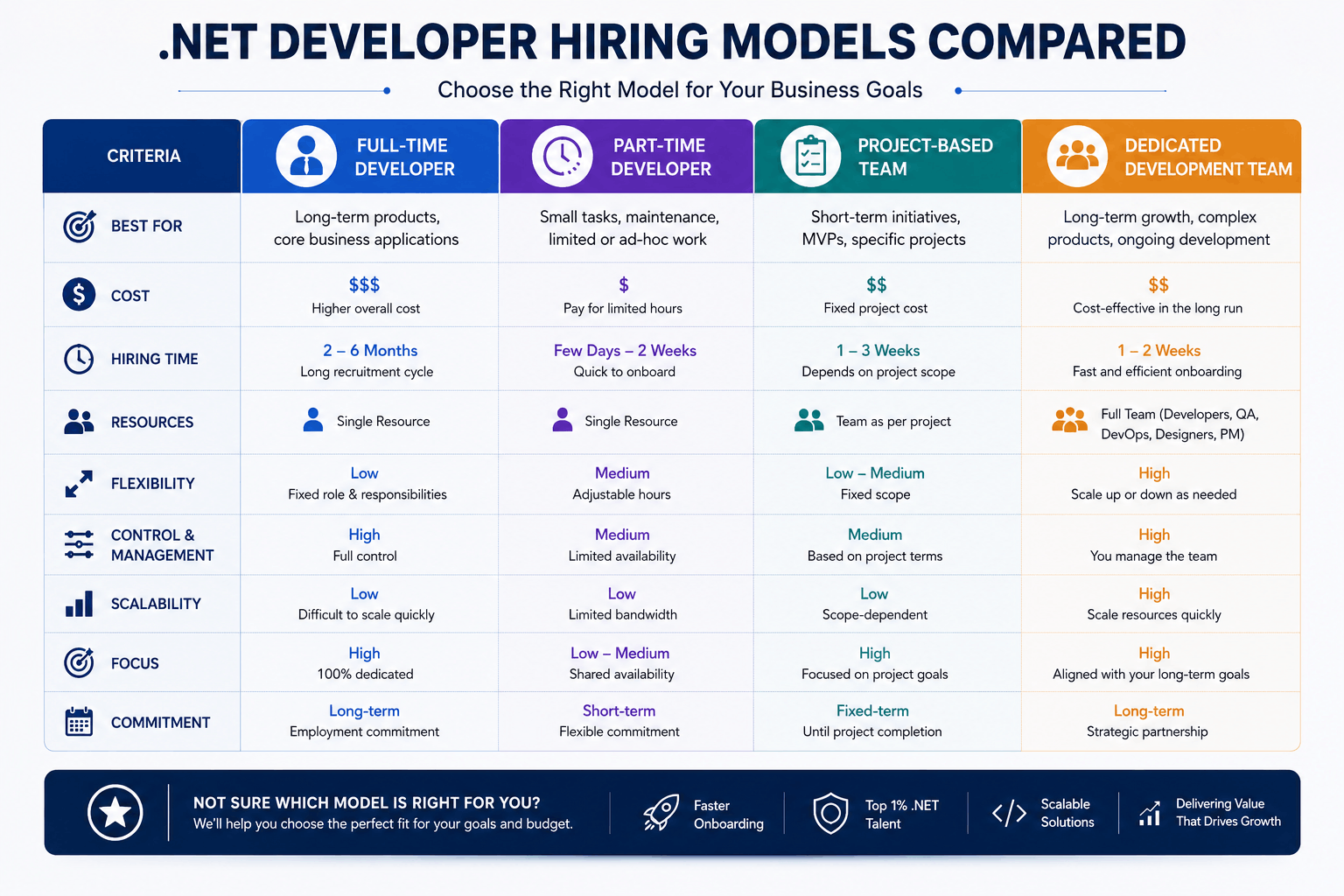
One of the biggest hiring decisions is choosing the right engagement model.
The answer depends on business goals, project complexity, budget, and long-term requirements.
1) Full-Time Internal Developer
Best For:
- Long-term internal products
- Large engineering organizations
- Internal technology departments
Advantages:
- Complete control
- Strong organizational alignment
- Deep product knowledge
Challenges:
- Longer recruitment cycles
- Higher employment costs
- Talent availability constraints
2) Part-Time Developer
Best For:
- Maintenance projects
- Small enhancements
- Limited workloads
Advantages:
- Lower short-term commitment
- Flexible engagement
Challenges:
- Limited availability
- Slower delivery
- Reduced project continuity
3) Project-Based Hiring
Best For:
- Fixed-scope initiatives
- Short-term development needs
- MVP development
Advantages:
- Predictable scope
- Defined timelines
Challenges:
- Limited flexibility after project completion
- Less long-term continuity
4) Dedicated Development Team
Many growing businesses choose a dedicated development team because it combines flexibility, scalability, and specialized expertise.
A dedicated team may include the following:
- .NET Developers
- QA Engineers
- DevOps Specialists
- UI/UX Designers
- Project Managers
- AI Engineers
Advantages:
- Faster onboarding
- Scalable resources
- Consistent delivery
- Reduced hiring overhead
- Access to specialized skills
For businesses seeking long-term product development, this model often provides the strongest balance between control and operational efficiency.
Common Hiring Mistakes Companies Make
Even experienced organizations make mistakes when evaluating technical talent.
Avoiding these pitfalls can significantly improve hiring outcomes.
-
Hiring Based Only on Cost
The lowest rate rarely produces the highest value.
Experienced developers often deliver better architecture, fewer defects, and faster execution.
Modern software increasingly runs in cloud environments.
Hiring developers without Azure knowledge can create future scalability challenges.
-
Focusing Only on Coding Skills
Technical capability is important, but communication, collaboration, and business understanding matter equally.
-
Overlooking Security Knowledge
Security vulnerabilities can become expensive problems later.
Developers should understand secure coding practices and modern authentication mechanisms.
-
Not Evaluating Architecture Skills
A developer may write excellent code but struggle with system design.
For long-term projects, architectural thinking is essential.
Many businesses will add AI capabilities within the next few years.
Hiring developers with AI integration experience can reduce future hiring challenges and accelerate innovation.
How Rushkar Helps US Companies Hire Remote .NET Developers
At Rushkar, we help organizations build scalable software teams without the delays and complexity associated with traditional recruitment.
Our clients typically engage us when they need:
- Dedicated .NET Developers
- ASP.NET Core Developers
- Azure Engineers
- Full-Stack Development Teams
- Enterprise Software Experts
- AI-Enabled Development Resources
Rather than simply providing developers, we focus on helping businesses build sustainable engineering capacity.
1) Flexible Engagement Models
We offer:
- Individual Developers
- Team Extension
- Dedicated Development Teams
- Managed Development Teams
- Long-Term Product Development Support
This flexibility allows businesses to align technical resources with changing project requirements.
2) Enterprise-Grade Technical Expertise
Our teams have experience building:
- SaaS Platforms
- Enterprise Applications
- Customer Portals
- Healthcare Software
- Financial Systems
- Logistics Solutions
- AI-Powered Applications
3) Modern Technology Capabilities
In addition to .NET expertise, our teams support the following:
- Azure Cloud Development
- DevOps Automation
- AI Integration Services
- OpenAI Implementations
- LLM Development
- Microservices Architecture
This enables businesses to access specialized skills without expanding internal hiring efforts.
Final Hiring Checklist
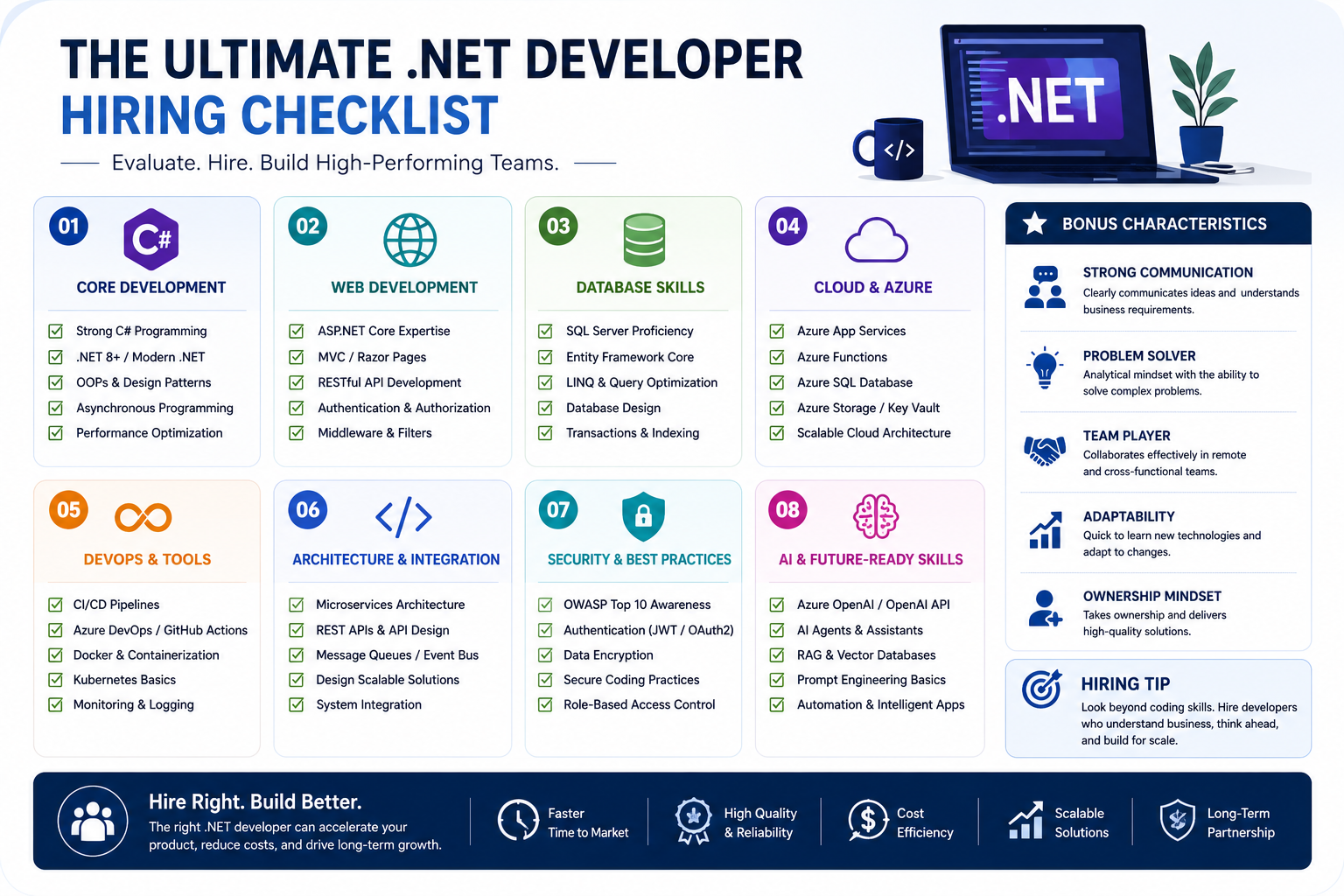
Before you hire remote .NET developers, make sure candidates demonstrate expertise in the following areas:
- C# and Modern .NET
- ASP.NET Core and MVC
- SQL Server and Database Optimization
- Azure Cloud Services
- DevOps and CI/CD
- REST APIs and Microservices
- Security Best Practices
- Problem-Solving Skills
- Communication and Collaboration
- AI Integration Knowledge
- Scalability and Architecture Design
The best hiring decisions focus on long-term business value rather than short-term cost savings.
Conclusion
The demand for experienced remote .NET developers continues to grow as businesses accelerate digital transformation, cloud adoption, and AI initiatives.
Successful hiring requires more than technical screening. Organizations must evaluate architecture expertise, cloud capabilities, database knowledge, security practices, communication skills, and future-ready technologies such as artificial intelligence.
Whether you're looking to hire offshore .NET developers, expand an existing engineering team, or build a dedicated development capability from the ground up, choosing the right talent can significantly impact product quality, delivery speed, and long-term scalability.
At Rushkar, we help US businesses access experienced, dedicated .NET developers, enterprise engineering expertise, and scalable delivery models designed to support long-term growth.
Ready to Build Your .NET Team?
Explore our:
CTA: Request Developer Profiles | Schedule a Free Consultation
Frequently Asked Questions
How much does it cost to hire remote .NET developers?
The cost of hiring remote .NET developers depends on experience, location, technical expertise, and engagement model. Businesses can choose individual developers, project-based resources, or a dedicated development team. The most important factor is evaluating long-term value, technical capability, and delivery quality rather than focusing solely on hourly rates.
What skills should I look for when hiring ASP.NET developers?
Strong ASP.NET developers should have expertise in C#, ASP.NET Core, MVC architecture, SQL Server, Entity Framework, REST APIs, security practices, and cloud technologies such as Microsoft Azure. For modern applications, experience with microservices, DevOps, and AI integrations is becoming increasingly valuable.
Should I hire a dedicated .NET developer or a dedicated development team?
The answer depends on project scope. A single developer may be suitable for smaller initiatives, while a dedicated development team is often a better choice for long-term product development, enterprise applications, SaaS platforms, and digital transformation projects that require multiple technical disciplines.
How do I evaluate a remote .NET developer during interviews?
Focus on practical experience rather than theoretical knowledge. Assess expertise in modern .NET development, cloud architecture, database optimization, API development, security, DevOps practices, and problem-solving ability. Technical assessments and architecture discussions often provide better insights than generic coding questions.
Is offshore .NET development secure?
Yes, when working with a reputable development partner. Security depends on development processes, secure coding standards, access controls, data protection policies, NDAs, and infrastructure governance. Experienced teams typically follow industry best practices for application and data security.
Can remote .NET developers work in US time zones?
Most experienced offshore development teams offer flexible engagement models and overlapping work hours with US businesses. This helps improve collaboration, sprint planning, stakeholder communication, and project visibility.
What industries commonly use .NET for software development?
.NET is widely used across healthcare, finance, insurance, logistics, manufacturing, retail, education, and enterprise software sectors. Its scalability, security, and Microsoft ecosystem integration make it a popular choice for mission-critical business applications.
Why are AI skills becoming important for .NET developers?
Many modern business applications now incorporate artificial intelligence, automation, predictive analytics, and AI-powered workflows. Developers with experience in Azure OpenAI, AI agents, LLM integrations, and intelligent automation can help organizations build future-ready software solutions while reducing implementation complexity.