Software Isn't Changing. The Way We Build Software Is.
Most discussions about generative AI get off to a bad start.
They start with language models, image creation, chatbots, and code assistants. Despite their significance, those technologies are merely a part of a bigger shift. The real change occurs long before a designer creates the first screen or an engineer writes code. Product teams are beginning to reevaluate how digital products should be planned, validated, developed, tested, and improved in an environment where software can generate content, reason over information, and adapt to user context.
For this reason, generative AI in digital product development is no longer merely a passing trend. It affects all phases of the product development process. Product managers, designers, data specialists, security experts, and business leaders now participate in decisions that were previously solely the responsibility of engineering teams. Instead of asking, "Can we add AI to this product?" successful organizations ask, "Should AI even be part of this experience?"
The difference may sound subtle, but it often determines whether an AI initiative creates long-term business value or becomes another feature customers ignore. A language model can generate impressive responses, but it cannot fix an unclear workflow, poor product strategy, or disconnected business data. The products that succeed are rarely the ones with the most AI. They are the ones where AI removes friction, shortens decision-making, and helps users accomplish meaningful work with less effort.
This shift is changing product engineering from the ground up, and understanding that change is becoming just as important as choosing the right technology stack.
The Product Development Lifecycle Was Built for Predictable Software
For decades, digital product development followed a predictable sequence. Teams researched the market, documented requirements, designed interfaces, developed features, tested predefined functionality, and released software in planned iterations. Every stage assumed one thing: the application would behave exactly as developers instructed it to behave.
Generative AI challenges that assumption.
Modern applications are no longer limited to predefined outputs. They can summarize thousands of documents, generate personalized responses, search enterprise knowledge bases, recommend actions, create content, and interact with users in ways that depend on context rather than fixed rules. This introduces a different engineering mindset. Product teams are no longer designing only user interfaces or business logic. They are designing systems that combine deterministic software with probabilistic AI models.
That distinction changes how products should be built.
Instead of focusing only on feature delivery, teams must think about data quality, retrieval strategies, AI governance, evaluation frameworks, model behavior, and continuous learning. These considerations now influence AI product development, AI software development, and custom AI development just as much as traditional software architecture.
|
Traditional Product Development
|
AI-Driven Product Development
|
|
Features follow predefined rules
|
Responses adapt to context
|
|
User journeys are fixed
|
Experiences evolve with user interactions
|
|
Testing validates expected outputs
|
Testing evaluates quality, relevance, and consistency
|
|
Releases introduce new functionality
|
AI capabilities continue improving after deployment
|
The lifecycle itself has not disappeared. It has become more dynamic.
Why Adding AI Features Is No Longer Enough
Many companies still approach AI the same way they approached mobile apps or cloud adoption. They identify an existing product, add an AI capability, launch the update, and expect customer engagement to increase.
The market suggests otherwise.
Users rarely adopt AI simply because it exists. They adopt products that solve problems faster, simplify complex tasks, or reduce repetitive work. A chatbot that answers the same questions already covered in documentation creates little value. An AI assistant that retrieves information from multiple enterprise systems, summarizes it, and recommends the next action addresses a genuine business need.
This is where product strategy becomes more important than model selection.
Before selecting an LLM, choosing an AI framework, or evaluating infrastructure, product teams should answer questions such as:
- Which workflow consumes the most employee or customer time?
- Which decisions depend on scattered information?
- Which repetitive activities reduce productivity?
- Where can AI improve accuracy without reducing trust?
- Which experiences genuinely benefit from contextual intelligence?
These questions produce better products because they begin with business outcomes rather than technology choices.
Organizations investing in AI consulting services, AI integration, and enterprise AI initiatives are increasingly following this approach. Rather than treating AI as an isolated capability, they evaluate where intelligence fits naturally into existing workflows and where conventional software continues to deliver the better experience.
That shift explains why successful AI products feel less like demonstrations of technology and more like software that simply works better.
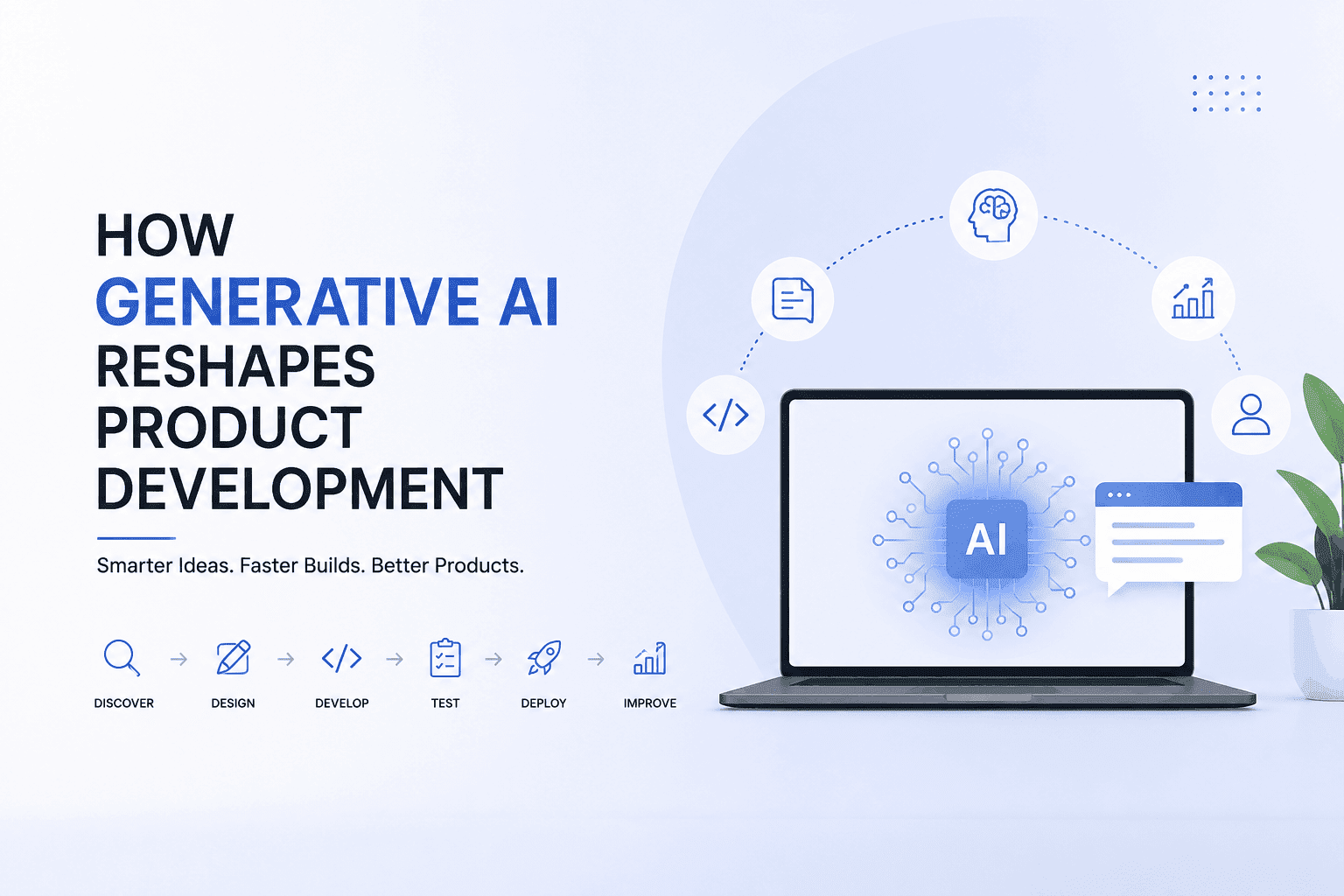
How Generative AI Changes Every Stage of the Product Development Lifecycle
Generative AI delivers the greatest value when it becomes part of the development process instead of being treated as the final feature added before release. Each phase of the product lifecycle now presents new opportunities to improve speed, decision-making, and product quality. At the same time, each phase introduces new responsibilities that traditional software projects rarely had to address.
The following framework shows where the biggest changes are happening.
|
Product Stage
|
Traditional Approach
|
How Generative AI Changes It
|
|
Product Discovery
|
Customer interviews, surveys, competitor research
|
Identifies patterns from large datasets, summarizes feedback, uncovers unmet user needs
|
|
Product Design
|
Static wireframes and prototypes
|
Generates design ideas, user flows, microcopy, and rapid prototype variations
|
|
Development
|
Manual coding and documentation
|
Assists with code generation, documentation, reviews, and developer productivity
|
|
Testing
|
Rule-based QA and regression testing
|
Generates test cases, detects edge cases, analyzes defects, and improves test coverage
|
|
Deployment
|
Scheduled releases and monitoring
|
Predicts risks, summarizes logs, supports incident investigation, and improves release confidence
|
|
Product Improvement
|
Analytics dashboards and user feedback
|
Explains behavioral trends, recommends improvements, and personalizes future experiences
|
The value is not that AI replaces these activities. The value comes from helping teams spend more time solving product problems and less time completing repetitive work.
Product Discovery Is Becoming More Data-Driven
Every successful product starts with understanding the customer.
Traditionally, product discovery depended on interviews, market research, analytics dashboards, and stakeholder assumptions. These methods still matter, but they often struggle to keep pace with the amount of customer data businesses collect every day.
Support tickets, product reviews, CRM notes, chatbot conversations, feature requests, and social media discussions all contain valuable insights. The challenge is extracting meaningful patterns from thousands of conversations.
Generative AI changes that process.
Instead of manually reviewing feedback, product teams can group recurring issues, identify emerging trends, summarize customer sentiment, and prioritize opportunities much faster. Combined with Natural Language Processing (NLP) and Machine Learning, these insights help teams validate ideas before investing months in development.
The result is a roadmap driven by evidence rather than assumptions.
Better Design Starts With Better Context
Design has always balanced user expectations with business objectives.
Generative AI adds another layer by helping designers explore multiple solutions before development begins. It can draft UX copy, generate interface variations, organize information architecture, and suggest improvements based on accessibility or usability guidelines.
The biggest advantage is not speed alone.
It allows design teams to test more ideas without increasing project timelines.
That means discussions shift from "Which design can we finish?" to "Which design solves the user's problem best?"
Human designers still make the final decisions. AI simply expands the range of possibilities available during exploration.
AI Is Changing How Software Is Built, Not Who Builds It
One of the biggest misconceptions is that Generative AI replaces software developers.
In reality, experienced engineers now spend less time writing repetitive code and more time solving architectural problems.
Modern AI software development often includes:
- Generating boilerplate code and API integrations.
- Explaining legacy codebases.
- Creating technical documentation.
- Suggesting refactoring opportunities.
- Producing unit tests and integration tests.
- Accelerating code reviews.
The engineering challenge has shifted from writing every line manually to validating quality, security, maintainability, and business logic.
For organizations investing in custom AI development, this distinction is important. Productivity gains come from supporting engineering teams, not replacing them.
At Rushkar Technology, this is where AI delivers practical value. Development teams use AI to remove repetitive engineering tasks while architects continue making decisions around scalability, integration, security, and long-term maintainability. That balance keeps projects moving faster without compromising software quality.
Testing AI Products Requires a Different Mindset
Testing traditional applications is relatively predictable. Inputs produce expected outputs, making failures easier to identify.
AI-powered products behave differently.
The same prompt may generate different responses depending on context, retrieved knowledge, or model updates. Testing must therefore evaluate more than functionality.
Teams should measure the following:
- Response quality.
- Accuracy and factual consistency.
- Hallucination risk.
- Latency.
- Security and privacy.
- User satisfaction.
- Cost per interaction.
This is one reason many organizations are adopting MLOps, continuous model evaluation, and AI observability as part of their development practices. AI products require continuous monitoring long after deployment, making evaluation an ongoing engineering responsibility rather than a final QA milestone.
Building AI Products That Continue Delivering Value
Adding Generative AI to an application has become easier. Building an AI-enabled product that remains accurate, scalable, secure, and commercially valuable is still a significant engineering challenge.
One decision often determines the success of an AI initiative long before development begins: Should you build a custom AI capability, integrate an existing AI service, or combine both?
There is no universal answer.
A customer support platform that summarizes tickets may only require API integration with an existing Large Language Model. An insurance platform handling confidential customer records may require Retrieval-Augmented Generation (RAG), enterprise search, private deployment, and strict AI governance. A healthcare application supporting clinical workflows introduces another level of complexity involving compliance, auditability, and data privacy.
The right architecture depends on business goals, data maturity, regulatory requirements, and long-term product strategy rather than the popularity of a particular AI model.
A Practical Decision Framework
|
Business Goal
|
Recommended Approach
|
|
Add AI features quickly
|
Integrate an existing LLM through APIs
|
|
Build domain-specific experiences
|
Custom AI development with RAG
|
|
Use internal company knowledge
|
Vector database + enterprise search
|
|
Automate multi-step workflows
|
AI Agents with workflow automation
|
|
Handle regulated business data
|
Private AI deployment with governance controls
|
This framework helps product teams avoid a common mistake: selecting technology before defining the business problem.
Common Mistakes That Slow AI Product Success
Many AI initiatives fail for reasons unrelated to model quality. The most successful organizations spend more time validating product decisions than experimenting with prompts.
Watch for these common mistakes:
- Treating AI as a feature instead of part of the overall product experience.
- Choosing an LLM before understanding user workflows.
- Building custom models when existing services already solve the problem.
- Ignoring data quality and expecting AI to compensate for incomplete or inconsistent information.
- Measuring AI adoption instead of business outcomes such as productivity, retention, or customer satisfaction.
- Skipping governance, monitoring, and continuous evaluation after deployment.
Avoiding these mistakes usually saves far more time and budget than switching to a different model later in the project.
The Future of Digital Product Development
The next generation of software will be judged differently.
Customers will not ask which language model powers an application. They will ask whether the product helps them finish work faster, make better decisions, or reduce unnecessary effort.
That expectation is already changing product roadmaps.
Instead of planning isolated AI features, product teams are designing applications where intelligence becomes part of the entire user journey. Search becomes conversational. Documentation becomes interactive. Dashboards explain trends instead of displaying charts. Workflow automation becomes adaptive instead of rule-based.
Products are gradually moving from software that executes instructions to software that collaborates with people.
That shift creates new opportunities for businesses willing to rethink product strategy instead of simply adding AI capabilities.
Turning AI Ideas Into Production-Ready Products
Technology alone rarely creates competitive advantage.
Successful AI products combine thoughtful product strategy, reliable engineering, secure infrastructure, high-quality data, and continuous improvement. Missing any one of these elements often limits the value AI can deliver.
This is why many organizations work with an experienced AI development company before moving beyond prototypes. The challenge is no longer integrating a model into an application. It is designing an architecture that supports growth, governance, evolving business requirements, and long-term maintainability.
At Rushkar Technology, AI engagements begin with understanding the product, users, and business objectives before recommending technologies. Whether the requirement involves AI consulting services, AI software development, AI integration, or custom AI development, the goal remains the same: build products where AI creates measurable business value rather than becoming another feature that users eventually ignore.
Final Thoughts
Generative AI is changing far more than application features. It is changing how digital products are researched, designed, engineered, tested, and continuously improved.
The organizations creating lasting value are not the ones adding AI wherever they can. They are the ones identifying where intelligence genuinely improves the customer experience, simplifies complex work, and supports measurable business outcomes.
That perspective will shape the next generation of digital products. The sooner product teams begin designing around it, the stronger their competitive position will be.
Frequently Asked Questions
Is Generative AI replacing traditional software development?
No. It changes how software is designed and built by assisting with research, design, coding, testing, and ongoing product improvement. Human expertise remains central to architecture, security, and product decisions.
Does every digital product need Generative AI?
No. AI should address a clear business or user problem. If a traditional workflow already delivers speed, accuracy, and simplicity, adding AI may increase cost without improving the product experience.
What industries benefit the most from Generative AI?
Healthcare, financial services, eCommerce, logistics, education, manufacturing, and SaaS products are among the sectors seeing significant value, particularly where knowledge management, customer interactions, document processing, or workflow automation play a major role.
Should businesses build custom AI solutions or use existing models?
It depends on the use case. Standard productivity features often work well with existing models, while domain-specific products, enterprise knowledge systems, or regulated industries usually benefit from custom AI solutions combined with enterprise data and governance.