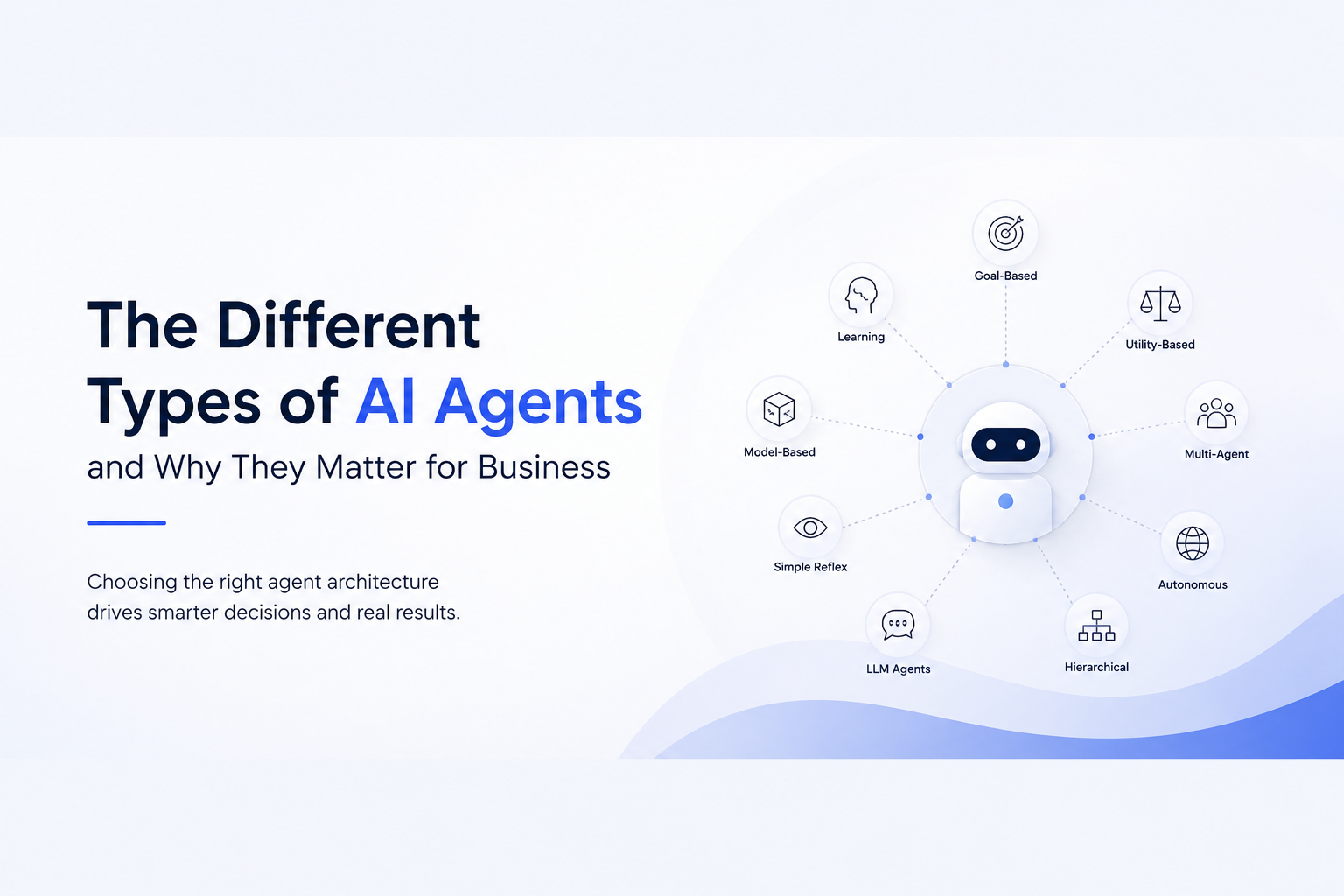
Buying a more capable language model won't rescue a poorly designed workflow. It's like hiring a Formula 1 driver to compete on a road that hasn't been built yet. The driver's talent never gets a chance to matter.
That may sound counterintuitive in a market obsessed with foundation models, benchmark scores, and the latest AI releases. Yet, once AI moves from experimentation to production, the conversation changes. Success depends less on which model you choose and more on how that model fits into your business processes, software ecosystem, and decision-making architecture.
This shift explains why the term "AI agent" has become central to enterprise AI discussions. Unlike traditional automation that follows predefined rules or AI assistants that respond to prompts, AI agents are designed to pursue objectives. They can retrieve information, reason across multiple data sources, interact with enterprise applications, and execute tasks with varying degrees of autonomy.
The temptation, however, is to assume that every business problem deserves an AI agent. It doesn't.
Some workflows benefit from intelligent planning. Others need nothing more than deterministic automation. Choosing the wrong architecture often creates more work than it removes, increasing infrastructure costs, governance overhead, and operational complexity without delivering meaningful business value.
At Rushkar Technology, we've found that successful AI initiatives usually begin with a simple question that has nothing to do with language models:
What kind of decisions does this workflow actually require?
The answer shapes everything that follows, from the type of AI agent to deploy and the supporting infrastructure to the level of human oversight needed in production.
This article takes a business and engineering perspective on AI agents. Rather than revisiting textbook definitions, we'll explore the different types of AI agents through the lens of enterprise decision-making, helping technology leaders understand where each architecture fits, where it doesn't, and how to choose an approach that creates measurable business value instead of unnecessary complexity.
Why Some AI Projects Lose The Race Before They Begin
One of the biggest misconceptions in enterprise AI is that better models automatically produce better outcomes.
In practice, production systems tell a different story.
Many organizations spend weeks evaluating LLMs and only a few days mapping the workflow those models are expected to support. It's an understandable mistake. Models are visible. Workflows aren't. One has benchmark scores and leaderboards; the other lives in process diagrams, legacy applications, undocumented business rules, and years of operational habits.
That's also where most AI projects succeed or fail.
Consider a customer onboarding process. An AI model might generate excellent responses, but the workflow still depends on CRM records, identity verification, compliance checks, document management, ERP updates, and approval chains. If those systems aren't connected, the model becomes an intelligent participant inside a fragmented process rather than the solution itself.
Here's the reality many enterprises discover after deployment:
- AI rarely replaces existing software. It coordinates it.
- Integration challenges are usually harder than prompting challenges.
- Governance becomes more valuable as autonomy increases.
- Simpler architectures often outperform more sophisticated ones when business rules are predictable.
This is why architecture deserves as much attention as model selection.
Before deciding which AI agent to build? Technology leaders should answer a handful of practical questions:
|
Business Question
|
Why It Matters
|
|
Does the workflow require reasoning or predictable execution?
|
Determines whether AI is necessary or automation is sufficient.
|
|
Will the agent interact with multiple business systems?
|
Influences integration architecture and tool orchestration.
|
|
Can decisions be made independently, or should humans remain in the approval loop?
|
Defines governance and operational risk.
|
|
Does the workflow change frequently?
|
Helps determine whether adaptive or rule-based agents are more appropriate.
|
Organizations that answer these questions early rarely build AI because it's fashionable. They build it because the architecture supports a genuine business need.
And that's usually the difference between an impressive demonstration and a dependable production system.
AI Agent vs. AI Assistant vs. Automation
One reason AI conversations become confusing is that automation, AI assistants, and AI agents are often treated as the same technology. They aren't. Each addresses a different level of business complexity.
|
Capability
|
Automation
|
AI Assistant
|
AI Agent
|
|
Primary purpose
|
Execute predefined workflows
|
Help users complete individual tasks
|
Complete business objectives across workflows
|
|
Decision-making
|
Rule-based
|
Prompt-driven reasoning
|
Goal-oriented planning and execution
|
|
Enterprise system access
|
Fixed integrations
|
Limited, usually user-initiated
|
Dynamic interaction with multiple business applications
|
|
Human involvement
|
Required for exceptions
|
The user leads every interaction
|
Can operate independently within defined boundaries
|
|
Best suited for
|
Repetitive operational tasks
|
Knowledge retrieval, content generation, employee productivity
|
Cross-functional business processes, orchestration, and intelligent decision-making
|
The distinction becomes easier when viewed through responsibility rather than technology.
Automation follows instructions.
AI assistants help people work faster.
AI agents help businesses get work done.
That doesn't mean AI agents replace the other two. In most enterprise environments, they complement them.
A procurement workflow, for example, might use automation to route approvals, an AI assistant to summarize supplier contracts, and an AI agent to coordinate vendor onboarding across procurement, finance, legal, and ERP systems.
The strongest enterprise AI strategies aren't built around a single capability. They're built around choosing the right capability for each part of the workflow.
The Different Types of AI Agents in Business
Enterprise AI discussions often categorize agents into neat technical definitions. That approach is useful in a classroom, but it doesn't help a CTO decide how to modernize customer service, automate procurement, or improve supply chain operations.
A better question is, "What business problem are you trying to solve?"
The right AI agent isn't the most advanced one. It's the one that introduces just enough intelligence to complete the job without adding unnecessary cost, latency, or governance overhead.
1. Simple Reflex Agents
Simple Reflex Agents are built for predictable environments where every condition has a predefined response. They don't remember previous interactions or evaluate multiple possibilities. If a known event occurs, they execute the corresponding action.
For many organizations, that's exactly what's needed.
A logistics company automatically notifying customers about shipment delays or a bank flagging transactions that exceed predefined thresholds doesn't require reasoning. It requires consistency.
|
Best For
|
Enterprise Examples
|
Watch Out For
|
|
Rule-based workflows
|
Payment alerts, ticket routing, inventory notifications
|
Dynamic situations requiring context or judgment
|
Business Takeaway:
Don't underestimate this architecture. Many companies attempt to replace mature automation with AI agents, only to increase operational costs while solving the same problem.
2. Model-Based Agents
Business decisions rarely happen in isolation. Customer conversations continue across channels, supply chains evolve throughout the day, and IT incidents change as new information becomes available.
Model-Based Agents maintain an internal understanding of the environment, allowing them to make decisions based on both the current situation and previous events.
A customer support platform, for example, can recommend different resolutions depending on past interactions, product history, and unresolved issues instead of treating every request as a new conversation.
|
Best For
|
Enterprise Examples
|
Watch Out For
|
|
Context-aware workflows
|
Customer support, insurance claims, healthcare case management
|
Requires reliable state management and synchronized data
|
Business Takeaway:
When continuity matters, context becomes more valuable than speed. A fast answer without historical awareness often creates more follow-up work than it eliminates.
3. Goal-Based Agents
Unlike reactive systems, Goal-Based Agents work backward from an objective. They evaluate different paths before deciding which action moves them closer to the desired outcome.
This makes them particularly effective for workflows involving multiple stages, dependencies, or approvals.
Think about employee onboarding. Completing the process involves document verification, account provisioning, security permissions, training schedules, and compliance checks. The objective isn't a single task. It's successfully onboarding the employee.
|
Best For
|
Enterprise Examples
|
Watch Out For
|
|
Multi-step workflows
|
Customer onboarding, loan processing, procurement, project delivery
|
Planning complexity increases as workflows grow
|
Business Takeaway:
Organizations often focus on making AI answer better questions. Goal-Based Agents remind us that choosing the next action is often more valuable than generating the next response.
4. Utility-Based Agents
Not every business decision has one correct answer.
A retailer may want to maximize revenue while maintaining customer satisfaction. A logistics company might balance delivery speed against transportation costs. A manufacturer could prioritize production efficiency without exceeding energy budgets.
Utility-Based Agents evaluate competing priorities and select the option that delivers the greatest overall business value based on predefined objectives.
|
Best For
|
Enterprise Examples
|
Watch Out For
|
|
Optimization problems
|
Dynamic pricing, route optimization, workforce scheduling
|
Business priorities must be clearly defined
|
Business Takeaway:
The challenge isn't teaching the AI how to decide. It's helping the business agree on what "best" actually means.
5. Learning Agents
Some industries change too quickly for static rules to remain effective.
Fraud patterns evolve. Customer behavior shifts. Equipment performance changes. Demand fluctuates.
Learning Agents improve their decisions by incorporating feedback over time, making them well-suited for environments where historical outcomes help predict future performance.
This architecture underpins many recommendation systems, predictive maintenance platforms, and adaptive fraud detection solutions used across modern enterprises.
|
Best For
|
Enterprise Examples
|
Watch Out For
|
|
Continuously changing environments
|
Fraud detection, predictive maintenance, recommendation engines
|
Requires ongoing evaluation, quality data, and governance
|
Business Takeaway:
Learning shouldn't be confused with autonomy. A system that adapts over time still needs performance monitoring, auditability, and clearly defined success metrics.
A Quick Reality Check
Looking at these five architectures, it's tempting to assume that organizations should always move toward more intelligent agents.
That's rarely the case.
A well-designed enterprise AI strategy isn't measured by how autonomous the system becomes. It's measured by how effectively intelligence is applied where it genuinely creates value.
In many successful implementations, multiple architectures coexist. Rule-based automation handles predictable tasks, Model-Based Agents manage context-rich interactions, and Goal-Based or Learning Agents are introduced only where business decisions require flexibility.
The smartest AI platform isn't the one using the most sophisticated agent. It's the one that knows when not to.
6. Hierarchical Agents
As AI initiatives expand across departments, a single agent often becomes responsible for too many decisions. It retrieves data, validates information, coordinates approvals, and communicates outcomes. While this approach works for smaller workflows, it becomes difficult to scale and even harder to govern.
Hierarchical Agents solve this by distributing responsibilities. A parent agent coordinates the workflow, while specialized child agents handle individual tasks such as document verification, compliance checks, or ERP updates. The structure closely mirrors how enterprise teams operate, with managers coordinating specialists instead of doing every task themselves.
|
Best For
|
Enterprise Examples
|
Watch Out For
|
|
Large, multi-stage workflows
|
Procurement, insurance claims, software release management
|
Poor task orchestration can create bottlenecks between agents
|
Business Takeaway:
As workflows grow, clarity of responsibility often matters more than increasing intelligence. Dividing work between specialized agents usually produces systems that are easier to maintain, monitor, and audit.
7. Multi-Agent Systems
Some business problems are too broad for a single agent, regardless of how capable it is.
Consider supply chain management. Forecasting demand, optimizing inventory, planning transportation, and communicating with customers require different expertise. Expecting one AI agent to excel at every task creates unnecessary complexity.
Multi-Agent Systems address this by allowing several specialized agents to collaborate toward a shared business objective. One agent forecasts demand, another manages warehouse inventory, and another coordinates delivery schedules. Together, they create a more flexible and resilient system.
|
Best For
|
Enterprise Examples
|
Watch Out For
|
|
Cross-functional operations
|
Supply chain, cybersecurity, smart manufacturing, enterprise operations
|
More agents increase coordination, monitoring, and testing complexity
|
Business Takeaway:
Adding more agents doesn't automatically make a system smarter. Every new participant introduces communication overhead, making orchestration just as important as individual intelligence.
8. LLM Agents
LLM Agents have become the face of modern Enterprise AI, but they're often misunderstood.
Many organizations assume an LLM Agent is simply a chatbot connected to company data. In production, the architecture is far more sophisticated.
A typical LLM Agent combines reasoning, Retrieval-Augmented Generation (RAG), memory, tool calling, enterprise APIs, and business rules to complete tasks rather than simply answer questions. Instead of responding with information alone, it can retrieve customer records, create support tickets, update CRM systems, summarize contracts, or initiate approval workflows.
|
Best For
|
Enterprise Examples
|
Watch Out For
|
|
Knowledge-intensive workflows
|
Enterprise search, IT support, customer service, contract analysis
|
Requires governance, observability, secure integrations, and continuous evaluation
|
Business Takeaway:
The LLM is only one component of the architecture. Production success depends just as much on integrations, security, retrieval quality, and workflow design as it does on model capability.
9. Autonomous Agents
Autonomous Agents represent the highest level of operational independence currently adopted in enterprise environments.
Unlike other architectures, they don't wait for every instruction. They interpret objectives, plan execution, monitor outcomes, adapt to changing conditions, and continue working until predefined goals are achieved or governance boundaries are reached.
While this sounds appealing, fully autonomous systems remain uncommon in production. The reason isn't technology. It's accountability.
The more authority an AI system receives, the greater the need for auditability, risk controls, approval workflows, and operational oversight.
|
Best For
|
Enterprise Examples
|
Watch Out For
|
|
Mature AI operations
|
Infrastructure optimization, cloud operations, cybersecurity response
|
High governance, compliance, and operational risk
|
Business Takeaway:
Autonomy isn't a feature to maximize. It's a responsibility to manage. Many successful organizations introduce autonomy gradually, allowing AI to recommend actions before granting execution authority.
Which AI Agent Should Your Business Choose?
Choosing an AI agent or AI Agent Development Company shouldn't start with the latest model release or the most advanced architecture. It should start with the workflow itself.
The table below offers a practical decision framework for matching business challenges with the most appropriate agent architecture.
|
Business Challenge
|
Recommended Agent
|
Why It Fits
|
|
Repetitive, rule-driven processes
|
Simple Reflex Agent
|
Fast, predictable, and easy to govern
|
|
Context-dependent decisions
|
Model-Based Agent
|
Maintains workflow continuity across interactions
|
|
Multi-step objectives
|
Goal-Based Agent
|
Plans actions around business outcomes
|
|
Balancing competing priorities
|
Utility-Based Agent
|
Optimizes decisions using business objectives
|
|
Continuously changing environments
|
Learning Agent
|
Improves through operational feedback
|
|
Enterprise workflows with multiple approval stages
|
Hierarchical Agent
|
Separates coordination from execution
|
|
Cross-functional operations
|
Multi-Agent System
|
Enables specialized collaboration
|
|
Language-intensive business processes
|
LLM Agent
|
Combines reasoning, retrieval, and tool usage
|
|
Mature operational environments
|
Autonomous Agent
|
Supports continuous execution with controlled independence
|
A Practical Decision Framework
Before investing in AI development, ask these five questions:
- Is the workflow deterministic, or does it require reasoning?
- Will the agent interact with multiple enterprise systems?
- Does it need historical context to make accurate decisions?
- Can the organization define clear governance boundaries?
- What happens if the AI makes the wrong decision?
These questions often reveal that the simplest architecture is also the most effective.
One pattern we've consistently observed during enterprise AI consulting engagements at Rushkar Technology is that organizations spend considerable time evaluating language models but far less time evaluating workflow architecture. In production, the opposite approach usually produces more reliable results.
AI agents don't replace ERP systems, CRMs, or existing business applications. They connect them, coordinate them, and reduce the manual effort required to move work across the organization.
That's why the smartest AI strategy isn't about building the most autonomous system. It's about building the most appropriate one.
Common Mistakes Companies Make When Implementing AI Agents
Enterprise AI projects rarely fail because the model wasn't capable enough. More often, they fail because expectations and architecture never aligned.
The following mistakes appear repeatedly across AI implementation projects, regardless of industry.
- Starting with the model instead of the workflow. A sophisticated LLM cannot compensate for disconnected systems, unclear business rules, or fragmented processes.
- Using AI where automation is enough. Not every workflow benefits from reasoning. Rule-based processes are often faster, cheaper, and easier to govern with traditional automation.
- Giving agents too much autonomy too early. Many organizations skip the intermediate stages of recommendations, approvals, and supervised execution. Gradual autonomy builds trust and reduces operational risk.
- Ignoring enterprise integrations. AI agents create value by interacting with CRMs, ERPs, knowledge bases, APIs, and internal applications. Without reliable integrations, even the best reasoning capabilities remain isolated.
- Treating deployment as the finish line. Production AI requires continuous evaluation, monitoring, and refinement. Measuring task completion, decision quality, latency, and business outcomes is just as important as measuring model accuracy.
Perhaps the biggest misconception is believing that AI agents replace enterprise software. In reality, they extend its capabilities by helping existing systems work together more intelligently.
How Rushkar Approaches Enterprise AI Agent Engineering
Every organization arrives with a different workflow, technology stack, and operational challenge, so there is rarely a one-size-fits-all architecture.
At Rushkar Technology, AI consulting engagements typically begin by understanding how work moves across the business before selecting models or frameworks. That means mapping decision points, identifying where deterministic automation is sufficient, defining where reasoning adds value, and designing secure integrations with existing enterprise systems.
From there, the focus shifts to building AI solutions that are observable, governed, and scalable. Whether the project involves AI agents, Retrieval-Augmented Generation (RAG), enterprise AI integration, or custom AI development, the objective remains consistent: create systems that solve measurable business problems while fitting naturally into existing operations rather than disrupting them.
Conclusion
The conversation around AI agents is no longer about whether businesses should adopt them. It's about choosing the right architecture for the right problem.
Some workflows benefit from deterministic automation. Others require contextual reasoning, collaboration across enterprise systems, or adaptive decision-making. Understanding those differences is far more valuable than chasing the newest model or the highest benchmark score.
Organizations that approach AI through the lens of workflow design, governance, and business objectives tend to build systems that scale beyond proof-of-concept. The model may evolve over time, but a well-designed architecture continues to deliver value.
As Enterprise AI becomes part of everyday operations, the companies that succeed won't necessarily be the ones with the most advanced AI agents. They'll be the ones that know exactly where intelligence belongs, where simplicity works better, and how to balance both within a practical, production-ready architecture.
Frequently Asked Questions
1. What is the difference between an AI agent and an AI assistant?
An AI assistant primarily helps users by answering questions, generating content, or retrieving information after receiving prompts. An AI agent goes further by planning tasks, interacting with business systems, making contextual decisions, and executing workflows to achieve a defined objective.
2. Which type of AI agent is best for enterprise applications?
There isn't a universal answer. The right choice depends on workflow complexity, business risk, and operational requirements. Rule-driven processes may only require automation or Simple Reflex Agents, while enterprise-wide workflows often benefit from Goal-Based, LLM, or Multi-Agent architectures.
3. Do all AI agents use Large Language Models?
No. Many AI agents operate using predefined rules, machine learning models, optimization algorithms, or decision frameworks without relying on LLMs. Large Language Models become valuable when reasoning, natural language understanding, or knowledge retrieval is central to the workflow.
4. Can AI agents work with existing enterprise software?
Yes. In fact, that's where they create much of their value. Modern AI agents are designed to integrate with CRMs, ERPs, cloud platforms, APIs, document repositories, and internal business applications, allowing organizations to improve existing workflows instead of replacing established systems.
5. How should businesses begin implementing AI agents?
Start with a clearly defined business process rather than a technology choice. Identify repetitive tasks, decision points, available data, governance requirements, and system integrations. A focused pilot with measurable outcomes usually delivers more insight than attempting enterprise-wide automation from day one.