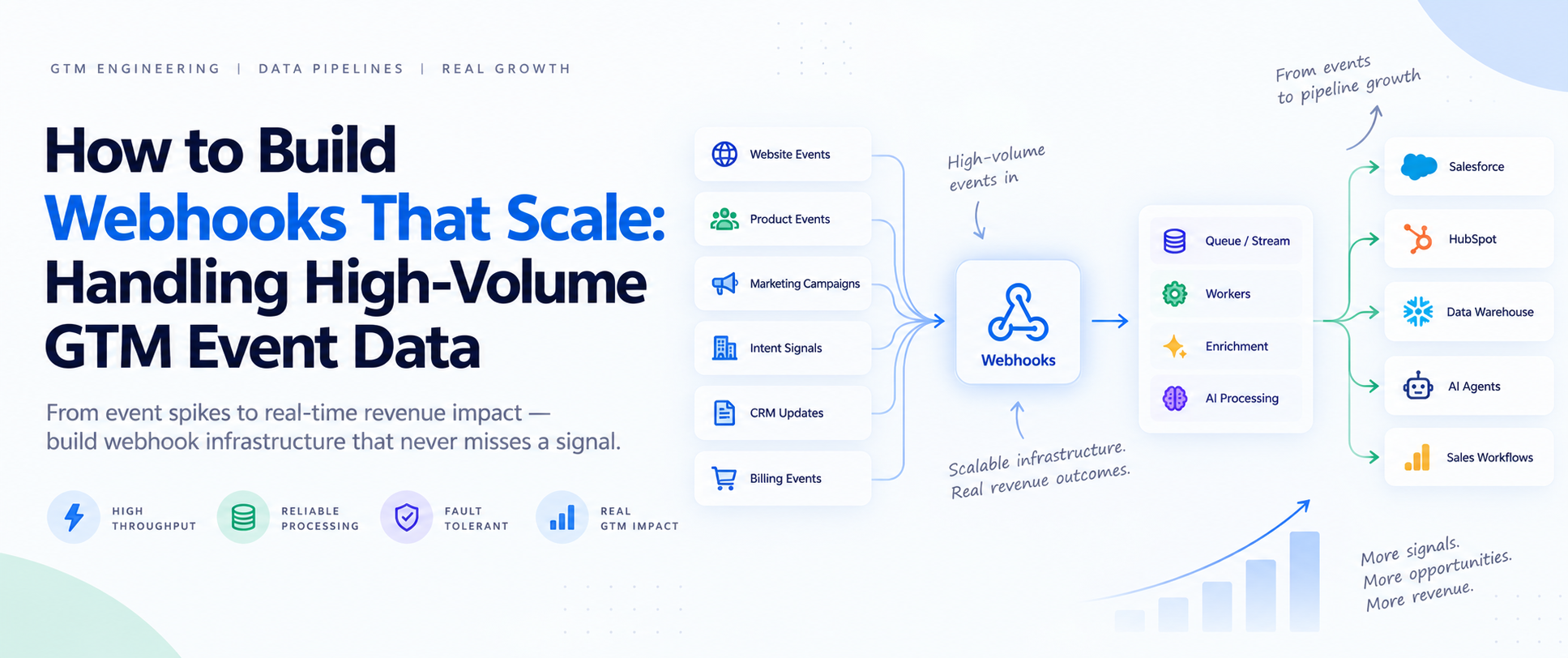
A webhook can look almost trivial in a development environment. One application sends an HTTP request, another receives it, the payload is validated, some business logic runs, and the sender gets a successful response. That model works until the same endpoint becomes the entry point for thousands of CRM changes, product events, website signals, enrichment requests, intent activities, billing events, and automation triggers arriving within a narrow window.
At that point, the question is no longer whether the webhook works. The question is how to scale webhooks without allowing event spikes to overwhelm the systems processing those events.
This distinction matters in modern GTM architecture because webhook traffic is often connected directly to revenue workflows. A product event can update an account, a website visit can trigger B2B intent signal activation, and a new contact can enter an automated data enrichment waterfall before the resulting information reaches Salesforce, HubSpot or another CRM.
Rushkar Technology approaches this as an engineering problem rather than simply an integration task. A production-grade webhook architecture needs durable event ingestion, asynchronous processing, controlled concurrency, idempotency, retry handling, observability and a clear strategy for downstream rate limits. Without those pieces, increasing traffic can expose weaknesses that were invisible when the system handled only a few hundred events.
Why Standard Webhooks Break Under High GTM Volume
The first scaling problem usually comes from putting too much processing inside the incoming HTTP request. A webhook handler may validate the payload, transform data, query a database, call an enrichment provider, update the CRM and trigger another workflow before returning a response, creating a chain in which one slow dependency can delay the entire request.
The sender does not know that the CRM is slow or that the enrichment service has reached its API quota. It only knows that the receiving endpoint did not respond within the expected timeframe. Depending on the provider, that can lead to another delivery attempt, which adds more work while the original request may still be running.
Inngest's research into webhook systems operating at millions of daily requests describes the same underlying problem: traffic is often uneven, with temporary spikes reaching many times normal volume. Its recommended architecture separates webhook handling from downstream processing, uses queues for backpressure, applies idempotent processing, and provides retry and dead-letter mechanisms for failures.
The practical lesson is straightforward: the webhook endpoint should receive the event, not perform the entire business workflow.
Why GTM Event Traffic Is Particularly Difficult to Predict
GTM workloads are driven by behaviour, campaigns and system activity, so average traffic can be misleading. A product launch, advertising campaign, CRM migration, reverse-ETL process or large enrichment job can create an event burst several times larger than normal operating traffic.
Consider a GTM platform receiving 500 events per second during normal operation. A campaign suddenly generates 5,000 events per second. If every event immediately creates multiple CRM requests, enrichment calls and database writes, the problem is not limited to the webhook service. The database connection pool, CRM API, enrichment provider and worker processes can all become bottlenecks.
That is why a high volume webhook architecture should be designed around peak conditions rather than average throughput. Engineers need to understand peak events per second, payload size, processing time, downstream API limits, database capacity, concurrency requirements and acceptable event latency before deciding how the system should scale.
The Architecture Behind Scalable Webhook Event Streaming
The most important architectural decision is to separate ingestion from processing.
The incoming webhook service should authenticate the source, perform basic schema validation, capture the event identifier and place the event into durable storage, a message queue or an event stream. Once the event has been safely accepted, the endpoint can acknowledge the sender while background workers perform the expensive operations.
That creates a clear flow from ingestion to processing and finally to downstream systems. The webhook service is responsible for accepting events reliably, the queue absorbs temporary differences between arrival and processing rates, workers control execution capacity, and downstream connectors manage CRM, database and third-party API interactions.
This separation is the foundation of reliable webhook event streaming and is also what allows real time data pipelines to operate without forcing every connected system to handle peak traffic simultaneously.
Queues Create the Buffer That Webhooks Need
A queue provides something a direct webhook-to-database architecture does not: time.
If 10,000 events arrive while downstream processing can safely handle 2,000, the queue can hold the remaining workload instead of forcing the database or CRM to accept requests at an unsafe rate.
Amazon SQS, for example, uses visibility timeouts to control when a received message becomes available again, and AWS explicitly recommends designing consumers to tolerate duplicate delivery because standard queues provide at-least-once delivery.
Kafka approaches the problem through persistent event streams and partitions, making it useful when several consumers need the same event data or when event replay and independent processing are important. The architecture should be selected according to the workload, rather than assuming that every GTM system needs the same messaging technology.
A queue is often appropriate when events represent processing tasks. An event stream becomes more attractive when multiple services need to consume the same business events independently, retain event history, or rebuild downstream state.
Handling Webhook Backpressure Without Breaking the CRM
The difficult part of scaling is rarely accepting traffic. It is controlling what happens after the traffic has been accepted.
Handling webhook backpressure means recognising that downstream systems have finite processing capacity. A CRM may impose API limits, a PostgreSQL database may have a finite connection pool, and an enrichment provider may allow only a certain number of requests within a time window.
Suppose the queue contains 100,000 events. Increasing worker concurrency without considering those dependencies can make the queue smaller while making the overall system less stable. The workers may consume the backlog quickly, but the CRM begins returning rate-limit responses and the database starts timing out.
A better design gives each important downstream dependency its own concurrency and rate controls. Workers can process events quickly when capacity is available and slow down when a dependency reaches its operating limit.
The queue becomes a pressure-release mechanism rather than a waiting room for a failing application.
Monitoring queue depth, oldest-event age, processing latency, retry volume and downstream error rates gives engineers a much clearer picture of whether the system is genuinely scaling or simply moving the bottleneck from one component to another.
Idempotency Matters More as Event Volume Increases
Duplicate events are a normal property of distributed systems. A sender can retry after a timeout even though the original event was processed successfully, while a worker can complete an external operation and fail before recording that the operation succeeded.
At low volume, duplicate processing may appear occasionally. At high volume, even a small duplicate rate can create thousands of unnecessary operations.
An event therefore needs a stable identifier wherever the source platform provides one, and the processing layer needs a way to recognise whether that event has already produced its intended side effects. This becomes particularly important when an event creates a CRM task, changes an account status, triggers a notification or initiates an enrichment workflow.
AWS explicitly advises designing SQS consumers to be idempotent because the same message may be delivered more than once. Its documentation also notes that an incorrectly configured visibility timeout can make a message available to another consumer before the first consumer has finished processing it.
Deduplication and idempotency should not be treated as identical concepts. Deduplication identifies repeated events, whereas idempotency ensures that repeating an operation does not create an unwanted additional outcome. A robust GTM event pipeline needs to think about both.
Build Failure Recovery Into the Webhook Architecture
A webhook system should be designed with the expectation that something will eventually fail. The CRM will become unavailable, an API will return a timeout, a worker will terminate unexpectedly, a credential will expire, or an upstream system will send an invalid payload.
The architecture needs to distinguish between failures that may disappear after a short delay and failures that require intervention.
A temporary timeout can normally be retried with controlled backoff. A malformed payload should not be sent through the same retry cycle indefinitely. A dead-letter queue provides a separate destination for events that have exceeded their permitted processing attempts, allowing engineers to inspect the failure without blocking healthy events.
AWS recommends using dead-letter queues for messages that repeatedly fail and adjusting visibility timeouts according to the actual processing duration. If the timeout is too short, another consumer can receive the message while the original worker is still processing it; if it is too long, recovery from a failed consumer can be unnecessarily delayed.
This is also why retry logic should include backoff and jitter rather than immediately sending another request. When a downstream service is already under pressure, thousands of simultaneous retries can turn a temporary incident into a sustained outage.
Event Replay Is Part of Production Readiness
A mature webhook system should answer an uncomfortable question: What happens to the events if the CRM is unavailable for thirty minutes?
If the answer is “we lose them,” the system has a recovery problem.
Durable queues and event streams provide a better foundation because events can remain available while downstream processing catches up. Kafka's persistent event model, for example, allows consumers to work through retained records and rebuild downstream state when required.
Replay is useful after failed deployments, schema changes, CRM outages, enrichment failures and data-processing defects. It also creates an important operational advantage: engineers can correct the processing logic and reprocess historical events rather than asking another system to reconstruct what happened.
Replay must still respect downstream limits and idempotency. Replaying 500,000 events into a CRM at unrestricted speed simply creates a second incident.
Turning Webhook Data Into GTM Infrastructure
Once the event pipeline is reliable, webhooks can become the foundation for a much broader GTM engineering system.
Modern GTM engineering is increasingly concerned with connecting data, automation and revenue workflows rather than managing isolated tools. Clay describes GTM engineering as building automated revenue systems around data, AI and workflow automation, with the underlying work spanning data foundations, modelling and activation.
That makes webhook architecture particularly useful because a business event can become the trigger for several controlled actions.
A high-intent website event can initiate B2B intent signal activation. The resulting account can enter an automated data enrichment waterfall, where missing firmographic or contact information is obtained from appropriate sources. Once the record has been validated, the enriched information can be written into the CRM through a real-time CRM data enrichment workflow.
The webhook is not responsible for all of those actions. It provides the reliable event transport that allows each downstream stage to operate independently.
Where an LLM Data Normalization Pipeline Fits
GTM data is rarely clean enough to assume that every source uses identical terminology. One provider may identify a company through a domain, another through a company name, and an internal application through an account identifier. Job titles, industries, technologies and buying signals can also arrive as inconsistent text.
Deterministic validation should handle predictable fields such as IDs, timestamps, numerical values and enumerated states. AI becomes more useful when the pipeline needs to interpret unstructured information, classify a signal or map semantically similar descriptions.
An LLM data normalization pipeline can therefore operate after basic validation and before downstream activation. It can help classify unstructured events, extract relevant attributes or standardise information that conventional mapping rules cannot reliably interpret.
The important architectural decision is to keep AI processing outside the critical webhook acknowledgement path. If an LLM provider becomes slow or unavailable, the event should remain safely stored rather than causing the original webhook request to fail.
AI Agent Workflow Orchestration Needs a Reliable Event Layer
The same architecture can support AI agent workflow orchestration, but the event pipeline and the agent should remain separate responsibilities.
A webhook can signal that an account has crossed a particular engagement threshold. The event can then move through enrichment and validation before an AI workflow determines whether the account requires research, prioritisation or another action.
This model is especially relevant to AI SDR infrastructure, where product usage, account activity and intent signals can provide context for sales research and prioritisation.
The agent should not receive unrestricted control over revenue systems simply because the webhook delivered an event. Permissions, validation rules, business constraints and human approval requirements should remain explicit.
For high-volume environments, selective AI processing is also important for cost and latency. Sending every low-value event to a language model is rarely necessary when filtering, aggregation and deterministic rules can eliminate most of the workload first.
What Should You Measure When Scaling Webhooks?
Webhook throughput alone does not tell you whether the system is healthy.
Engineering teams should monitor peak events per second, queue depth, oldest queued event, processing latency, worker concurrency, retry frequency, dead-letter volume, database performance and downstream API errors. These measurements show where the pipeline is constrained and whether additional workers would actually improve performance.
GTM teams need another measurement: event-to-action latency.
If an account generates a meaningful buying signal at 10:00 and that signal does not become usable CRM information until 10:20, the system is not providing real-time activation even if every individual API request succeeds.
That is why revenue infrastructure scaling should be measured in terms of both technical capacity and business responsiveness. The system needs to handle traffic without losing events, corrupting data or creating delays that undermine the GTM process.
When GTM Engineering Services Become Practical
Companies can absolutely build webhook infrastructure internally. The decision depends on engineering capacity, system complexity and whether revenue infrastructure is a core internal capability.
The challenge is that production webhook systems require continuous attention. Queue configuration, retry policies, data contracts, observability, CRM APIs, enrichment services, authentication, replay, schema changes and downstream rate limits all need maintenance as the GTM stack evolves.
This is where GTM engineering services can provide a practical extension to an internal engineering team. Rushkar Technology can approach the problem across application development, API integration, event-driven architecture, data workflows and AI automation, allowing the technical infrastructure to be designed around the actual revenue process rather than a collection of disconnected automations.
The objective should not be to outsource every integration. It should be to establish a reliable technical foundation for the GTM systems that have become too important to operate as ad hoc scripts and fragile point-to-point connections.
Conclusion
Building webhooks that scale is not primarily a matter of adding more application servers. It is a matter of separating responsibilities so that event ingestion, processing and downstream business actions do not compete for the same resources.
A scalable design accepts events quickly, stores them safely, processes them asynchronously, controls concurrency and assumes duplicate delivery. It uses backpressure rather than allowing a traffic spike to reach every downstream system at once, while retries, dead-letter queues and event replay provide recovery when something inevitably fails.
For GTM teams, that foundation opens the door to much more than reliable webhook delivery. It supports webhook event streaming, real time data pipelines, B2B intent signal activation, real-time CRM data enrichment, automated data enrichment waterfall workflows, AI SDR infrastructure and AI agent workflow orchestration without turning the webhook handler into an unmanageable block of business logic.
Rushkar Technology's approach is to treat that infrastructure as part of the revenue system itself. The event needs to arrive reliably, the data needs to remain trustworthy, the processing needs to respect downstream capacity, and every automated action needs a clear business purpose.
The strongest webhook architecture is therefore not simply the one that handles the largest number of requests. It is the one that continues to preserve, process and deliver valuable GTM events when traffic spikes, APIs slow down, workers fail and downstream systems temporarily become unavailable.
Frequently Asked Questions
How do you scale webhooks for high-volume traffic?
The most reliable approach is to separate webhook ingestion from event processing. Incoming events are authenticated, validated and placed into durable queues or event streams, while background workers process them according to downstream capacity. This allows the ingestion layer to absorb traffic spikes without forcing the CRM, database or enrichment providers to handle the same peak volume.
What is the role of queues in high-volume webhook architecture?
Queues create a controlled buffer between incoming events and downstream processing. When events arrive faster than workers can safely process them, the queue holds the backlog instead of allowing the traffic spike to overwhelm databases, CRM APIs or external services. Workers can then process the backlog according to concurrency and rate limits.
How do you handle webhook backpressure?
Handling webhook backpressure requires controlling processing capacity rather than blindly increasing worker concurrency. Queue depth, event age, processing latency and downstream API limits should determine how quickly workers consume events. Individual dependencies should also have their own rate limits and retry policies.
Why is idempotency important for webhook event streaming?
Webhook systems can receive the same event more than once because of retries, network failures or consumer failures. Idempotent processing ensures that duplicate delivery does not create duplicate CRM records, notifications, enrichment operations or other business side effects.
Should AI process every GTM webhook?
No. Deterministic validation and transformation are better suited to structured data and predictable rules. AI is more useful for classification, semantic matching, extraction and other tasks involving unstructured information. Keeping AI processing behind the durable event layer also prevents model-provider latency from affecting webhook ingestion.
When should a company consider GTM engineering services?
GTM engineering services become relevant when revenue infrastructure spans multiple CRMs, APIs, enrichment platforms, databases, event streams and automation workflows that require specialised architecture and ongoing maintenance. The appropriate model depends on the company's internal engineering capability, system complexity and the importance of GTM infrastructure to its operating model.