Educational institutions are sitting on a goldmine of knowledge. The problem isn't creating more content. It's finding the right piece of information when someone needs it. For many students and faculty members, searching across course materials, policy documents, research repositories, and learning management systems still feels like looking for a needle in a haystack.
This challenge has become more visible as AI in education moves from experimentation to everyday use. According to the OECD, about 37% of lower secondary teachers used AI for their work in 2024, while 57% said AI helps them prepare or improve lesson plans. At the same time, concerns around accuracy, academic integrity, and trustworthy AI responses continue to grow.
Many institutions responded by introducing an AI chatbot for education to support admissions, answer student queries, or simplify access to academic resources. These systems work well for general questions, but they often struggle with institution-specific information such as updated curricula, scholarship policies, examination rules, or faculty guidelines. The limitation isn't the language model itself. Large language models generate responses from what they have learned during training; they don't automatically understand the latest documents stored in a university's LMS or internal knowledge base.
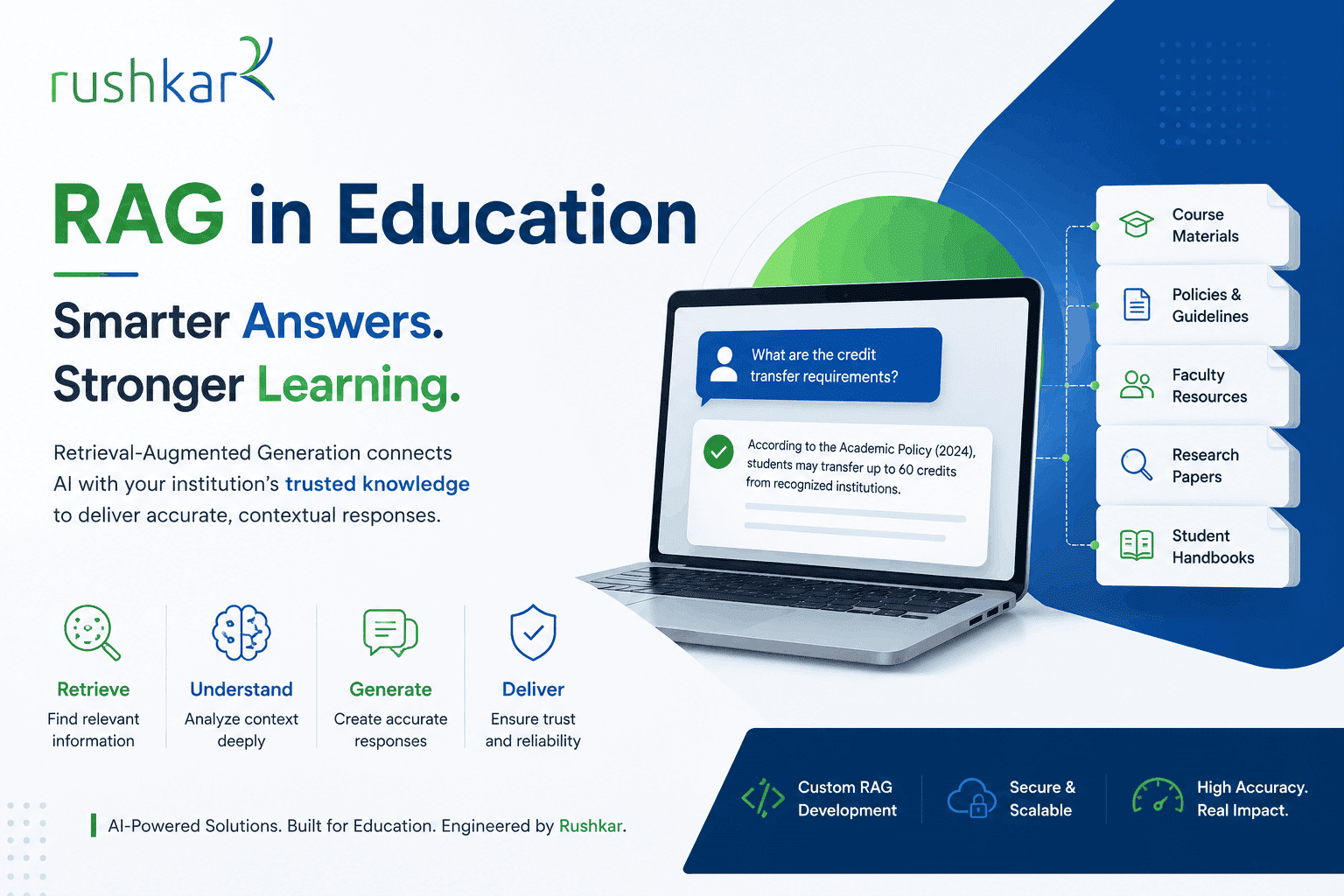
This is where Retrieval-Augmented Generation (RAG) in education changes the equation. Instead of relying solely on the model's memory, a RAG-powered system retrieves relevant information from trusted institutional sources before generating an answer. The result is an educational AI assistant that responds using verified knowledge rather than assumptions.
For universities, schools, and EdTech companies, that difference matters. Trust is the foundation of every learning experience. Whether you're building a student support platform, an AI tutor for students, or a campus-wide knowledge assistant, Retrieval-Augmented Generation Service offers a practical way to deliver accurate, contextual, and up-to-date information at scale. In the sections ahead, we'll explore how RAG works, where it creates the most value, and what it takes to build a production-ready educational AI solution.
Why Traditional AI Models Struggle in Educational Environments
The conversation around generative AI in education has matured. Educational institutions are no longer asking whether AI can answer student questions. They are asking whether those answers can be trusted.
That difference is significant because education depends on accuracy. A student checking graduation requirements, a lecturer reviewing revised assessment policies, or an admissions officer confirming scholarship eligibility all expect answers based on their institution's latest information. Even a small error can create confusion, increase administrative workload, or affect important academic decisions.
This is where many first-generation AI solutions begin to show their limitations.
Today's large language models in education excel at understanding natural language, summarizing content, translating documents, and explaining complex concepts. However, they are not connected to your university's curriculum, internal policies, learning management system, or academic knowledge base by default. Unless that information is provided during the conversation, the model responds using patterns learned during training rather than your institution's most recent documentation.
That gap becomes obvious when organizations deploy an AI chatbot for education in production. During demonstrations, the chatbot answers general questions fluently. Once students and faculty begin asking institution-specific questions, response quality often declines. An AI tutor for students should reference the prescribed syllabus instead of generic online material. An academic assistant chatbot should retrieve updated faculty guidelines before recommending academic procedures. Likewise, a student support chatbot should answer admission, examination, and administrative queries using verified institutional policies, not assumptions.
The issue isn't that language models lack capability. They lack access to the information that matters most.
This realization is changing how universities, schools, and EdTech companies approach education chatbot development. Instead of building chatbots that rely entirely on pretrained knowledge, organizations are adopting Retrieval-Augmented Generation (RAG) in education. By retrieving relevant information from an institutional knowledge base before generating a response, RAG delivers contextual, reliable, and up-to-date answers that users can trust. That retrieval-first approach is quickly becoming the foundation for every modern educational AI assistant designed for real-world academic environments.
What Is Retrieval-Augmented Generation (RAG) in Education?
One of the most searched questions today is "What is Retrieval-Augmented Generation?" Closely behind it are "What is RAG in education?" and "Why use RAG for education?" The growing interest reflects a broader shift in how educational organizations are approaching AI. Rather than asking whether AI can answer questions, institutions are asking whether those answers can be trusted.
At its core, Retrieval-Augmented Generation (RAG) combines two capabilities into a single workflow. Before an AI model generates a response, it first searches a trusted knowledge source for information related to the user's query. The retrieved content is then provided to the language model as context, allowing it to generate an answer based on verified information instead of relying entirely on its pretrained knowledge.
A simple comparison makes the difference easier to understand.
Imagine asking two academic advisors the same question about graduation requirements. One answers entirely from memory. The other checks the latest academic handbook before responding. Both may know the subject well, but only one verifies the information against the official source. A RAG-powered system follows the second approach every time.
This distinction is particularly valuable in education because institutional knowledge changes continuously. Universities update admission policies, schools revise curriculum frameworks, faculty members publish new learning materials, and accreditation bodies introduce new compliance requirements. Retraining a language model every time these documents change isn't practical. Updating a centralized knowledge base, however, is.
That is why a retrieval-augmented generation chatbot has become a preferred architecture for universities, online learning platforms, and EdTech companies. Instead of treating AI as a replacement for institutional knowledge, it treats knowledge as the foundation of every response. Students receive contextual answers, faculty members access current academic documentation, and administrators spend less time answering repetitive questions because the AI retrieves information directly from trusted institutional resources.
How a RAG Chatbot Works Behind the Scenes
From a student's perspective, using a RAG chatbot for education feels simple. They ask a question in natural language, and the AI responds within seconds. Behind that interaction, however, a carefully designed retrieval pipeline ensures every answer is based on trusted institutional knowledge rather than the language model's memory.
A production-ready educational AI assistant typically follows these stages:
- Centralize institutional knowledge: The first step is creating an educational knowledge base by consolidating information from multiple sources, including Learning Management Systems (LMS), Student Information Systems (SIS), admission portals, faculty handbooks, policy documents, research repositories, digital libraries, FAQs, and course materials. Instead of treating these as isolated repositories, the platform creates a unified source of truth for the AI.
- Prepare content for intelligent retrieval: Documents are cleaned, structured, and divided into meaningful sections through a process called chunking. Each section is converted into vector embeddings, enabling document retrieval AI to understand semantic relationships instead of matching exact keywords. This improves retrieval accuracy while reducing irrelevant search results.
- Perform semantic search: When a learner asks, "Can I transfer credits from another university?", the system doesn't look for identical words. It uses semantic search in education to identify related concepts such as credit equivalency, lateral admissions, or transfer policies. This allows the assistant to deliver contextual answers for students, even when institutional terminology differs from everyday language.
- Generate evidence-backed responses: The most relevant content is retrieved first and passed to the language model as context. Instead of answering from memory, the AI generates responses using verified institutional information. This combination of retrieval and generation enables factual response generation, improves transparency, and significantly reduces hallucinations.
- Keep knowledge continuously updated: One of the biggest strengths of Retrieval-Augmented Generation in education is the separation between knowledge and the language model. When institutions publish a revised syllabus, update admission criteria, or introduce new academic policies, administrators simply update the repository. The assistant immediately begins using the latest information without retraining the model, making education chatbot development more scalable, easier to maintain, and better suited for rapidly evolving academic environments.
Where Retrieval-Augmented Generation Delivers the Greatest Value
Educational organizations often begin exploring AI with a single objective, such as improving admissions support or reducing repetitive student queries. Once a retrieval layer is introduced, however, the same platform can support multiple departments without building separate AI solutions for each use case.
One of the most common applications is an AI learning assistant that helps students navigate course materials, lecture notes, recommended readings, and faculty-approved resources. Instead of searching through dozens of documents, learners ask questions in natural language and receive responses supported by official academic content. This creates a more engaging learning experience while encouraging students to use verified institutional resources rather than unreliable online sources.
Admissions teams can also benefit from a knowledge base chatbot for education capable of answering questions about eligibility criteria, required documentation, fee structures, scholarship opportunities, and application deadlines. During peak admission periods, these chatbots reduce repetitive inquiries while maintaining consistency across every interaction.
Faculty members gain value differently. An intelligent teaching assistant can retrieve curriculum guidelines, assessment policies, accreditation requirements, research documentation, and departmental procedures within seconds. Rather than searching multiple repositories or contacting administrative teams, educators interact with a single conversational interface connected to the institution's knowledge base.
The same architecture also supports academic assistant chatbots for researchers, helping them discover publications, summarize institutional reports, and locate relevant documentation across digital libraries. Combined with personalized learning support, these capabilities contribute to a more adaptive learning system where AI responds according to the learner's context instead of delivering generic information.
Perhaps the biggest advantage is that all these experiences are built on the same retrieval infrastructure. Instead of creating independent AI tools for admissions, academics, student services, and research, institutions establish one trusted knowledge layer that supports multiple AI applications across the campus.
Benefits of Retrieval-Augmented Generation for Schools, Universities, and EdTech Platforms
Educational institutions are investing in AI for one reason: to improve the learning experience without adding unnecessary operational complexity. While conversational AI has already simplified many routine interactions, Retrieval-Augmented Generation in education delivers value because it improves the quality of information, not just the quality of conversation.
One of the most immediate benefits is higher accuracy. Since responses are generated using trusted institutional documents, students and faculty receive information that aligns with official policies, course materials, and academic guidelines. This significantly reduces the risk of outdated or inconsistent answers that can occur when an AI model relies only on pretrained knowledge.
RAG also improves operational efficiency. Admissions teams, student service departments, and academic advisors often answer the same questions hundreds of times throughout the year. A well-designed student support chatbot can resolve routine inquiries instantly, allowing staff to focus on complex cases where human interaction adds the most value. Rather than replacing support teams, AI helps them spend their time more effectively.
Another important advantage is scalability. Educational institutions continuously publish new learning materials, update regulations, and introduce new academic programs. Because the AI retrieves information from an evolving knowledge repository, updates become much easier to manage. Institutions don't need to rebuild the entire system every time documentation changes. They simply update the knowledge base, and the assistant begins using the latest information during future conversations.
For EdTech companies developing digital learning products, this flexibility creates opportunities to build more reliable AI-powered platforms. Whether the goal is to create an AI tutor for students, a curriculum assistant, or an enterprise AI chatbot solution, retrieval-first architecture provides a stronger foundation for long-term growth.
Challenges of Building a Production-Ready Educational AI Assistant
Building a working prototype is only the beginning. The real engineering challenge starts when thousands of students, educators, and administrators begin using the system simultaneously.
One of the biggest misconceptions surrounding AI chatbot development for education is that choosing a powerful language model guarantees better results. In practice, the quality of a RAG system depends far more on the knowledge it retrieves than on the model generating the response.
Poorly structured documents, duplicate content, outdated policies, or incomplete repositories reduce retrieval quality long before the language model becomes the problem. If the retrieval layer surfaces the wrong information, even the most advanced AI model will produce an incorrect answer because it is working with incomplete context.
Security is another critical consideration. Universities manage academic records, research documents, examination materials, faculty information, and other sensitive institutional resources. Not every user should have access to the same knowledge. A production-ready platform requires role-based access control so that students, faculty members, researchers, and administrators retrieve only the information they are authorized to view.
Institutions should also establish a process for evaluating AI responses after deployment. Monitoring unanswered questions, reviewing retrieval accuracy, collecting user feedback, and updating the knowledge base should become part of ongoing operations rather than a one-time implementation task. The most successful educational AI projects continue improving long after the first version goes live.
Best Practices for Building a Reliable RAG-Based Education Platform
Organizations planning RAG application development often focus on selecting the right language model. While model selection matters, experience shows that long-term success depends far more on the overall architecture than on the model itself.
Some practical recommendations include:
- Create a centralized and well-governed educational knowledge base before introducing AI.
- Use semantic search to improve retrieval quality instead of relying only on keyword matching.
- Keep curriculum documents, admission policies, faculty resources, and student guidelines synchronized with the knowledge repository.
- Implement role-based permissions to protect sensitive academic and administrative information.
- Continuously evaluate retrieval quality using real student questions and usage patterns.
- Design the platform so that future AI models can be adopted without rebuilding the entire retrieval infrastructure.
These practices help institutions move beyond experimental chatbots and build AI systems that remain useful as academic content, student expectations, and technology continue to evolve.
Choosing the Right RAG Development Partner
As educational organizations expand their AI initiatives, selecting the right engineering partner becomes just as important as selecting the right technology.
A reliable AI assistant development company should understand both enterprise AI architecture and the operational realities of educational institutions. Building a production-ready solution involves much more than connecting a language model to a collection of PDFs. It requires expertise in knowledge management, semantic search, secure integrations, API development, cloud infrastructure, governance, and long-term maintenance.
If your goal is to build an AI tutor chatbot, launch a campus-wide knowledge assistant, or invest in custom education chatbot development, evaluate whether the development team has experience designing scalable AI systems rather than only building conversational interfaces.
At Rushkar, our RAG Development Services focus on building AI solutions that integrate securely with institutional knowledge, business systems, and enterprise applications. Alongside AI Development Services, Generative AI Development Services, and AI Chatbot Development, we help educational organizations transform fragmented information into intelligent knowledge platforms that support students, faculty members, and administrators with reliable, context-aware responses.
Conclusion
The future of AI in education isn't defined by who deploys the biggest language model. It will be shaped by institutions that make their knowledge easier to access, easier to trust, and easier to use.
That is why Retrieval-Augmented Generation in education has become more than another AI trend. It provides a practical architecture for connecting language models with institutional knowledge, allowing educational organizations to deliver accurate, contextual, and continuously updated information without constantly retraining AI models.
Whether you're planning a university knowledge assistant, an AI learning assistant, or a campus-wide student support platform, success depends on the strength of your knowledge foundation as much as the intelligence of the model itself. Organizations looking to hire a RAG development company should evaluate expertise in retrieval architecture, knowledge management, security, and scalability before making a technology decision. Those capabilities determine whether an AI initiative becomes a trusted academic resource or simply another chatbot with limited long-term value.
Frequently Asked Questions
- What is RAG in education?
Retrieval-Augmented Generation (RAG) in education is an AI architecture that retrieves information from institutional documents before generating a response. This enables AI assistants to answer questions using trusted academic resources instead of relying only on pretrained knowledge.
- How does RAG help students?
RAG helps students by providing accurate answers based on course materials, university policies, research resources, and curriculum documents. It supports faster learning, better academic guidance, and more reliable student services.
- How do you build a RAG chatbot for education?
Building a RAG chatbot for education involves creating an educational knowledge base, implementing semantic search, indexing documents, integrating a large language model, and continuously updating institutional content to ensure responses remain accurate.
- What are education chatbots used for?
Education chatbots support admissions, academic advising, student services, faculty assistance, research support, learning management systems, and personalized learning experiences. Modern RAG-powered chatbots can also function as AI tutors and intelligent teaching assistants.
- Why should organizations choose RAG over a traditional AI chatbot?
Traditional chatbots rely primarily on pretrained knowledge, while RAG systems retrieve current information directly from trusted institutional documents before generating responses. This makes them better suited for educational environments where policies, curriculum, and academic information change regularly.