On-Demand Towing App Development: A Complete Vehicle Recovery Platform
01. Project Overview
Getting a vehicle towed isn't always a simple job. A customer may be stranded on a highway, outside their home, or in an unfamiliar location. They need to find a towing service, explain where the vehicle is, confirm that a driver is available, and arrange its transportation.
This project was built through on-demand app development to make that process easier for customers and towing service providers.
The client wanted an on-demand towing platform where customers could request vehicle transportation through a mobile application. The idea was similar to booking a ride, but instead of arranging passenger travel, the application connects customers with towing service providers.
Rushkar developed three parts for the solution: a customer app, a driver app, and a web-based admin panel.
Customers can register, add vehicle information, enter pickup and destination locations, place towing requests, and track their assigned drivers. Drivers use their own application to manage availability, receive requests, accept jobs, and handle service activities. Administrators can manage the users, bookings, services, payments, and commissions from the web panel.
The platform was developed using Flutter, .NET, Microsoft SQL Server, and AWS. It also includes integrations for maps, real-time messaging, payments, OTP verification, notifications, and email communication.
The objective was to give towing businesses a practical digital system for handling service requests and managing their daily operations.
02. Project Snapshot
| Category |
Details |
| Industry |
Automotive and Transportation |
| Project Type |
On-Demand Towing Application |
| Business Model |
Service Marketplace |
| Customer Application |
Mobile App |
| Driver Application |
Mobile App |
| Admin Platform |
Web-Based Admin Panel |
| Mobile Technology |
Flutter |
| Backend |
.NET |
| Database |
Microsoft SQL Server |
| Cloud |
AWS |
| Main Features |
Towing Booking, Driver Matching, Live Tracking, Digital Payments |
| Payment Integration |
Stripe Connect |
| Development Type |
Custom Software Development |
03. Executive Summary
The client wanted to take the traditional towing service process and make it available through a mobile platform.
In a conventional setup, customers often have to contact towing companies, explain their location, discuss the vehicle, and wait for someone to confirm the service. The business also has to coordinate drivers, check availability, manage bookings, and handle payments.
Doing all this manually can make it difficult to keep track of active jobs, especially when multiple requests come in.
Rushkar developed a custom towing app with separate interfaces for customers and drivers. A central admin panel handles the management side.
A customer can select a vehicle, enter the pickup and destination locations using Google Maps, and submit a towing request. The driver receives relevant requests through the driver app and can review and accept a job. Once assigned, the customer can follow the driver's location and check service updates.
The driver application also handles availability, vehicle information, booking history, and earnings-related details. On the business side, administrators can manage customer accounts, verify drivers, assign bookings, configure services, and review transactions.
One important part of the project was the payment setup. The business follows a commission-based marketplace model, so the payment process needed to account for both the platform's share and the driver's payout. Stripe Connect was integrated for this purpose.
The result is a complete towing service platform covering customer bookings, driver operations, administrative management, and payment processing.
04. The Client's Vision
Bringing On-Demand Booking to the Towing Industry
The client wanted customers to arrange towing services without having to search for providers and coordinate every detail manually.
The idea was familiar to anyone who has used a ride-hailing application. A customer opens the app, enters the required information, places a request, and gets connected with a service provider.
But towing has its own requirements.
The customer needs to provide vehicle details. The driver needs to know where the vehicle is located and where it must be transported. The business needs to manage available drivers, bookings, and payments.
The client wanted a platform that could handle these requirements through one system.
The main expectations were:
A simple registration and booking process for customers.
Vehicle information as part of the towing request.
Pickup and destination selection through maps.
A way for available drivers to receive and accept requests.
Driver location tracking and booking updates.
Digital payments and driver payouts.
An administration panel for managing the service.
The goal was to make towing easier to request while giving the business better control over the work happening behind each booking.
05. The Challenge
What Needed to Be Solved
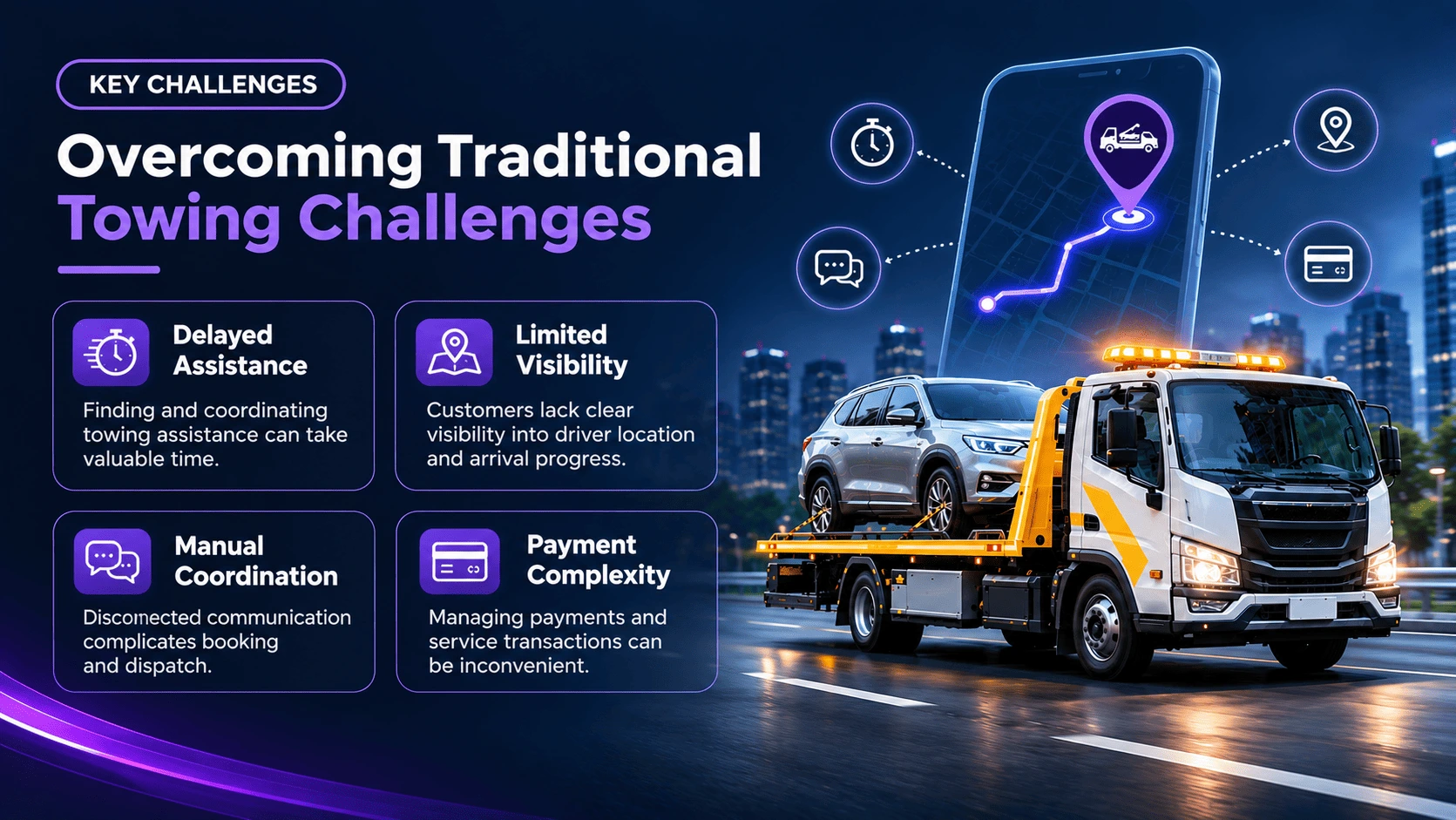
Building a towing application involves more than adding a booking button. The platform has to deal with vehicles, locations, drivers, service progress, and payments. Each part affects the others.
1. Customers Needed a Better Way to Find Towing Assistance
A customer with a broken-down vehicle should be able to submit a service request without repeatedly calling different providers. The application needed a clear booking process that collected the information required to arrange the service.
2. Drivers Needed a Way to Receive and Manage Jobs
The business needed to connect customer requests with available towing providers. Drivers also needed control over their availability so they could decide when they were ready to receive requests.
3. Pickup and Destination Details Had to Be Clear
Unlike a normal appointment, a towing job involves moving a vehicle from one place to another. Both locations matter. Incorrect or incomplete information can make coordination difficult.
4. Customers Needed to Know What Was Happening
After submitting a request, customers needed information about the driver and the progress of the service. The platform therefore required location tracking and booking status updates.
5. The Business Needed Operational Control
Administrators needed to manage customers, drivers, bookings, service categories, and payments. They also needed access to driver verification and assignment-related functions.
6. Payments Had to Follow the Marketplace Model
The business earns a commission from completed services, while drivers receive the remaining eligible amount. A suitable payment integration was required to support customer transactions, commission deductions, and driver payouts.
These were the main requirements that shaped the application structure and its technical integrations.
06. Our Solution
Three Applications Built Around One Service Process
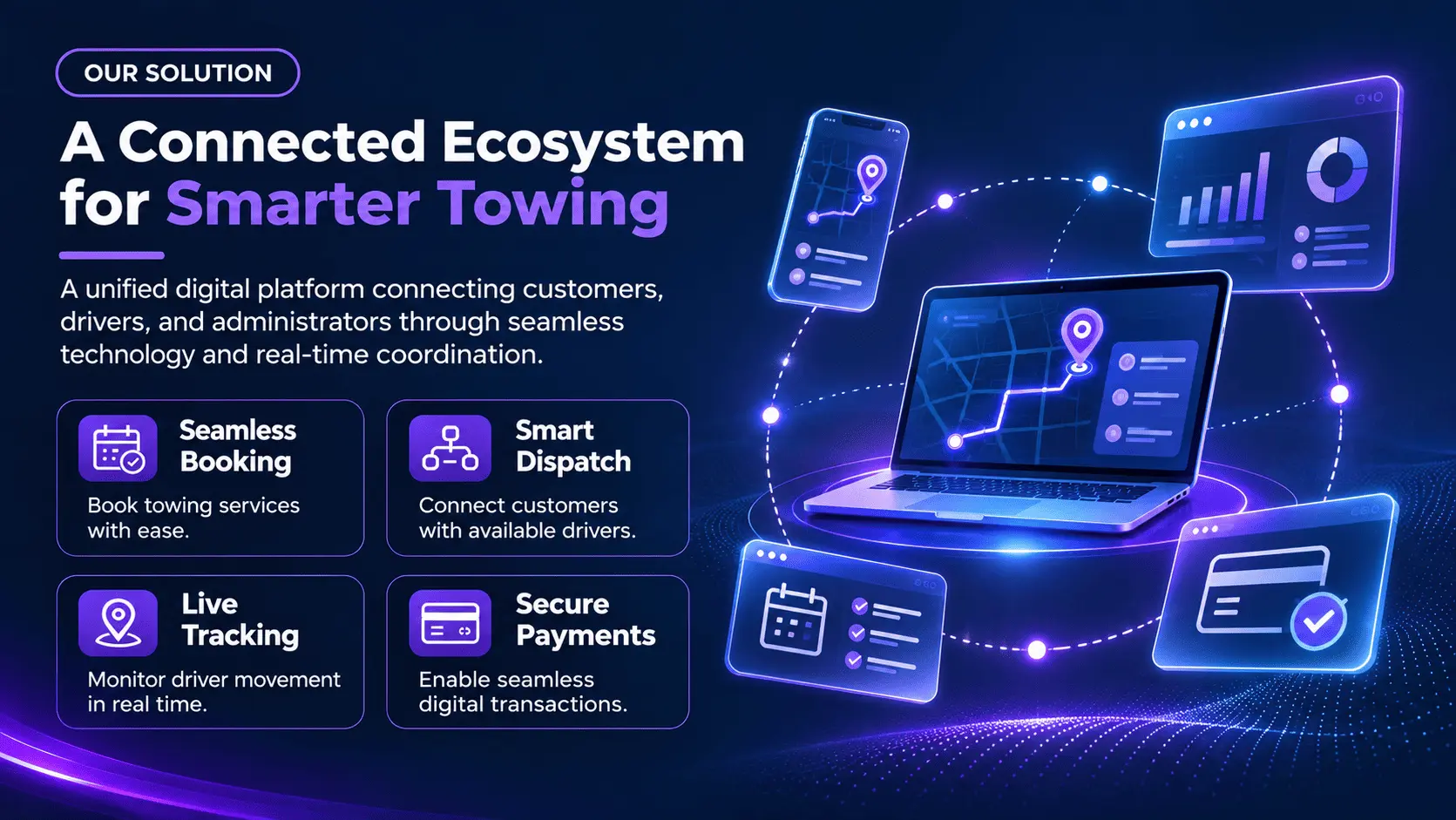
Rushkar handled the mobile app development for customers and drivers, along with the backend and web-based admin panel. Each component handles a different part of the towing business.
- Customer App
Customers use this application to register, enter vehicle details, request towing, share locations, view driver information, track bookings, and complete payments.
- Driver App
Drivers use their application to register, submit documents, manage availability, receive service requests, accept jobs, navigate to pickup points, and update the service status.
- Admin Panel
The administration team uses the web platform to manage customers, drivers, bookings, vehicle records, service categories, commissions, transactions, and payouts.
The applications communicate with the backend, which handles the business logic and data required by the different user roles.
This arrangement keeps the customer experience simple without leaving the business dependent on manual management.
07. Customer Mobile Application
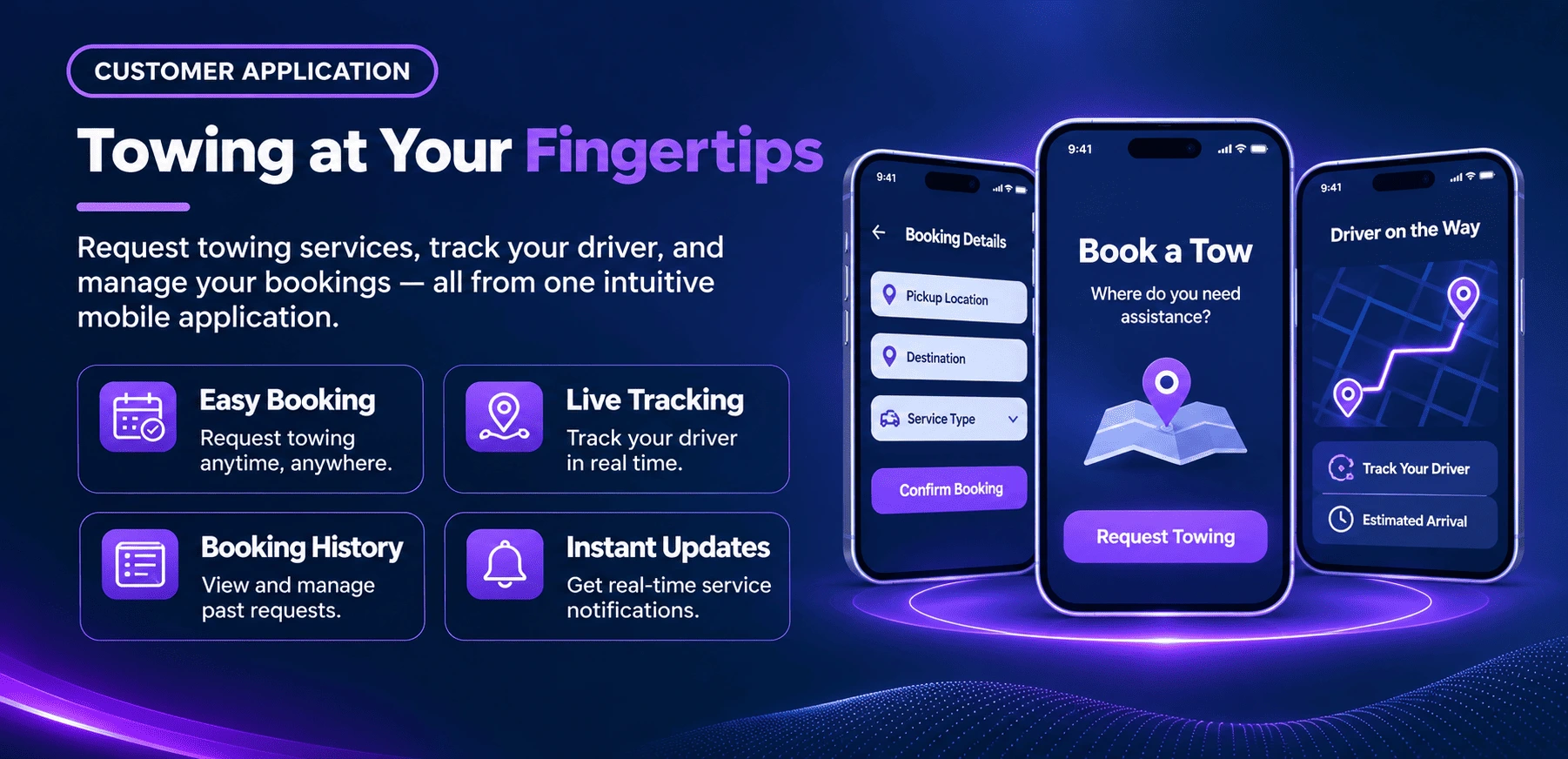
How Customers Request a Towing Service
The customer app was designed for people who need to arrange vehicle transportation without going through a complicated booking process.
After signing in, customers can provide their vehicle and location details and submit a request through the application.
- Account Registration
Customers can create an account and sign in using the available authentication process. Twilio supports OTP-based mobile number verification.
- Vehicle Selection
Customers can select their vehicle and enter the relevant information. This gives the service provider details about the vehicle involved in the request.
- Towing Request
The application allows customers to submit a towing booking. They can provide the required information and continue through the booking process.
- Pickup and Drop-Off Locations
Google Maps integration allows customers to select where the vehicle needs to be collected and where it should be taken.
- Driver Offers and Booking Confirmation
Customers can receive driver offers, review service provider information, and proceed with the booking. The application provides confirmation and relevant driver details.
- Driver Tracking
During an active booking, customers can follow the assigned driver's location through the integrated map functionality.
- Payments and Booking History
Customers can complete digital payments and refer to previous bookings, transaction information, and invoices.
- Reviews and Notifications
After service completion, customers can submit ratings and reviews. Push notifications provide updates about relevant booking events.
- Account Settings
Customers can manage personal information, saved addresses, and other account details.
08. Driver Mobile Application
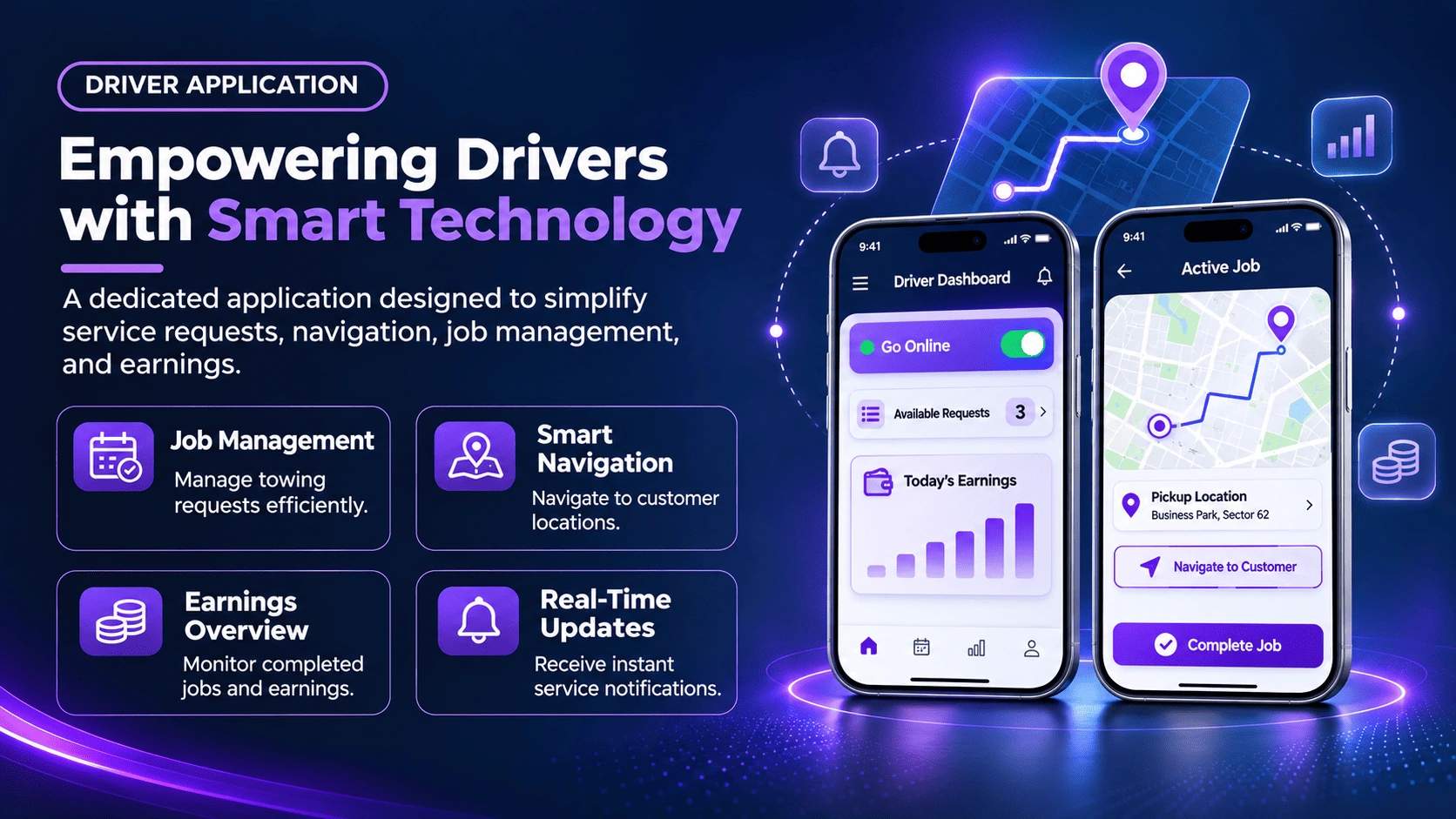
Tools for Towing Service Providers
The driver application handles the work that takes place after a customer submits a towing request.
Drivers need to manage their availability, review incoming jobs, reach the pickup point, and update the service as it progresses. The app brings these activities together.
- Driver Registration and Verification
Drivers can create accounts, complete their profiles, and submit the required documents. The administration team can review their registration and verification status.
- Online and Offline Status
Drivers can change their availability whenever their working status changes. Going online indicates that they are ready to receive service requests.
- Incoming Service Requests
The app sends notifications about relevant towing requests. Drivers can review the available details before responding.
- Navigation to Pickup Locations
Google Maps helps drivers navigate to the customer's location. This is particularly useful when a vehicle is waiting at an unfamiliar place.
- Pickup and Service Updates
Drivers can follow the pickup verification process and update the service status through completion.
- Earnings and Wallet
The application provides access to booking history, earnings information, and wallet-related details.
- Driver Payouts
Stripe Connect supports the payout process. The applicable platform commission is deducted before the remaining eligible amount is transferred to the driver. The integration also supports the platform's instant payout workflow.
- Feedback and Profile Management
Drivers can view service-related feedback and manage their profile information, vehicle details, and documents.
09. Admin Panel
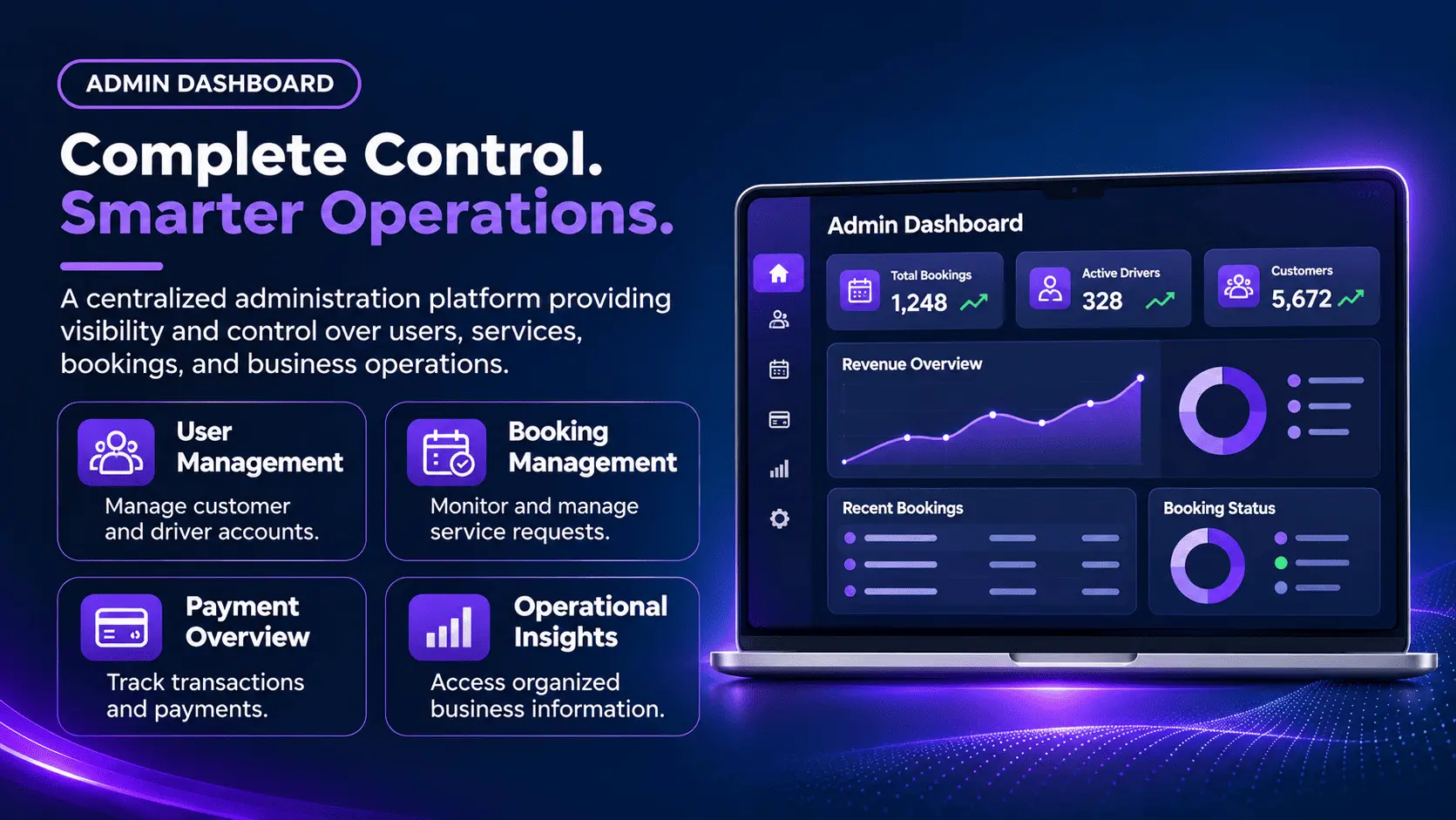
Managing Bookings, Drivers, and Payments
The admin panel is where the business manages the operational side of the towing marketplace.
A customer app can collect requests, and a driver app can handle jobs, but administrators still need to oversee what is happening across the platform. The web panel provides access to the main management functions.
| Module |
Administrative Functions |
| Dashboard |
View platform activity and operational information |
| Customer Management |
Manage customer accounts and profiles |
| Driver Management |
Review registrations, documents, and driver status |
| Booking Management |
View and manage towing requests |
| Driver Assignment |
Coordinate drivers with customer bookings |
| Service Management |
Configure towing categories and service offerings |
| Vehicle Management |
Maintain vehicle details and classifications |
| Payment Management |
Review transactions and payment records |
| Commission Management |
Manage platform commission settings |
| Payout Management |
Handle driver payout operations through Stripe Connect |
| Notification Management |
Manage notification workflows |
| Content Management |
Update application content and configurations |
| Reports and Records |
Access operational records and activity information |
| Access Management |
Manage administrative accounts and permissions |
For example, when the business needs to review a driver registration or check a booking, the relevant information is available through the administration platform. The same applies to service configurations and financial records.
This gives the business a central place to manage the marketplace rather than relying on separate records for each activity.
10. End-to-End Customer Journey
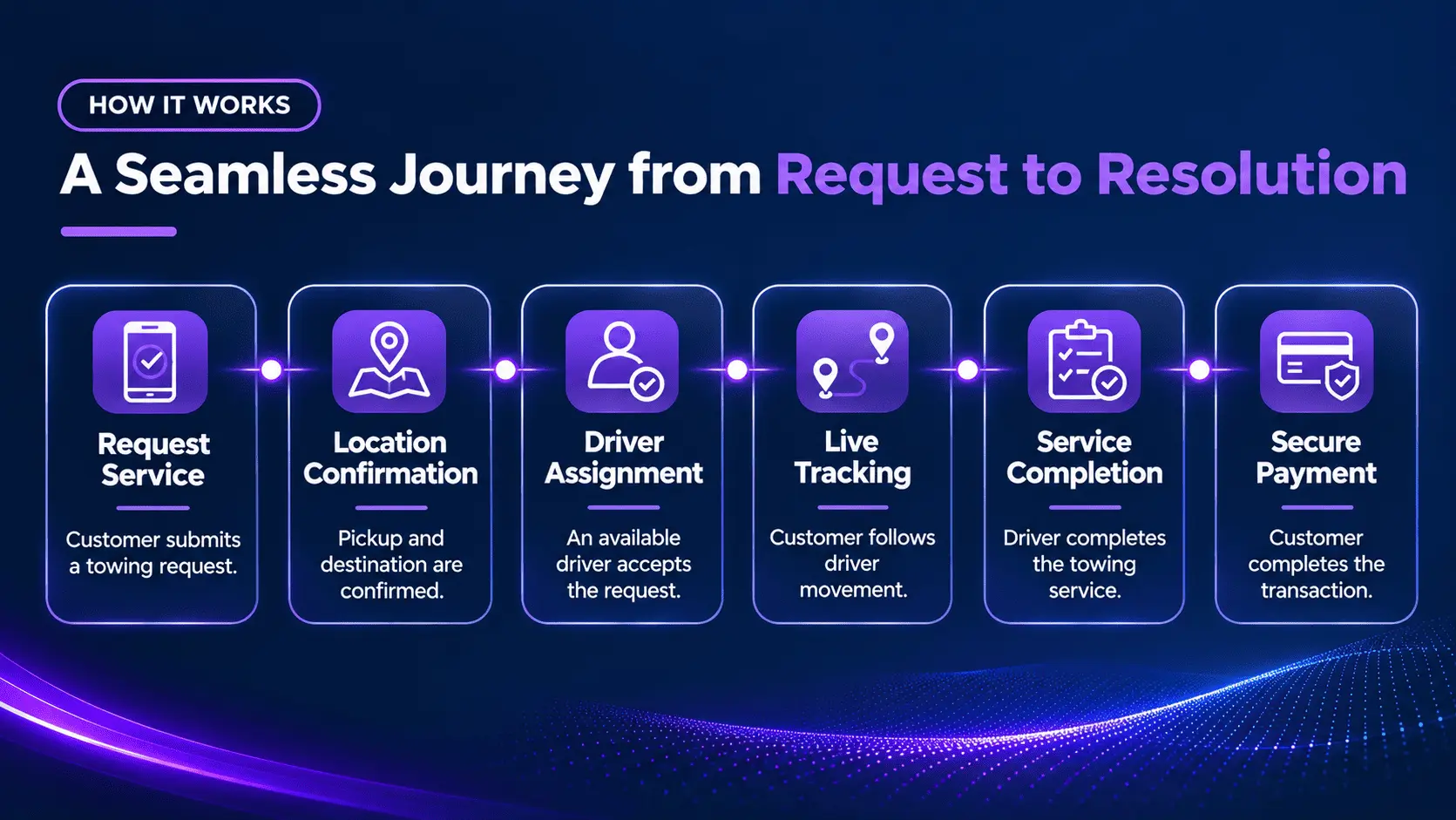
What Happens After a Customer Places a Request?
The booking process follows a sequence that connects the customer, driver, and administration system.
-
Customer Login: The customer creates an account or signs in through the mobile application.
-
Vehicle Details: The customer selects the vehicle and provides the required information.
-
Location Selection: The customer enters the pickup and destination locations using Google Maps.
-
Request Submission: The customer checks the details and submits the towing request.
-
Driver Matching: Available drivers receive relevant requests and participate in the matching and acceptance process.
-
Booking Confirmation: The customer receives confirmation and information about the assigned driver.
-
Driver Tracking: The customer can follow the driver's location during the service.
-
Vehicle Pickup: The driver reaches the pickup point and follows the verification process.
-
Vehicle Transportation: The driver takes the vehicle to the selected destination and updates the service status.
-
Payment and Review: The customer completes the payment process and can leave feedback.
The workflow gives customers a clear sequence to follow. It also provides the business with a structured way to manage each towing request.
11. Payment and Revenue Management
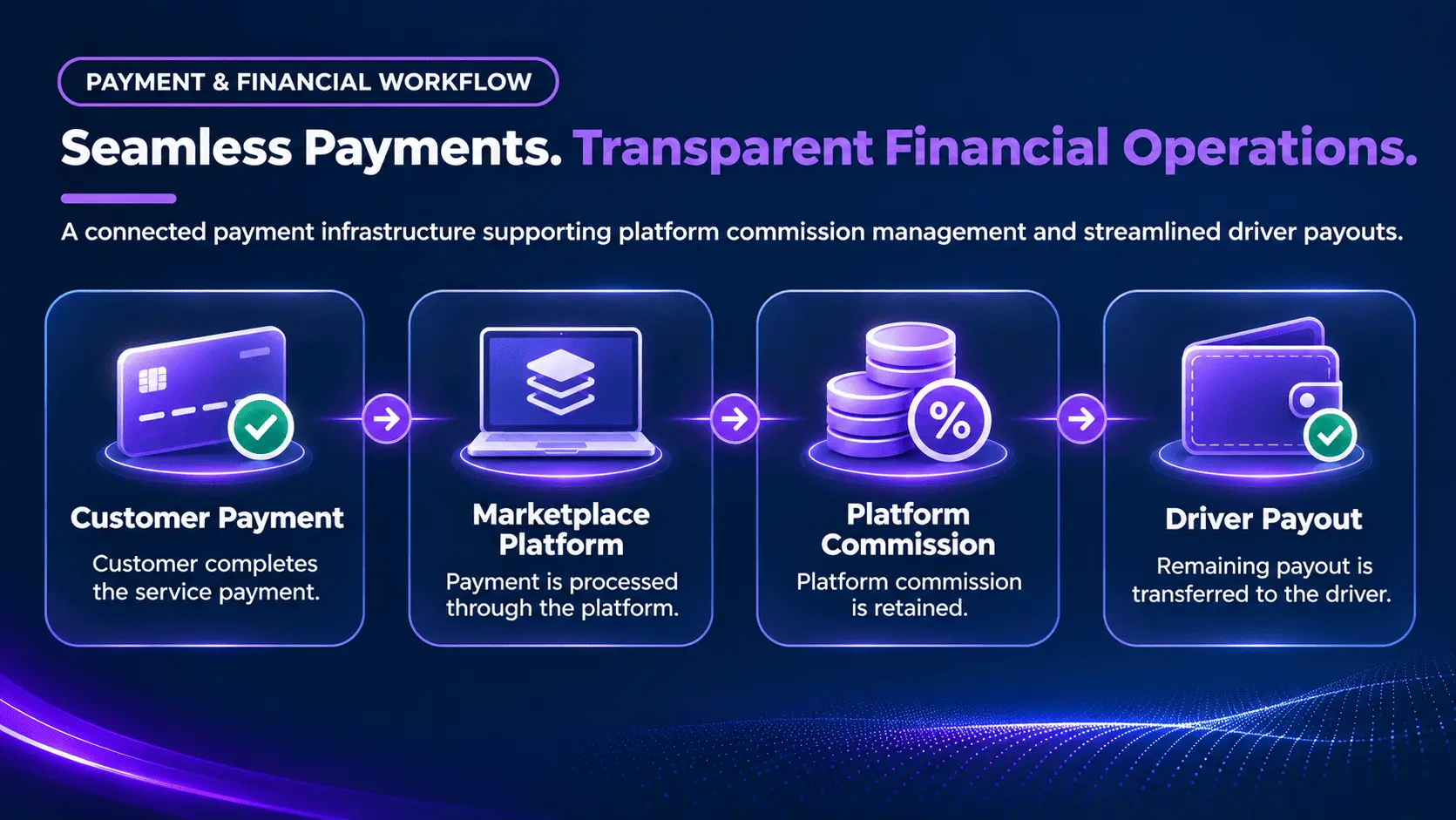
How the Commission-Based Payment Process Works
The client wanted a marketplace payment model in which the business receives a commission from each service and the driver receives the remaining eligible amount.
Rushkar integrated Stripe Connect to support this requirement.
When a customer pays for a towing service, the transaction is handled through the integrated payment infrastructure. The platform's applicable commission is deducted before the driver's payout is calculated.
Stripe Connect then facilitates the payout process for the driver. The integration supports the platform's instant payout workflow.
Administrators can also access payment transactions, commission information, and payout operations through the admin panel.
This arrangement connects three financial activities:
Customer payment collection.
Platform commission deduction.
Driver payout processing.
For a towing marketplace, this is an important part of the product. Payment handling needs to follow the business model, not sit outside the booking process.
12. Real-Time Communication and Tracking
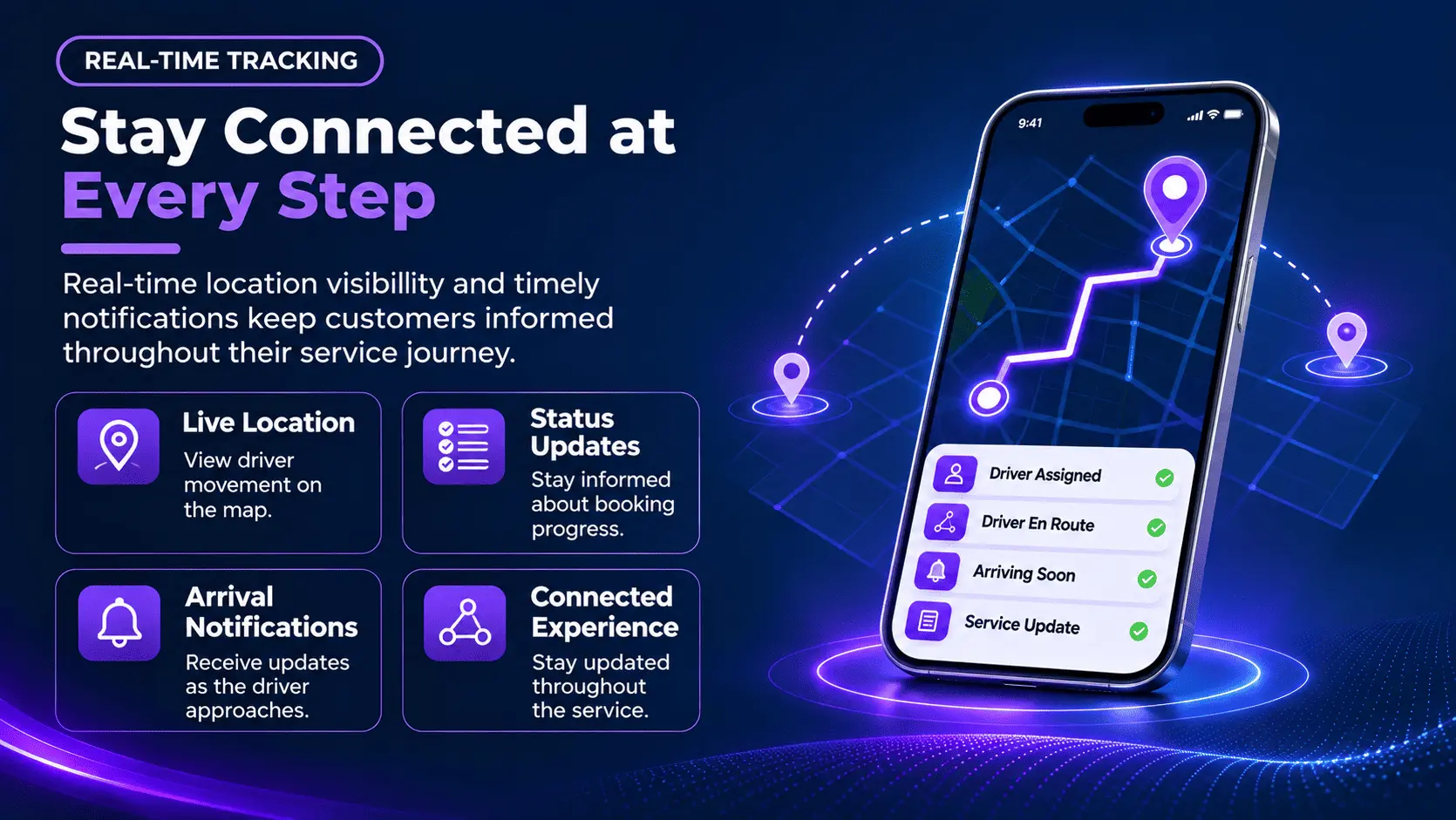
- Google Maps and HiveMQ MQTT
A towing request depends heavily on location information. The driver needs the correct pickup point, the customer needs to know where the driver is, and the platform needs to communicate booking updates.
Two integrations support these requirements.
- Google Maps Integration
Google Maps handles location-related functions in the application. Customers can select pickup and destination locations, while drivers can use maps to reach the vehicle. The integration also supports live driver tracking for customers.
- HiveMQ MQTT Integration
HiveMQ MQTT provides the real-time messaging infrastructure used for booking and service status updates. It allows connected platform components to exchange relevant information during an active service.
These integrations solve different problems. Google Maps handles geographical information, while MQTT supports service-related communication.
13. Notifications and Communication Infrastructure
The platform uses three communication services for different requirements.
- Firebase Cloud Messaging for App Notifications
Firebase Cloud Messaging sends push notifications to customers and drivers. These can include booking confirmations, service updates, and other relevant platform events.
Using separate services for these functions allows the application to handle mobile verification, push alerts, and email communication through the appropriate integrations.
14. AI and Intelligent Mobility
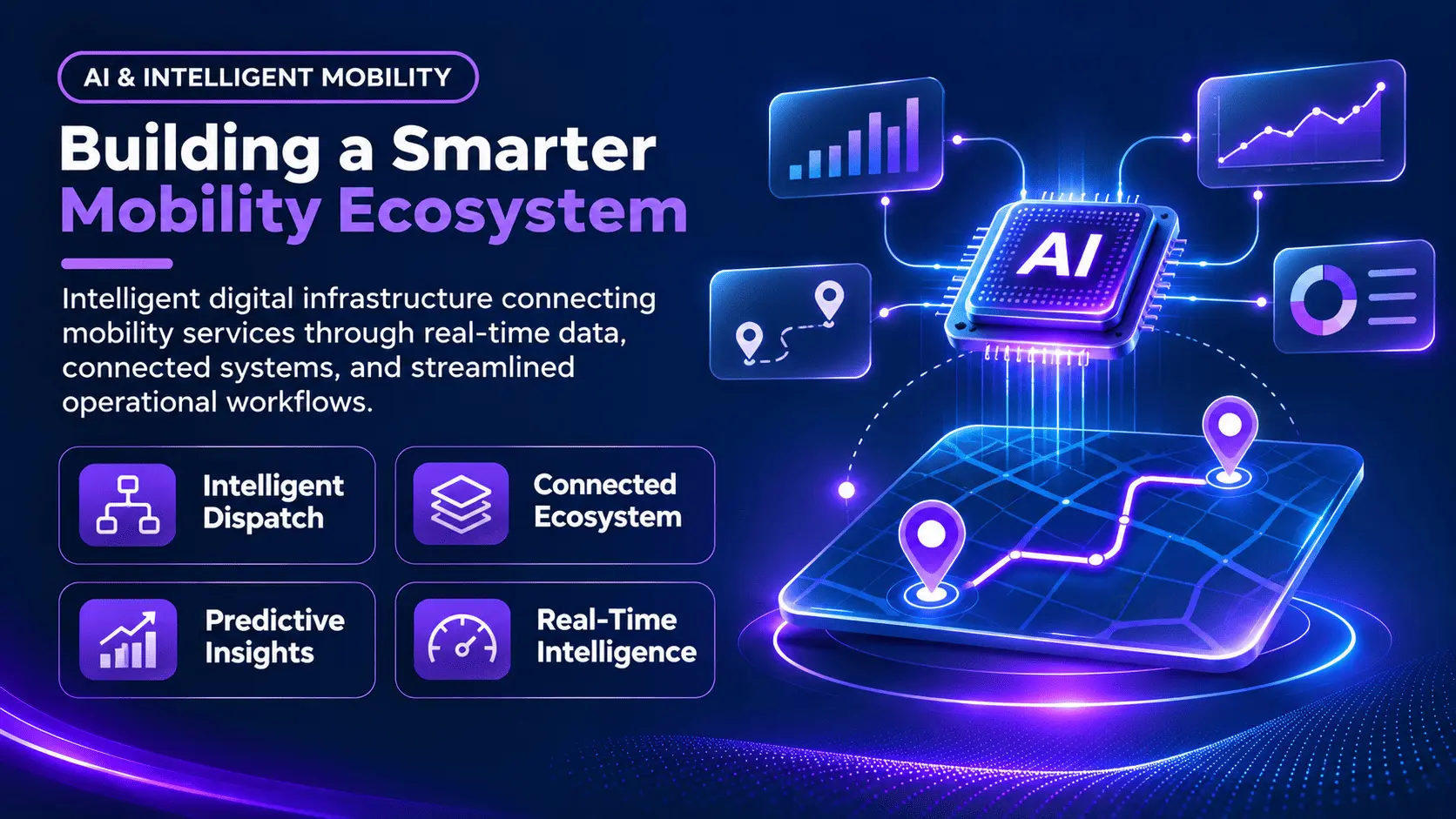
Possible AI Features for Future Development
The platform handles digital bookings, driver activity, location information, and service records. These data points could support additional intelligence features in the future.
However, the supplied project details do not confirm that AI capabilities were implemented in the delivered application. The following are potential additions, not existing features being claimed as part of this project.
- Driver Matching
A future matching engine could consider driver availability, location, towing vehicle category, and service requirements when suggesting suitable drivers.
- Dispatch Assistance
AI-assisted dispatch could help review new requests alongside available driver information. This may support assignment decisions when the business handles a larger number of bookings.
- Demand Forecasting
Historical booking information could be analyzed to identify locations and periods with higher towing demand. Businesses could use these findings when planning driver availability.
- Route Analysis
A route analysis feature could consider distance, traffic conditions, and destination information when identifying suitable routes for vehicle transportation.
- Service Performance Analysis
Booking records could be used to study cancellations, waiting periods, completed services, and other operational patterns.
- Fleet Utilization
Future reporting could help businesses understand vehicle usage and compare available towing capacity with incoming service demand.
These ideas can be considered as the platform evolves. Each would require its own development scope, suitable data, and testing before being introduced into the live application.
15. Technology Architecture
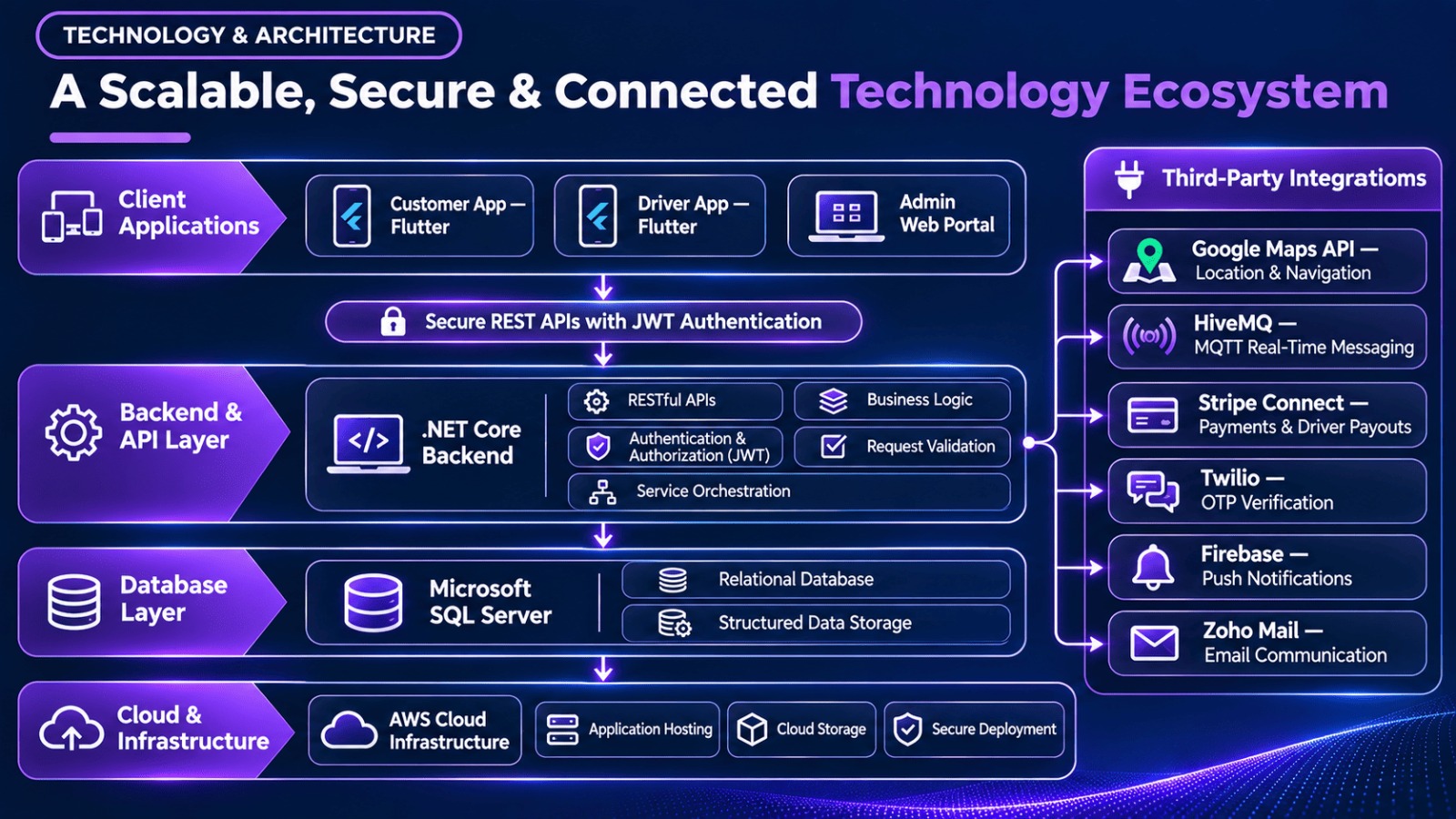
Technologies Used to Build the Platform
The application uses a combination of mobile development technology, backend services, database management, cloud hosting, and external integrations.
- Flutter-Mobile Applications
Flutter was used to develop the customer and driver apps. Both applications provide the mobile interfaces for their respective users.
- .NET-Backend Development
The .NET backend handles application logic, booking operations, customer and driver management, service coordination, payment-related workflows, and API communication. Businesses planning similar backend systems can explore Rushkar's ASP.NET and .NET development services.
- Microsoft SQL Server-Database
Microsoft SQL Server stores relational information such as customer accounts, driver profiles, vehicle details, bookings, transactions, and operational records.
- JWT-Authentication
JSON Web Token-based authentication supports authenticated communication between the applications and backend APIs.
- HiveMQ MQTT-Real-Time Messaging
HiveMQ MQTT supports the exchange of booking and service status updates across connected platform components.
- Google Maps-Location Services
Google Maps supports pickup and destination selection, navigation, and live driver tracking.
- Stripe Connect-Payment Processing
Stripe Connect handles the payment integration, platform commission deductions, and driver payout operations.
- Communication Services
Twilio supports OTP verification, Firebase Cloud Messaging handles push notifications, and Zoho Mail supports email communication.
The choice of technology is only one part of building a product. Planning the architecture, defining user workflows, and managing development stages are equally important. See our mobile app development process for more details.
16. Key Technical Challenges and Solutions
The project required several services to work together. The table below shows how the main requirements were handled.
| Technical Challenge |
Approach Used |
| Connecting customers and drivers |
Separate mobile applications supported by a shared backend |
| Capturing pickup and destination details |
Google Maps integration |
| Showing driver movement |
Google Maps-based live tracking |
| Sharing booking updates |
HiveMQ MQTT messaging |
| Managing driver availability |
Online and offline status in the driver application |
| Recording pickup and completion |
Defined service verification and status workflows |
| Managing daily operations |
Centralized admin panel |
| Processing customer payments |
Stripe Connect |
| Calculating platform commission |
Commission deduction before driver payout |
| Handling driver payouts |
Stripe Connect payout integration |
| Sending user communications |
Twilio, Firebase Cloud Messaging, and Zoho Mail |
| Managing application access |
JWT-based authentication and token-secured APIs |
The main requirement was to connect the booking process with the work performed by drivers and the management activities handled by administrators. The selected technologies support different parts of that process.
17. Security and Access Management
Managing Access to the Application
The platform contains customer information, driver records, booking details, payment information, and administrative functions. The application therefore includes authentication and access management mechanisms.
- JWT-Based Authentication
JWT authentication supports authenticated API requests between mobile applications and backend services.
- OTP Verification
Twilio supports mobile number verification during the relevant account registration and authentication workflows.
- Commission and Payout Handling
The financial workflow accounts for the applicable platform commission before facilitating the driver's remaining eligible payout.
- Administrative Permissions
The admin panel includes access management functions to control administrative accounts and permissions.
18. Business Impact
What the Business Can Manage Through the Platform
The main value of this towing app development project is that it brings customer requests, driver operations, and business management into one system.
For the business, this changes how the different parts of a towing service can be handled.
- Customers Have a Digital Booking Option
Instead of relying only on calls, customers can request towing through the application and share the required vehicle and location details.
- Drivers Have Their Own Working Interface
Drivers can manage availability, receive service requests, accept jobs, navigate to pickup points, and update service progress.
- Administrators Can Review Service Activity
The admin panel provides access to customer records, driver information, bookings, service settings, and financial operations.
- Payments Follow the Marketplace Model
Stripe Connect supports the commission and payout process, helping the business manage its share and driver settlements through the integrated financial workflow.
- The Platform Can Be Extended Later
The digital booking and operational records could support future reporting, demand analysis, and AI-assisted dispatch features if the business decides to develop them.
No verified figures were provided for revenue growth, reduced booking time, increased bookings, or lower operating costs. These should be included only when actual business results are available.
19. Technology Stack
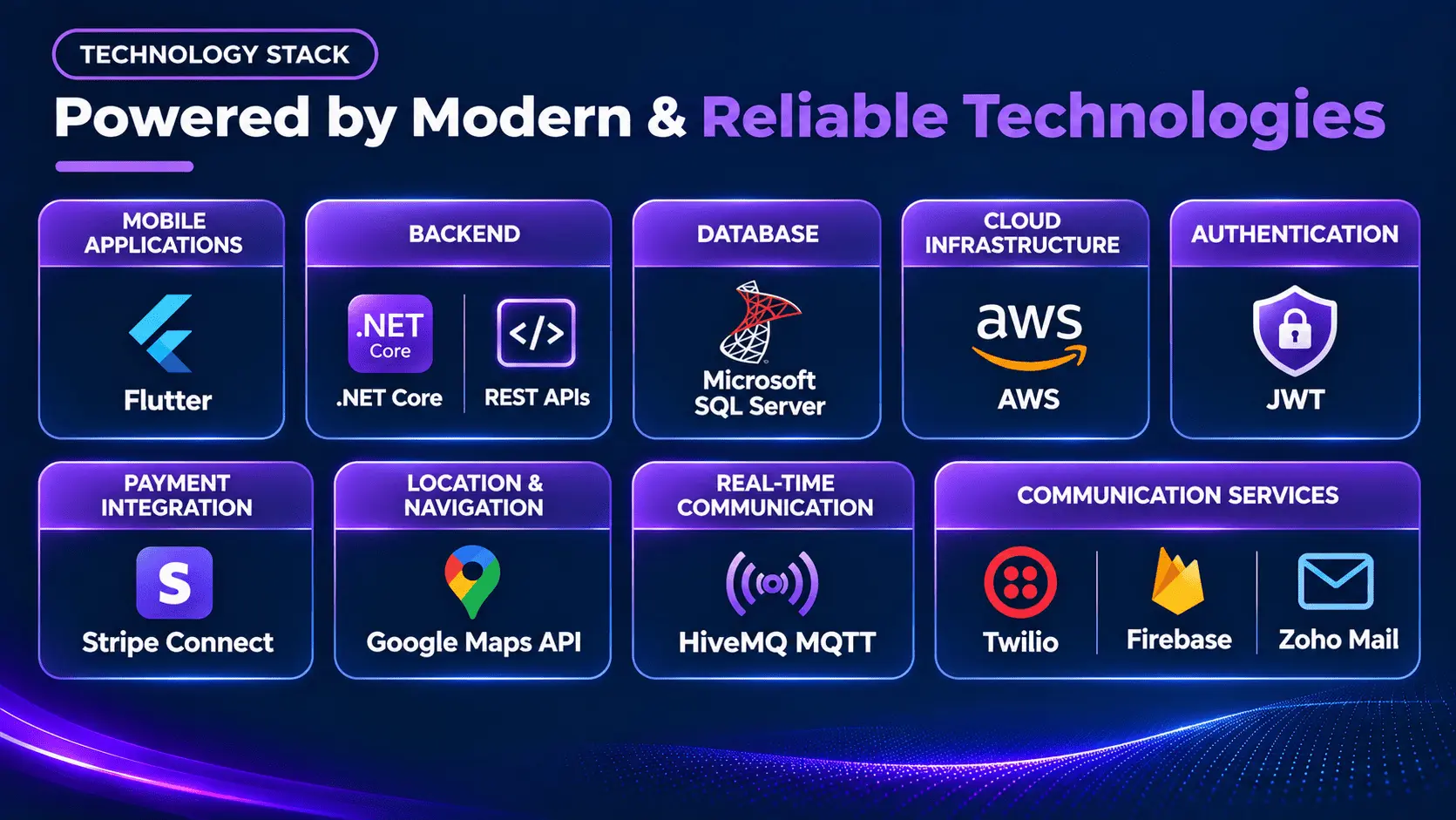
| Technology |
Application |
| Flutter |
Customer and driver mobile app development |
| .NET |
Backend services and business logic |
| Microsoft SQL Server (MSSQL) |
Database management |
| Amazon Web Services (AWS) |
Cloud infrastructure |
| JWT |
Authentication and API access |
| Stripe Connect |
Customer payments, commission deductions, and driver payouts |
| Google Maps |
Location selection, navigation, and live tracking |
| HiveMQ MQTT |
Real-time messaging |
| Twilio |
OTP verification |
| Firebase Cloud Messaging |
Push notifications |
| Zoho Mail |
Email communication |
20. Why Rushkar?
Building Software Around the Actual Business Process
A towing marketplace has several moving parts. Customers need a booking application, drivers need tools to manage their jobs, and administrators need access to service and financial records.
Rushkar handled the project across mobile application development, backend engineering, database management, third-party integrations, and administration.
This type of project also involves planning, building, testing, and maintaining the complete product. Learn more about our software product development services.
Our work covered the main requirements of the product:
- Custom Mobile App Development
Developing separate applications for customers and towing service providers, based on the tasks each group needs to perform.
- Backend and API Development
Handling booking operations, user management, service workflows, and communication between the different platform components.
- Third-Party Integrations
Working with Google Maps, HiveMQ MQTT, Stripe Connect, Twilio, Firebase Cloud Messaging, and Zoho Mail to support the required platform functions.
- Administration and Business Management
Developing the web panel to manage customers, drivers, bookings, services, and financial records.
- Future Product Enhancements
Planning additional capabilities around the business's future requirements, including reporting and potential AI-based features.
For businesses planning custom towing software, a roadside assistance app, or a vehicle recovery marketplace, Rushkar can help define the product scope and build the required applications. Businesses that already have an in-house team can also hire dedicated developers to work on specific development requirements.
21. Frequently Asked Questions
What is an on-demand towing app?
+
An on-demand towing app allows customers to request vehicle towing through a mobile application. They can provide vehicle details, select pickup and destination locations, and connect with available service providers.
How does a towing service app work?
+
A customer submits a towing request with vehicle and location details. Available drivers receive relevant requests and can take part in the booking process. Once a driver is assigned, the customer can follow the service through booking updates and location tracking.
What features should a towing app include?
+
A typical towing application may include customer registration, vehicle selection, towing requests, pickup and destination selection, driver availability, request acceptance, live tracking, notifications, payments, booking history, and an admin dashboard.
Why does a towing business need a driver app?
+
A separate driver application gives service providers a place to manage availability, receive requests, accept jobs, navigate to pickup locations, and update service progress. It also keeps driver-related activities separate from the customer interface.
Can a towing application provide live tracking?
+
Yes. Google Maps integration can support driver location tracking during an active booking. The exact implementation depends on the application's location and tracking requirements.
How do towing apps handle payments?
+
A towing marketplace can integrate a payment service such as Stripe Connect. In a commission-based model, the platform deducts its applicable share before facilitating the remaining eligible payout to the driver.
Which technology is suitable for towing app development?
+
Technology selection depends on the project requirements. This solution uses Flutter for mobile applications, .NET for backend development, Microsoft SQL Server for data management, and AWS for cloud infrastructure.
Can AI be used in towing management software?
+
Yes. AI could support driver matching, dispatch assistance, demand forecasting, route analysis, and service reporting. These capabilities need separate development and should be based on the actual needs and available data of the business.
How much does it cost to develop a towing app?
+
The cost depends on the number of applications, required features, payment integrations, tracking functionality, backend complexity, and admin requirements. A basic towing booking application will have a different scope from a complete marketplace with customer and driver apps.
Who can use custom towing management software?
+
Towing companies, roadside assistance providers, vehicle recovery businesses, fleet operators, and vehicle transportation companies can use custom towing software to manage bookings and service operations.
22. Planning Your Own Towing App?
Start with the Way Your Business Handles Towing Services
A towing application needs to work for the people using it every day. Customers need to request help without confusion. Drivers need the right information to handle each job. Administrators need to know which bookings are active and how payments are being managed.
That is why the booking process, driver workflow, payment model, and administrative requirements should be considered before development begins.
The platform developed by Rushkar brings these requirements together through customer and driver mobile applications, a web admin panel, location services, real-time messaging, and payment integration.
If you are planning an on-demand towing app, vehicle recovery application, or roadside assistance platform, contact Rushkar Technology to discuss your project requirements and development options.
The starting point is your business model. Once the services, users, and operational requirements are clear, the right application structure can be defined around them.
