Case Study | Transportation & Mobility | Gulf Cooperation Council.
Connecting customers, drivers and transportation operations through one real-time mobility platform
Taxi Booking & Fleet Management Platform is a connected mobility and fleet operations platform built to bring customer bookings, driver activity, vehicle management and transportation operations into one system.
The platform supports on-demand rides, scheduled journeys and hourly rentals, while giving administrators direct control over ride creation, driver assignment, reassignment, vehicle management, fares, offers, wallets and payments. Real-time fleet information provides the operational visibility needed to understand what is happening across active rides and available drivers.
The architecture also creates a structured foundation for mobility intelligence, allowing operational data such as demand, driver availability, location, ride activity and cancellations to support future AI-assisted decision-making.
Project Snapshot
| Field |
Details |
| Industry |
Transportation & Mobility |
| Market |
Gulf Cooperation Council. |
| Solution |
Intelligent Mobility & Fleet Operations Platform |
| Delivery |
20 weeks, from requirements gathering to final delivery |
| Platforms |
Customer Mobile App, Driver Mobile App, Admin Web Platform |
| Mobility Services |
On-Demand Rides, Scheduled Rides, Hourly Rentals |
| Core Capability |
Real-Time Fleet Tracking & Centralized Ride Management |
| Backend |
.NET Core |
| Mobile Development |
Flutter |
| Database |
Microsoft SQL Server |
| Real-Time Communication |
HiveMQ / MQTT |
| Communications |
Twilio |
| Payments |
MyFatoorah, OSTAP |
| Team |
2 Backend Developers, 2 Flutter Developers, 1 Team Lead, 1 Project Manager, 1 QA Engineer, 1 Figma Designer |
Executive Summary
One mobility platform built around the complete operating model
A transportation business does not operate through the customer booking screen alone.
Behind every ride, there is a chain of operational decisions. A customer needs to request the right service. A suitable driver needs to be available. The correct vehicle needs to be associated with the trip. The ride needs to be assigned, monitored and completed. Payments, wallets, cancellations and other commercial activities need to remain connected to that journey.
Taxi Booking & Fleet Management Platform was designed around this complete operating model.
The solution brings together three connected experiences: a customer mobile application, a driver mobile application and an administrative command platform. Customers can book immediate and scheduled rides or hourly rentals. Drivers can manage their availability, receive ride requests, execute trips and monitor their earnings. Administrators can manage customers, drivers, rides, vehicles, fares, offers, wallets, payments and fleet activity from a central platform.
This structure gives transportation operators something more valuable than another booking application: a single operational view of the mobility business.
The Client
A Gulf Cooperation Council. - focused mobility operation
Taxi Booking & Fleet Management Platform was developed for transportation operations in Gulf Cooperation Council. where customer demand, driver availability, vehicle assignment and ride execution need to remain coordinated throughout the day.
The platform had to accommodate more than customer-initiated bookings. Transportation teams also needed the ability to create rides on behalf of customers, intervene when a driver became unavailable and manage vehicles and commercial rules from the administration side.
That made operational flexibility an important part of the product.
Instead of treating the customer application as the centre of the system, the solution was designed around the relationship between customers, drivers, vehicles and operators.
The Challenge
The difficult part was keeping a moving operation synchronized
A mobility platform deals with information that changes continuously.
A driver who was available a few minutes ago may accept another ride. A vehicle may become unavailable. A customer may cancel. A scheduled ride may approach its pickup time. An administrator may need to remove a driver and assign another one.
At the same time, the system needs to keep the customer, driver and operations teams working from consistent information.
The project therefore had several interconnected challenges.
01
Keeping customer, driver and admin activity connected
The three sides of the operation needed to work from a common mobility lifecycle. A change made in one part of the system had to be reflected where it affected another part of the operation.
02
Providing real-time fleet visibility
Administrators needed visibility into driver locations, availability and current ride activity rather than relying only on completed-trip information.
03
Giving operators direct control
The admin team needed more than reports. They needed to create rides, assign drivers, change assignments and manage the ride lifecycle when operational conditions changed.
04
Supporting different mobility services
An immediate ride, a scheduled journey and an hourly rental have different timing and execution requirements. The platform had to support these services without fragmenting the underlying operating model.
05
Managing dynamic commercial rules
Fare configuration needed to accommodate factors such as location, timing and surge percentages, while promotional offers required their own management layer.
06
Connecting vehicles with drivers
Vehicles and drivers are related but separate operational entities. The system needed to manage both while keeping their relationship clear during ride execution.
Solution Strategy
One operating model across three digital experiences
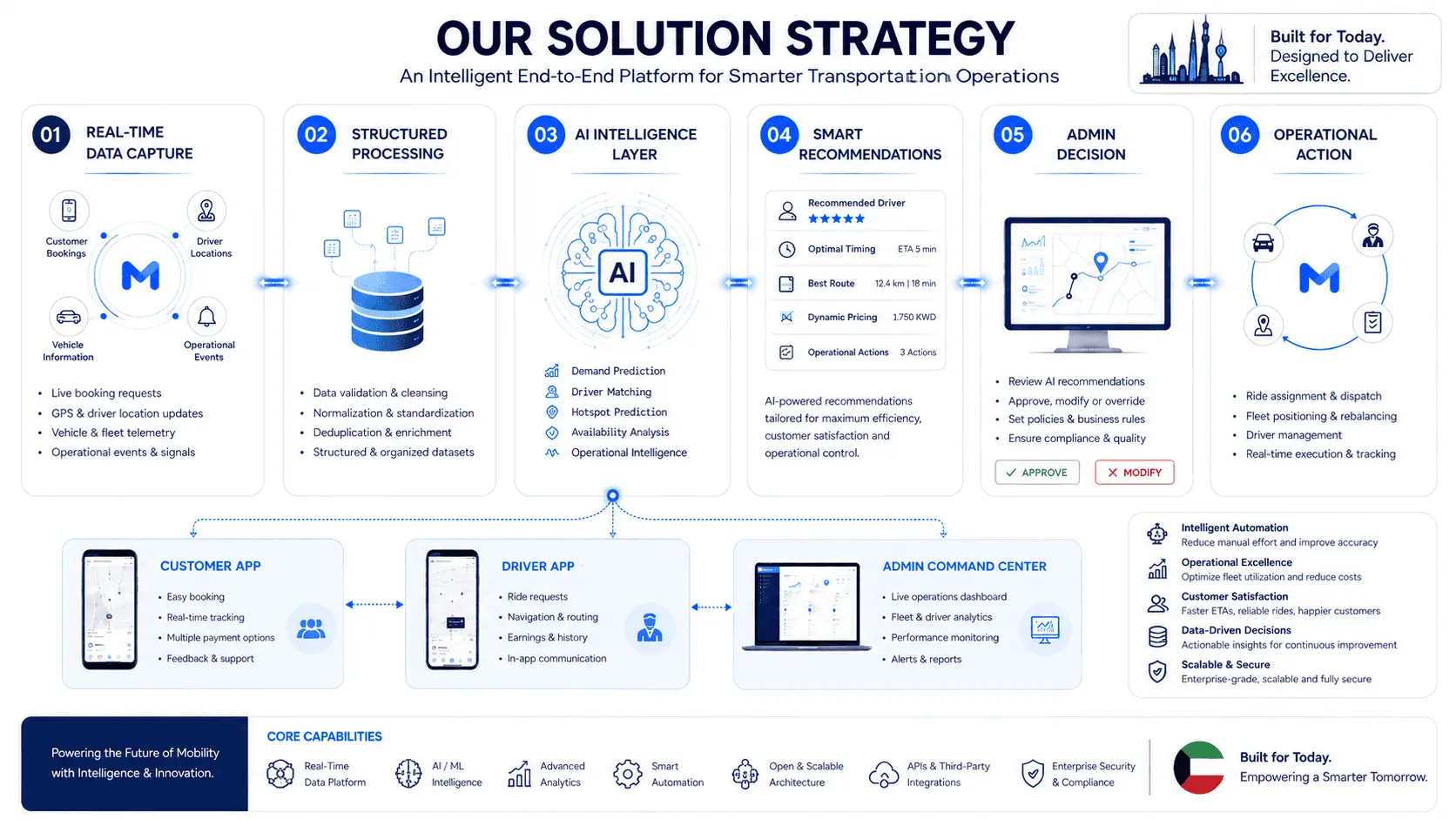
The solution was structured as one connected mobility ecosystem rather than three independent applications.
Each platform has its own purpose, but all three participate in the same operational flow.
1) Customer Mobile Application
The customer application provides the front-end experience for requesting and managing transportation services.
Key capabilities include:
Customer registration and OTP verification
On-demand rides
Scheduled rides
Hourly rentals
Pickup and destination selection
Vehicle and service selection
Driver tracking
Driver communication
Ride cancellation
Saved addresses
Ride history
Wallet and top-up
Ratings and feedback
Tipping
Notifications
Profile management
The objective was to keep the booking experience straightforward while giving customers visibility throughout the ride lifecycle.
2) Driver Mobile Application
The driver application acts as the operational workspace for drivers.
It supports:
Driver registration
OTP verification
Document submission
Driver verification
Vehicle configuration
Online and offline availability
Ride requests
Ride acceptance
Pickup management
Waiting-time management
Trip execution
Rental requests
Cancellation
Earnings
Wallet management
Ride history
Ratings and feedback
Notifications
Help centre
Profile management
The application connects driver availability and trip execution directly with the wider platform.
3) Admin Command Center
The administration platform provides the operational control layer.
Administrators can create customers and drivers, create rides, assign or reassign drivers, manage vehicles and configure commercial operations.
The platform includes:
Customer management
Driver management
Ride management
Live fleet tracking
Driver assignment
Driver reassignment
Vehicle management
Taxi service management
Fare management
Offer management
Hotspot management
Wallet management
Payment management
CMS
Banner management
Employee management
Admin roles
Master data management
This makes the Admin Panel an operational command centre rather than simply a reporting interface.
Admin Operations
The Admin Panel gives operators control over the ride lifecycle
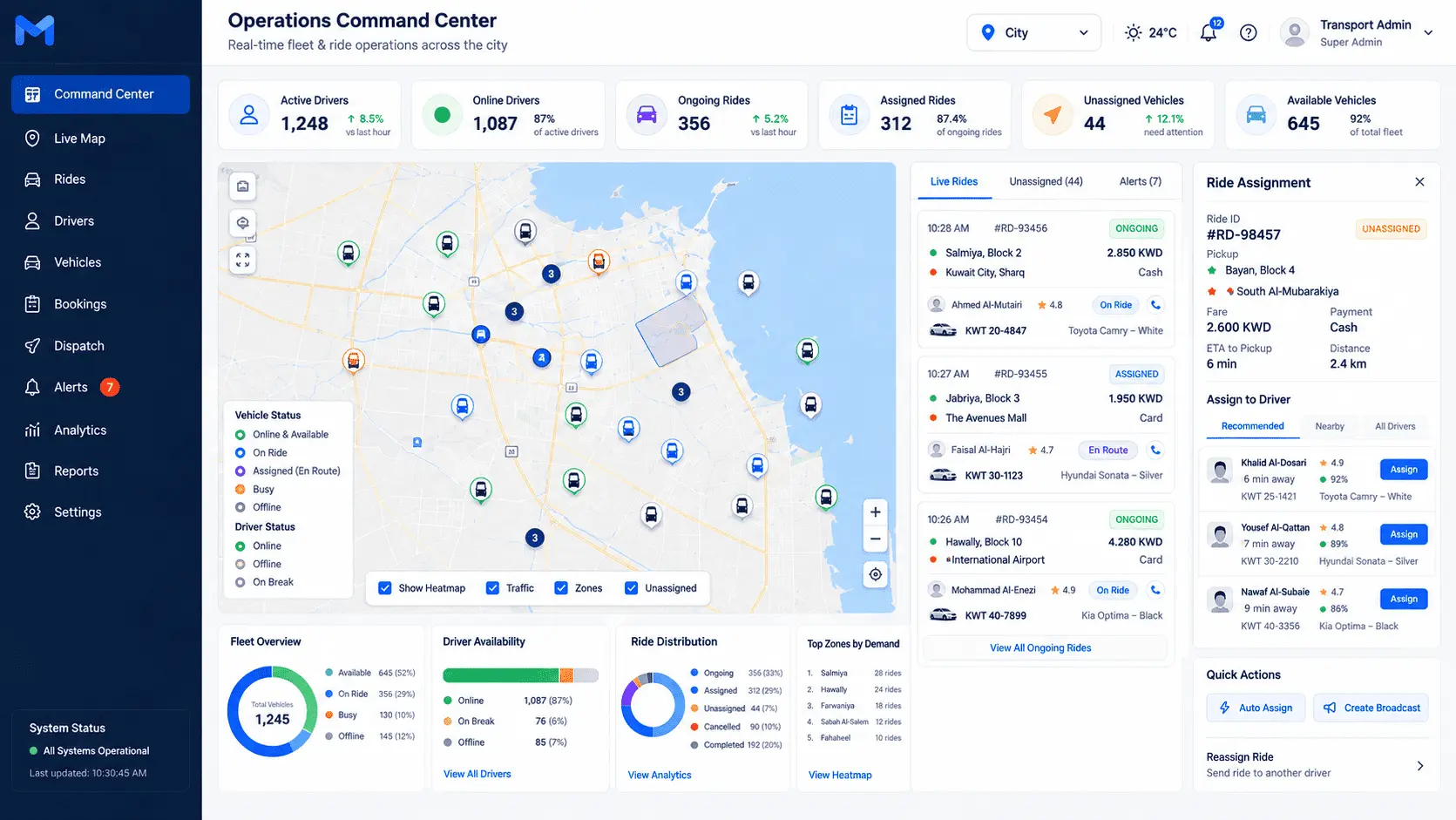
One of the notable capabilities of Taxi Booking & Fleet Management Platform is that administrators do not have to wait for a customer to initiate every ride.
1) Admin-created rides
Operators can create a customer and create a ride directly through the administration platform.
This supports situations where transportation needs to be arranged on behalf of a customer and provides operations teams with another controlled entry point into the ride lifecycle.
2) Ride status management
The platform distinguishes between key operational states:
| State |
Operational Meaning |
| Unassigned |
Ride is waiting for a driver |
| Assigned |
Driver has been assigned |
| Active |
Ride is currently being executed |
This gives operators a clearer picture of where rides are in the operational process and where intervention may be required.
3) Driver assignment and reassignment
Driver assignment considers operational information such as availability, distance, vehicle category and current ride activity.
If circumstances change after an assignment, administrators can remove the existing driver and reassign the ride rather than being locked into the original decision.
4) Vehicle management
Administrators can manage taxi services, vehicle makes, models, categories and registration details, then associate vehicles with drivers for operational use.
Operations Management
1) Control beyond the map
Real-time tracking is only one part of fleet management. Operators also need control over the commercial and financial systems surrounding each ride.
2) Fare and Offer Management
Fare configuration can account for location, start time, end time and surge percentage. This provides operators with configurable pricing controls while keeping promotional offers separate through dedicated offer management.
3) Wallet Management
Customer and driver wallets are connected to the wider mobility lifecycle.
The administration platform supports monitoring of:
Wallet balances
Transactions
Top-ups
Payouts
Refunds
Withdrawals
Pending transactions
4) Payment Management
Taxi Booking & Fleet Management Platform integrates MyFatoorah and OSTAP as payment gateways. The payment layer connects transaction activity with ride fares and wallet operations.
5) Hotspot Management
Hotspot management provides configurable zones, locations, demand levels and status.
This creates an operational foundation for identifying areas where demand and supply need closer attention, while also providing structured data that can support future demand intelligence.
Technical Architecture
A multi-layered architecture for a continuously changing operation
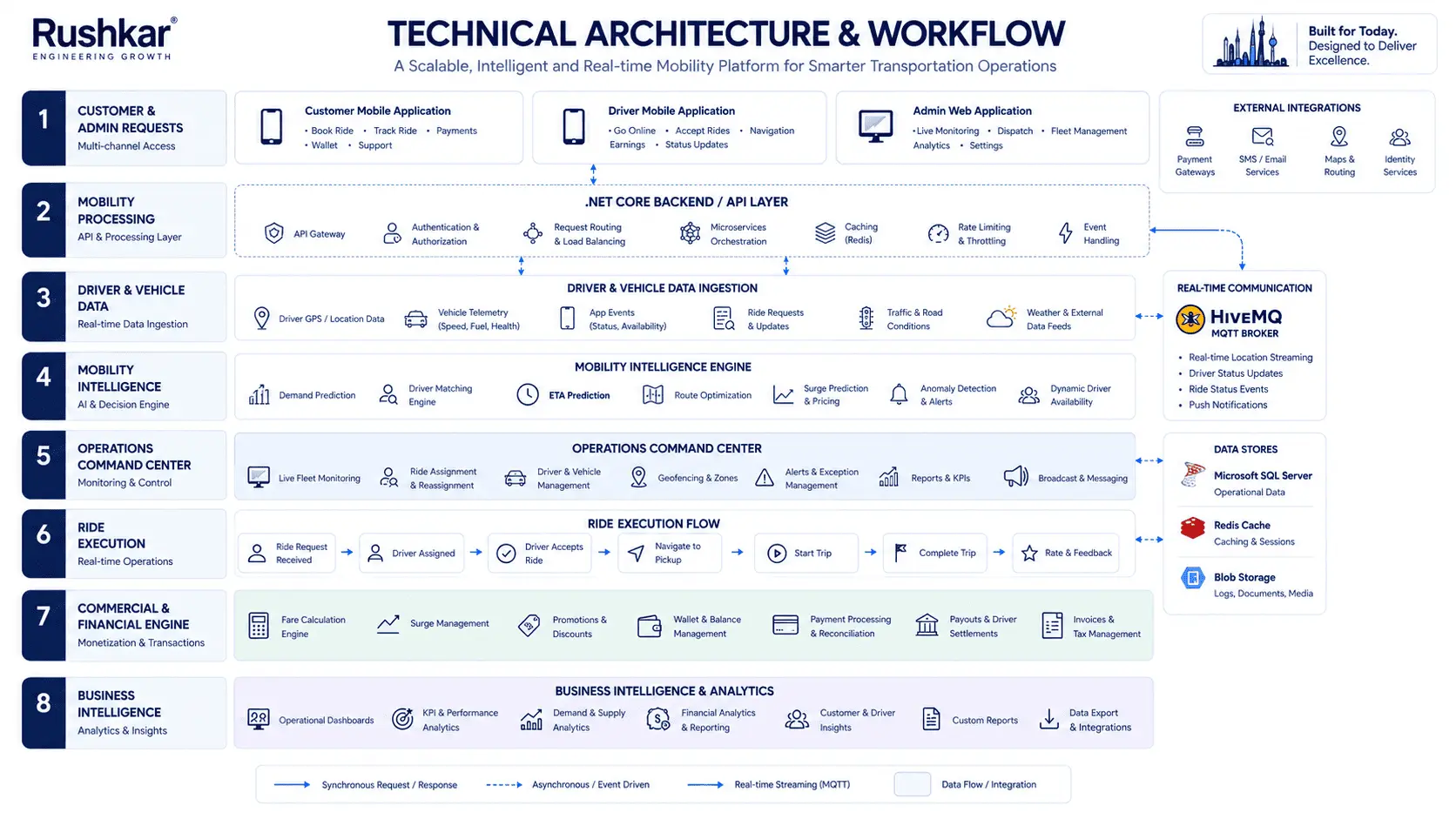
Taxi Booking & Fleet Management Platform connects several operational layers rather than treating mobility as a single booking workflow.
The architecture brings together:
Customer & Admin Requests, Mobility Processing, Driver & Vehicle Data, Intelligence, Fleet Operations, Ride Execution, Commercial Services, Business Intelligence
The backend provides the core application services, while Flutter supports the mobile experiences across customer and driver applications. Microsoft SQL Server provides structured data management, and HiveMQ/MQTT supports the real-time communication requirements of the fleet environment.
Twilio supports communication workflows, while MyFatoorah and OSTAP connect the payment layer with the broader mobility system.
The architecture was designed around the fact that fleet information does not remain static. Driver status, location, ride state and availability can change during the operating day, so the platform needs to handle those changes as part of normal system behaviour.
Intelligent Mobility Architecture
Turning operational data into decision support
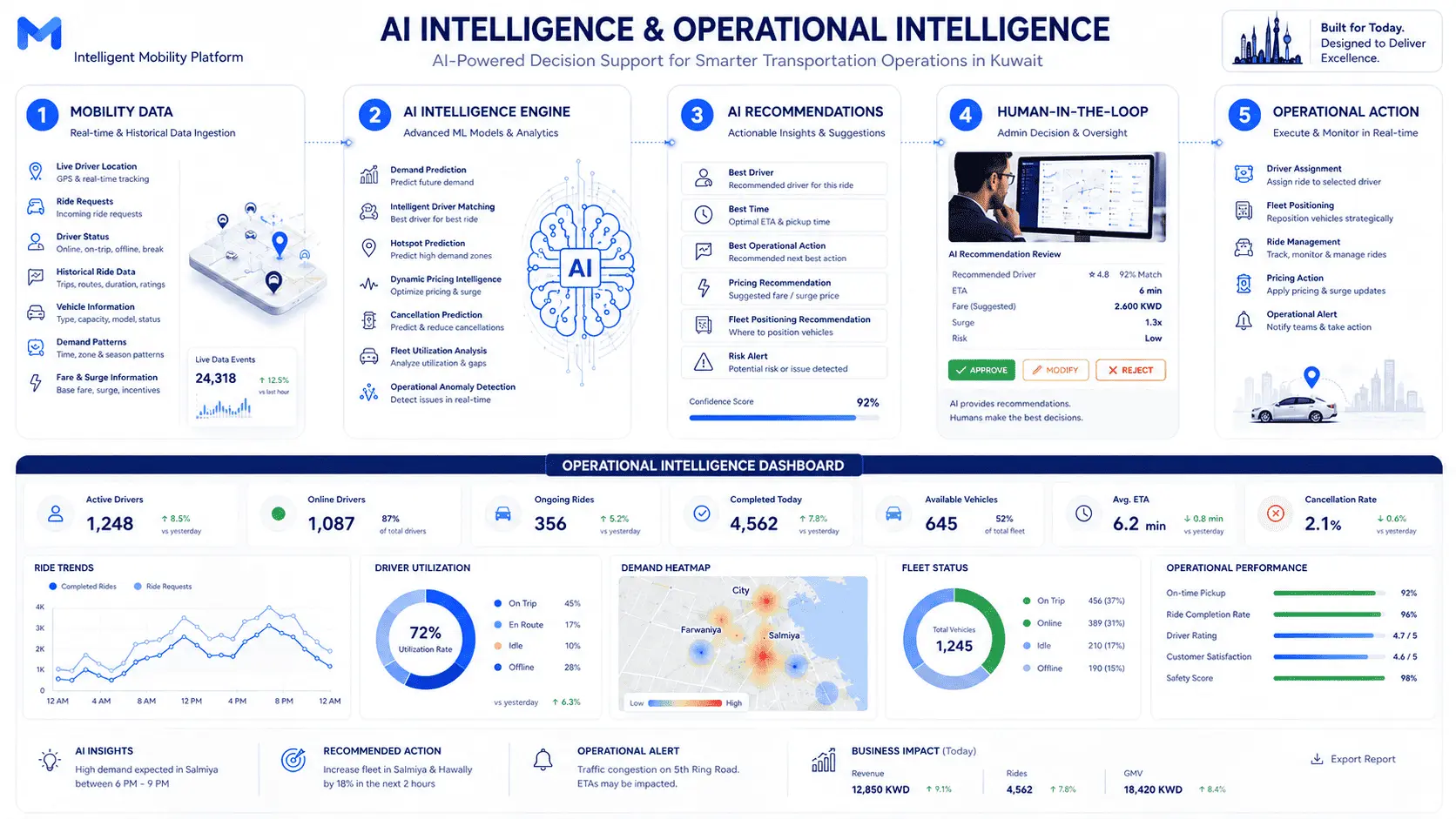
Every ride generates information.
Over time, the platform can accumulate data around booking patterns, driver availability, locations, ride types, waiting times, cancellations, vehicle categories, fares, surge activity, offers and customer feedback.
That information creates the basis for a mobility intelligence layer.
Rather than treating AI as a separate feature disconnected from the transportation system, the architecture places intelligence around the operational data already being generated.
The intended flow is:
Mobility Data, Intelligence Layer, Recommendation, Operational Decision, Action
The administrator remains part of that decision process where operational judgement is required.
AI Capabilities
Intelligence designed around real mobility decisions
The platform's data and architecture provide a foundation for several AI-assisted capabilities.
1) Intelligent Driver Matching
Driver location, availability, vehicle category, current ride status and distance can be evaluated together to support driver recommendations.
The recommendation can then be reviewed by an administrator, who retains the ability to accept or override it.
2) Demand Prediction
Historical and real-time ride activity can be analysed across factors such as:
Location
Time
Day
Ride type
Vehicle category
Demand volume
Driver supply
The objective is to identify patterns that may indicate where demand is likely to increase.
3) Predictive Hotspot Intelligence
Hotspot information can be combined with historical demand, current demand and driver supply to identify potential areas of increased demand.
This can support decisions around where available drivers may need to be positioned.
4) Driver Availability Intelligence
Online periods, location-based availability and recurring supply gaps can be analysed to identify periods or areas where additional driver availability may be required.
5) Ride and Cancellation Intelligence
Ride type, location, time, waiting periods and customer or driver activity can be examined to identify recurring cancellation patterns and operational issues.
6) Dynamic Pricing Intelligence
Taxi Booking & Fleet Management Platform's existing fare configuration provides structured inputs around location, timing and surge. These inputs can form the basis for intelligence that considers demand and supply when supporting pricing decisions.
7) Fleet Utilization Intelligence
Driver availability, assigned rides, active rides and online hours can be compared with completed rides to identify periods of unused capacity, high demand and vehicle-category requirements.
8) Operational Anomaly Detection
The intelligence layer can surface unusual patterns such as sudden cancellation increases, prolonged waiting times, assignment delays, unusual driver activity or unexpected demand spikes for operational review.
Operational Intelligence Dashboard
Bringing fleet, ride and commercial information into one view
Mobility operations become harder to manage when important information is scattered across separate screens.
The intelligence layer provides a foundation for combining operational information into a decision-support view.
Fleet Intelligence
Driver utilization, online hours, active fleet and vehicle-category performance.
Ride Intelligence
Ride volume, completion, cancellation, duration and service mix.
Location Intelligence
Demand zones, hotspots and potential supply-demand gaps.
Commercial Intelligence
Fare activity, surge usage, offers and wallet transactions.
Customer Intelligence
Booking behaviour, cancellation patterns, saved-location activity and feedback.
Operational Intelligence
Assignment delays, waiting periods, driver availability and unusual activity.
The purpose is not simply to display more charts. It is to bring related information together so transportation teams can understand what is happening and decide what requires attention.
Technical Challenges Solved
Engineering for real operating conditions
Real-Time Fleet Synchronization
CHALLENGE
Driver location, availability and ride status can change continuously.
SOLUTION
The real-time communication architecture provides the mechanism for keeping changing fleet information connected with the operational environment.
Admin-Assisted Transportation
CHALLENGE
Not every transportation request needs to originate from the customer application.
SOLUTION
Administrators can create customers and rides directly through the Admin Panel.
Dynamic Driver Assignment
CHALLENGE
A driver who initially appears suitable may become unavailable before a ride is executed.
SOLUTION
Assignment considers availability, distance, vehicle category and ride activity, while the Admin Panel provides reassignment capabilities when conditions change.
Dynamic Pricing
CHALLENGE
Transportation pricing can vary according to location, timing and surge conditions.
SOLUTION
Configurable fare management supports location, start time, end time and surge parameters.
Real-Time Operational Intervention
CHALLENGE
Transportation conditions can change after a driver has already been assigned.
SOLUTION
Administrators can manage assignments throughout the ride lifecycle, including removing and reassigning drivers when necessary.
Financial Complexity
CHALLENGE
Ride fares, wallets, payments, refunds, payouts and transactions need to remain connected.
SOLUTION
Customer and driver wallet management is integrated with payment operations and the broader ride lifecycle.
Multiple Mobility Models
CHALLENGE
Immediate rides, scheduled rides and hourly rentals follow different operational patterns.
SOLUTION
Dedicated customer flows support each service while connecting them to the same driver and administrative operating model.
Multi-Level Administration
CHALLENGE
Different members of an operations team may require different levels of system access.
SOLUTION
Role-based permissions allow administrative access to be configured around View, Add, Edit and Delete operations.
Security & Access Control
Controls built into the operating model.
Security and access management were incorporated into the operating model rather than treated as an isolated feature.
| Control Layer |
Implementation & Safeguards |
| OTP Verification |
Customer and driver registration workflows use OTP-based mobile verification. |
| Driver Verification |
Drivers can submit required documents as part of the verification process before becoming operational. |
| Role-Based Permissions |
Administrative access can be configured according to employee responsibilities, with permissions covering View, Add, Edit and Delete operations. |
| Account State Management |
Relevant workflows support states including Pending, Approved, Rejected, Active, Inactive and Suspended, allowing account status to be managed throughout the platform. |
Technology Stack
The technical foundation.
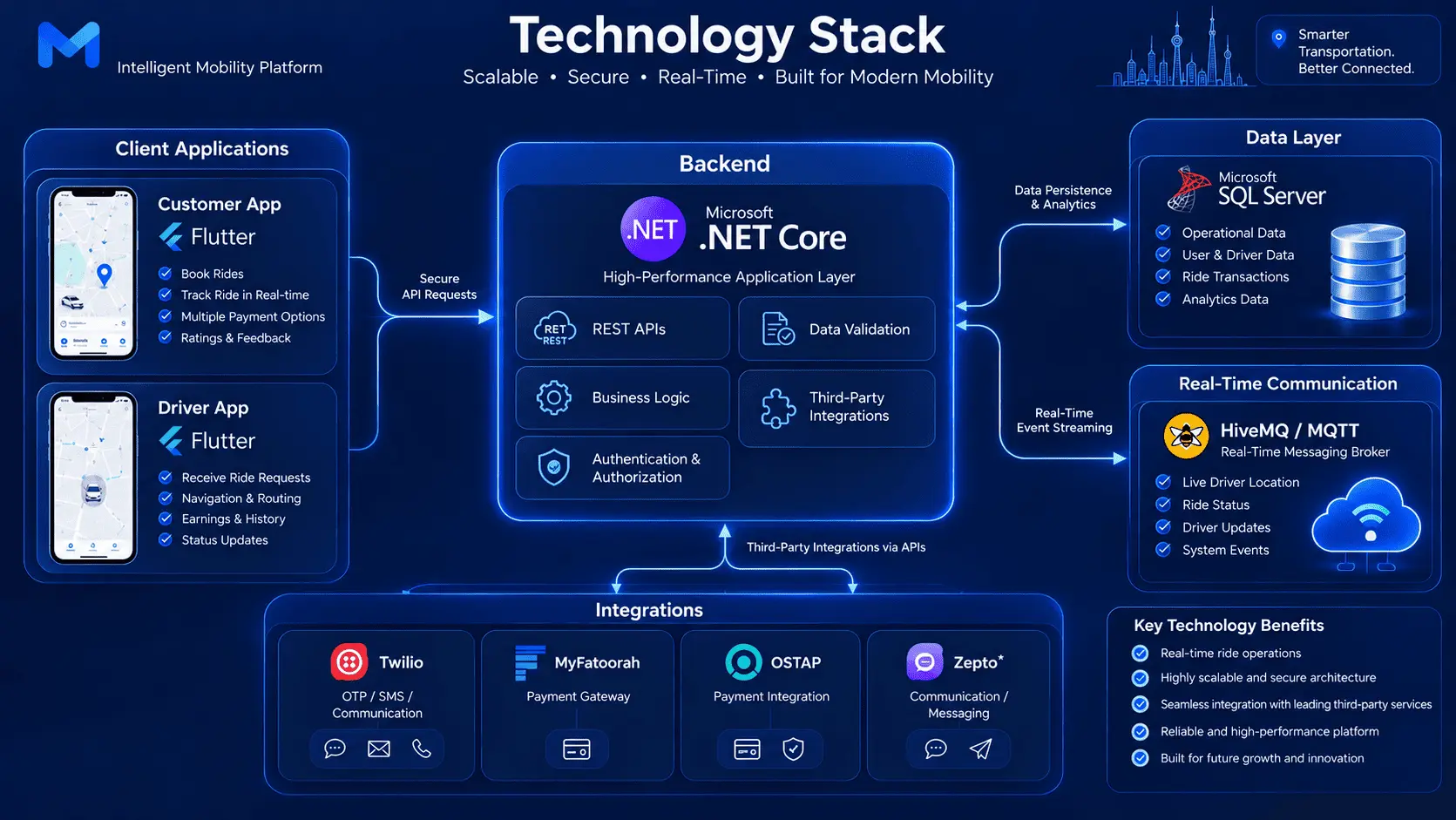
The solution combines mobile development, backend engineering, structured data, real-time messaging, communications and payment integrations.
- Backend: .NET Core
- Mobile: Flutter
- Database: Microsoft SQL Server
- Real-Time Messaging: HiveMQ / MQTT
- Communication: Twilio
- Payment Gateways: MyFatoorah, OSTAP
- Additional Integration: Taxi Booking & Fleet Management Platform*
*The exact product/service represented by “Taxi Booking & Fleet Management Platform†should be verified before publication.
Project Delivery
20 weeks from requirements to final delivery
The Taxi Booking & Fleet Management Platform platform was delivered over 20 weeks, covering requirements gathering through final delivery.
The project required several disciplines working together because the solution combined mobile applications, backend services, real-time communication, administration, payments, data management and operational workflows.
| Role |
Team Size |
| Backend Developers |
2 |
| Flutter Developers |
2 |
| Team Lead |
1 |
| Project Manager |
1 |
| QA Engineer |
1 |
| Figma Designer |
1 |
The delivery model brought product design, engineering, testing and project management together throughout the development cycle.
Key Features at a Glance
One platform, three operating experiences.
| Customer App |
Driver App |
Admin Platform |
| Registration & OTP |
Registration & OTP |
Dashboard |
| On-Demand Rides |
Document Upload |
Live Tracking |
| Scheduled Rides |
Driver Verification |
Driver Management |
| Hourly Rentals |
Vehicle Configuration |
Customer Management |
| Vehicle Selection |
Online/Offline |
Ride Management |
| Driver Tracking |
Ride Requests |
Driver Assignment |
| Driver Communication |
Ride Acceptance |
Driver Reassignment |
| Ride Cancellation |
Pickup Management |
Vehicle Management |
| Wallet & Top-Up |
Waiting-Time Management |
Fare Management |
| Saved Addresses |
Trip Execution |
Offer Management |
| Ride History |
Earnings |
Wallet Management |
| Ratings & Feedback |
Driver Wallet |
Payment Management |
| Tipping |
Ride History |
Hotspot Management |
| Notifications |
Ratings & Feedback |
Taxi Services |
| Profile Management |
Notifications |
CMS & Banners |
Business Impact
A stronger operating foundation for mobility
The value of Taxi Booking & Fleet Management Platform lies in how its different operational components work together.
Instead of maintaining separate systems for customer booking, driver management, fleet visibility, ride assignment, vehicle administration, pricing, wallets and payments, the platform brings these functions into one connected environment.
Centralized Fleet Visibility
Operations teams can view driver locations, availability and ride activity through a centralized administrative environment.
Configurable Commercial Operations
Fare rules, timing, location, surge settings and promotional offers can be managed centrally.
Greater Operational Control
Administrators can create rides, assign drivers, remove assignments and reassign drivers when transportation conditions change.
Connected Financial Operations
Customer wallets, driver wallets, payment gateways and transaction activity are connected to the wider mobility lifecycle.
Flexible Mobility Services
Customers can access on-demand rides, scheduled journeys and hourly rentals through the same mobility ecosystem.
Intelligence-Ready Architecture
The platform creates a structured foundation for demand prediction, driver matching, fleet utilization analysis, hotspot intelligence, cancellation analysis and other AI-assisted decision-support capabilities.
Six-Month Performance
Measure production performance with verified data
| KPI |
Measurement |
| Total Rides |
600,000 |
| Completed Rides |
540,000 |
| Completion Rate |
90% |
| Cancellation Rate |
10% |
| Scheduled Ride Volume |
60,000 |
| Rental Volume |
40,000 |
| Active Drivers |
900 |
| Driver Utilization |
52% |
| Average Assignment Time |
1.75 minutes |
| Payment Success Rate |
96% |
Why Rushkar?
Engineering the mobility operation, not just the application
Taxi Booking & Fleet Management Platform required more than mobile app development.
The platform brought together Flutter applications, .NET Core backend services, SQL Server, real-time messaging, payment integrations, fleet operations, administrative workflows and mobility data within one operating model.
The engineering challenge was to make these pieces work together around the realities of transportation: drivers move, ride conditions change, assignments need to be adjusted, customers need visibility and operators need the authority to intervene.
At Rushkar, a leading development and IT consulting firm, we approached the project from a larger systems perspective.
The result is a connected mobility platform where customer interactions, driver operations and administrative control are part of the same digital environment, while the operational data generated by the platform provides a foundation for deeper mobility intelligence.
FAQ
Frequently asked questions.
What is the Taxi Booking & Fleet Management Platform platform?
+
Taxi Booking & Fleet Management Platform is an intelligent mobility and fleet operations platform designed for transportation services in Gulf Cooperation Council. It connects customer bookings, driver operations, vehicle management, ride administration, fleet tracking, commercial management and payments.
What mobility services does Taxi Booking & Fleet Management Platform support?
+
The platform supports on-demand rides, scheduled rides and hourly rentals, allowing different transportation requirements to be managed within the same ecosystem.
Does Taxi Booking & Fleet Management Platform include real-time fleet tracking?
+
Yes. The administrative platform provides real-time visibility into fleet activity, including driver location, availability and ride status.
Can administrators create rides directly?
+
Yes. Administrators can create customers and rides directly through the Admin Panel, supporting operator-assisted transportation and giving the operations team direct access to the ride lifecycle.
Can administrators reassign drivers?
+
Yes. Administrators can remove an assigned driver and reassign another driver when operational conditions change.
What technologies were used to build Taxi Booking & Fleet Management Platform?
+
The documented technology stack includes .NET Core, Flutter, Microsoft SQL Server, HiveMQ/MQTT, Twilio, MyFatoorah and OSTAP, along with additional supporting integrations.
Does the platform support AI?
+
The platform's operational data and architecture provide a foundation for AI-assisted mobility intelligence, including driver matching, demand prediction, hotspot intelligence, fleet utilization analysis, cancellation analysis and anomaly detection. These capabilities should be described according to their verified production status rather than presented as deployed outcomes without supporting evidence.
Build the Next Intelligent Mobility Platform
Taxi Booking & Fleet Management Platform demonstrates how a transportation platform can move beyond customer booking and bring the customer, driver, vehicle and operator into one connected operating environment.
With real-time fleet visibility, centralized ride management, configurable commercial operations, connected financial workflows and an architecture prepared for mobility intelligence, the platform provides a foundation for transportation businesses that need greater control over increasingly dynamic operations.
Have a mobility product that needs real-time fleet management, intelligent dispatch, driver applications or custom transportation software? Rushkar can help engineer the technology behind it.