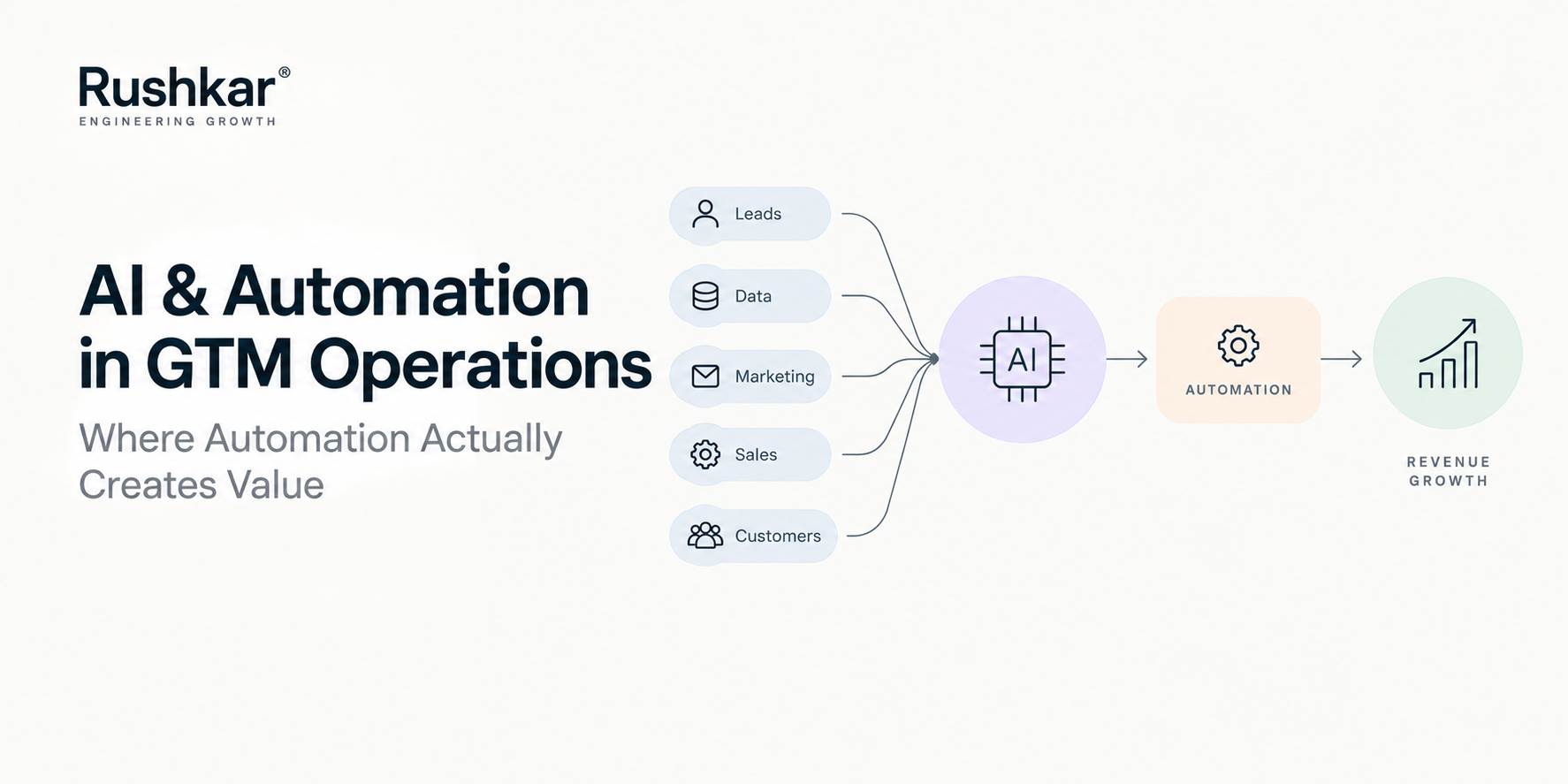
AI has found its way into almost every part of the go-to-market function. Sales teams use it for account research, marketers use it to identify and segment prospects, RevOps teams use it to clean and move data, and customer-facing teams use it to handle routine enquiries.
The problem is no longer finding something to automate.
The harder question is where AI and automation should sit inside the GTM operation, what they should be allowed to do, and how the resulting workflow should connect with the rest of the revenue system.
That distinction matters because a GTM operation is rarely one application. A typical environment can include a CRM, marketing automation platform, enrichment provider, website, communication tools, databases, analytics systems, internal applications and now several AI services. Automating one task inside one platform may save time while leaving the larger process unchanged.
Recent research reflects this shift. McKinsey's 2026 B2B Pulse Survey found that most B2B companies are already doing something with AI, but fragmented data, manual processes and disconnected teams continue to limit the value they capture. The companies making stronger use of AI are increasingly redesigning workflows rather than simply adding AI tools to existing processes.
For GTM operations, that means automation should be treated as an operating-system problem, not a collection of shortcuts.
What AI and Automation Actually Mean in GTM Operations
Automation and AI are related, but they solve different parts of the workflow.
Traditional automation follows predefined rules. If a lead submits a form, create a CRM record. If an opportunity reaches a particular stage, notify the account owner. If a customer meets certain conditions, start an onboarding sequence.
These workflows are valuable precisely because they are predictable. The system does not need to interpret anything. It simply follows the logic defined by the business.
AI becomes useful when the workflow involves information that is difficult to process through fixed rules alone.
An AI system can classify an enquiry, extract information from an email, summarise an account, analyse unstructured text, identify relevant signals, prepare a research brief or generate a response based on approved information.
The interesting part begins when the two are combined.
For example, an inbound enquiry could enter through a website, pass through validation rules, be enriched with external information, have its message classified by an AI model, and then be routed according to predefined business criteria. The AI performs a specific intelligence task, while conventional software controls what happens before and after it.
That combination is much closer to AI-powered GTM automation than simply adding an AI chatbot to a sales website.
Where GTM Automation Usually Starts
The best candidates for automation are not necessarily the most complicated activities. They are usually the repetitive activities that happen frequently and follow reasonably clear rules.
1. Lead Capture and Validation
A GTM workflow often begins before a salesperson ever sees the lead.
Information may arrive through forms, landing pages, product sign-ups, events, email, partner channels or third-party systems. Automation can standardise how that information enters the revenue system.
A properly designed workflow can check required fields, identify incomplete submissions, normalise data, detect obvious duplicates and determine which downstream process should receive the record.
This is particularly important because every later automation depends on the quality of the information entering the system.
2. Lead Enrichment
Enrichment is another area where automation can remove repetitive research.
A system can retrieve company information, industry data, technology signals, location, firmographic attributes or other approved information and associate it with the appropriate account or contact.
AI can then help interpret information that does not fit neatly into predefined fields.
But enrichment should not become an exercise in collecting everything available. More fields do not automatically produce better sales decisions. Data needs to be relevant, current and sufficiently reliable for the decision being made.
3. Lead Qualification and Routing
Qualification is where AI and conventional automation can work particularly well together.
A rules engine may determine whether a lead meets mandatory criteria such as geography, company size, product eligibility or service requirements. AI can interpret the less structured information, such as an enquiry description or email, and classify its intent.
The resulting information can then feed a routing workflow.
Instead of asking a salesperson to read every inbound enquiry, research the company and determine where it belongs, the system can prepare the relevant context and send the record to the appropriate queue or owner.
That does not mean AI should make every commercial decision. In many workflows, the system should provide a recommendation while leaving consequential decisions to a human.
Microsoft's current guidance for AI-powered sales enrichment, for example, emphasises that AI-generated enrichment is not intended to make final sales decisions and should remain subject to human oversight.
AI Is More Useful When It Handles Context, Not Just Tasks
A common mistake in GTM automation is to think about AI in terms of individual activities.
“Use AI to write emails.”
“Use AI to score leads.”
“Use AI to summarise meetings.”
Those are legitimate use cases, but they can produce a fragmented AI stack if every problem gets its own tool.
A more useful question is:
What information does the next step in the GTM process need, and how can the system prepare that information automatically?
Consider an account executive preparing for a meeting. The useful output may not be a generic AI summary. It could combine the latest CRM activity, previous meeting notes, open opportunities, support issues, relevant company developments and product usage information into a structured briefing.
The value comes from connecting those sources and presenting the right context at the right point in the workflow.
Microsoft described a similar problem in its own sales environment, where increasing amounts of available data also increased the manual effort required to find useful information. Its work on AI-led seller insights focused on bringing fragmented information together rather than simply generating more content.
That is an important distinction for GTM engineering: AI does not remove complexity by itself. The surrounding system has to organise the complexity first.
The GTM Workflow Becomes More Interesting When AI Can Take Action
There is a meaningful difference between an AI assistant that produces information and an AI system that can participate in a workflow.
An assistant might tell a salesperson that a prospect appears to be expanding into a new market.
An agentic workflow could retrieve approved account information, analyse a defined set of signals, prepare the relevant CRM update and trigger the next workflow, subject to the permissions and approval rules established by the organisation.
That introduces a different engineering problem.
Once an AI component can take action, the organisation needs to define:
- What information can the system access?
- Which applications can it interact with?
- What actions can it perform without approval?
- Which actions require human confirmation?
- How are incorrect outputs detected?
- How are actions logged and audited?
- What happens when the system cannot determine an answer confidently?
Gartner's 2026 research on AI agents in sales makes the same architectural point: adding more agents does not automatically create more productivity. Fragmented data, weak workflow integration and poor seller experience can simply cause organisations to scale their existing problems through AI.
That is why AI GTM Engineering is broader than model integration.
The model is only one component.
Where Automation Should Not Replace People
A mature GTM operation does not attempt to eliminate human involvement from every process.
Some decisions depend on commercial context, negotiation, customer relationships, regulatory requirements or information that cannot be safely reduced to a fixed rule.
A better architecture separates execution from judgement.
A system can automatically collect information, perform calculations, identify missing fields, classify a request and prepare a recommendation. A salesperson or manager can then make the decision where human judgement has greater value.
This model also makes automation easier to trust.
Instead of asking employees to accept an opaque AI decision, the workflow can show the relevant information, explain the action being proposed and request approval when necessary.
The objective is not “zero human work.” It is to remove work that does not require human judgement while preserving the parts of the process where judgement actually matters.
Why CRM Automation Alone Is Not Enough
A CRM remains central to many GTM operations, but it is rarely the complete system.
The lead may originate outside the CRM. Enrichment may happen through another provider. Product usage may sit in a database. Communication may happen through email or collaboration software. AI may operate through a separate model or application. Analytics may depend on another data environment.
That creates a technical chain:
Source → Data → Logic → AI → Decision → Action → CRM → Analytics
If those components are disconnected, adding more automation rules inside the CRM can create diminishing returns.
The system may automatically update a record, but someone still has to copy information from another platform. A lead may be automatically assigned, but the assignment may be based on outdated data. An AI-generated recommendation may look useful, but the model may not have access to the information required to make it reliable.
This is why GTM automation increasingly requires integration engineering, APIs, data pipelines, application logic and controlled AI workflows alongside CRM configuration.
Rushkar's GTM Engineering approach follows this broader architecture, connecting CRM platforms, APIs, data systems, AI services and workflow infrastructure rather than treating automation as an isolated CRM function.
The Three Layers of an AI-Enabled GTM Operation
A useful way to think about the architecture is through three layers.
1. The Data Layer
This is where customer and business information originates.
It includes CRM records, website activity, product data, enrichment sources, databases, emails, forms and other operational systems.
The priority is not simply collecting more data. It is establishing which data is trustworthy, where it comes from and how it should move through the system.
2. The Intelligence Layer
This is where AI, analytics and decision logic operate.
AI can classify, extract, summarise, recommend and interpret. Traditional rules can enforce business conditions that should remain deterministic.
The two should complement each other rather than compete.
3. The Action Layer
This is where the system actually changes something.
A lead gets routed. A CRM record is updated. A task is created. A salesperson receives a briefing. A customer receives a response. An approval request is generated.
This layer is often overlooked because teams focus heavily on what AI can produce. But the commercial value appears when the output leads to a useful action inside the actual GTM process.
Measuring Automation by Business Outcomes
Time saved is an easy metric, but it is not always the most meaningful one.
A GTM team can save hundreds of hours and still fail to improve the revenue process if those hours came from activities that were not affecting outcomes.
Better measurement connects automation to the workflow it was designed to improve.
Depending on the process, useful measures may include:
- Lead response time
- Percentage of leads requiring manual enrichment
- Duplicate-record rate
- Lead-to-opportunity conversion
- Routing accuracy
- Sales research time
- CRM data completeness
- Follow-up completion
- Opportunity progression
- Human approval rates
- AI exception rates
- Cost per automated workflow
- Revenue or pipeline influenced by the process
Gartner has recently recommended measuring AI-driven sales workflows through productivity and commercial outcomes rather than treating AI deployment itself as the achievement.
That changes how GTM teams should evaluate automation projects.
The question is not “How many AI agents have we deployed?”
It is “Which part of the revenue process became measurably better?”
The Biggest Risk: Automating a Broken Process
Automation can hide a process problem for a while, but it rarely fixes one automatically.
If lead ownership is unclear, automating lead routing may simply distribute the confusion faster.
If CRM fields are inconsistent, AI may make decisions using unreliable information.
If sales and marketing disagree about qualification criteria, an automated scoring model cannot resolve the organisational disagreement.
If nobody owns an integration, adding another workflow can make future maintenance harder.
McKinsey's 2026 research found that fragmented data, manual processes and disconnected teams remain major barriers to capturing value from AI. The research also points toward end-to-end workflow redesign rather than simply layering AI onto existing processes.
That is one of the clearest lessons for GTM operations: automation should follow process clarity, not substitute for it.
What the Next GTM Automation Architecture Looks Like
The direction is moving from isolated automations toward connected systems that can interpret information, make bounded decisions and execute defined actions.
That does not mean every GTM function becomes autonomous.
It means more of the operational work between customer signal and human action can happen without someone manually moving information between systems.
A prospect submits an enquiry. The system validates it. Relevant information is retrieved. AI interprets the request. Business rules determine eligibility. The CRM receives a structured record. The appropriate salesperson gets the context they need. The workflow records what happened. Exceptions are routed to people.
That is a very different proposition from simply installing an AI writing assistant.
Gartner's current research on sales operations describes the shift as workflow transformation: preparing data, translating business requirements into AI workflows, establishing governance, validating system performance and redesigning seller roles around the new operating model.
For companies with increasingly complex GTM stacks, that is where engineering becomes important.
AI and Automation Need an Operating Architecture
AI can reduce repetitive work, interpret information and support decisions across the GTM lifecycle. Automation can move data, enforce rules and execute predictable actions. Neither is particularly valuable when the underlying revenue systems remain disconnected.
The stronger approach is to design the workflow first, identify where deterministic automation is appropriate, identify where AI adds useful intelligence, and then engineer the connections between the systems involved.
That may involve CRM integration, APIs, data pipelines, custom applications, AI services, workflow orchestration and human approval mechanisms.
Rushkar works across these technical layers through its GTM Engineering and AI integration capabilities, including CRM integrations, AI-powered workflows, data pipelines, APIs and custom software.
The goal is not to put AI everywhere.
It is to build a GTM operation where data reaches the right system, intelligence is applied where it is useful, routine actions happen automatically, and people remain responsible for decisions that actually require them.