The titles sound similar because the work often overlaps.
A RevOps professional may spend time inside Salesforce or HubSpot building workflows. A GTM Engineer may work with the same CRM, connect it to other systems, build APIs, manage data flows and add AI to parts of the sales process. A Growth Engineer can also work with data, automation and software, but may be focused on getting more users through signup, activation or conversion.
Put three job descriptions side by side and you can easily find the same tools mentioned in all of them.
That does not make the jobs interchangeable.
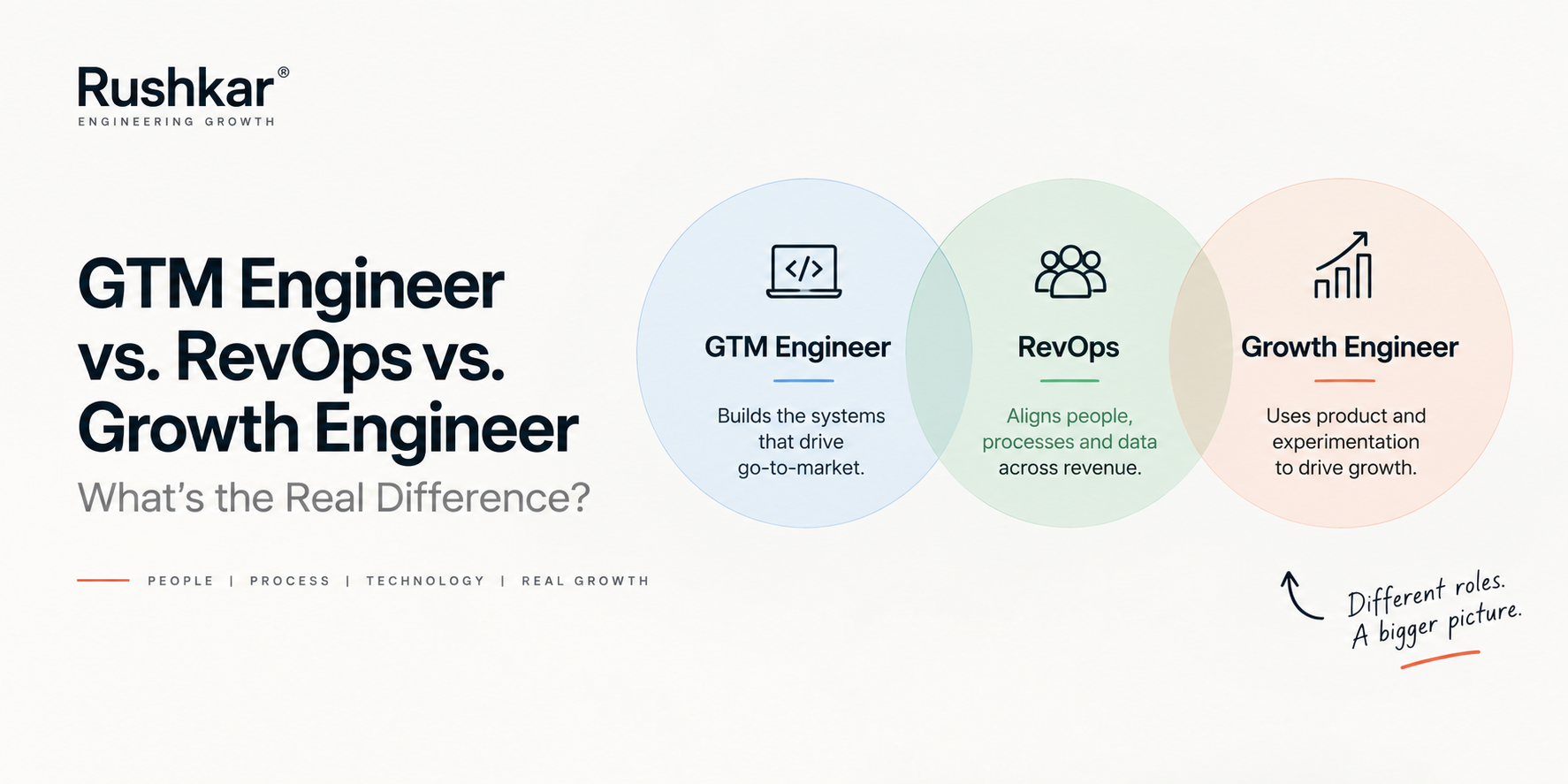
The real difference is easier to see when you stop looking at the software and look at the problem each role is responsible for solving. RevOps is concerned with how the revenue organisation operates. GTM Engineering is concerned with building the technical systems that support and automate that operation. Growth Engineering is usually much closer to the product, using engineering and experimentation to improve how people discover, adopt and continue using it.
There will be overlap. In smaller companies, there can be a lot of it. But the ownership, priorities and day-to-day work are different.
Why These Roles Get Confused So Easily
The modern revenue stack has made the old departmental boundaries much less obvious.
Sales teams use analytics. Marketing teams work with CRM data. RevOps teams build automations. Engineers work with customer information. Product teams run experiments based on revenue data. AI now sits across almost all of these activities.
That means two people with completely different responsibilities can be working inside the same platform on the same afternoon.
A RevOps manager might create a rule that sends enterprise leads to a particular sales team. A GTM Engineer might build the integration that checks company information from an external source before that rule runs. A Growth Engineer might build a product event that identifies when a free user reaches a particular stage of product adoption.
All three are dealing with data.
Only one is primarily responsible for the revenue operating process, one is building the technical machinery around it, and one is changing the product experience.
That distinction is more useful than trying to memorise three job descriptions.
What Does a RevOps Professional Actually Do?
RevOps sits closest to the operation of the revenue organisation.
Its responsibilities can include CRM structure, pipeline stages, territory management, lead lifecycle definitions, forecasting, reporting, data quality and the processes connecting marketing, sales and customer success.
The work often starts with questions such as:
- Why are leads sitting unassigned?
- Why are opportunities being reported differently by two teams?
- Why are salespeople following different qualification processes?
- Why does the forecast not match what is actually happening in the pipeline?
- Who owns an account when it moves between territories?
These are not primarily coding questions. They are questions about how the revenue organisation should function.
Gartner describes Revenue Operations as a function that brings together processes, data and technology across the revenue cycle rather than allowing sales, marketing and customer functions to operate in isolation.
A RevOps team may absolutely use automation and technical tools. In fact, it often becomes the team that identifies where automation is needed.
But there is a useful distinction between defining the operating rule and engineering a system that executes the rule across several platforms.
That is where the GTM Engineer enters the picture.
What Does a GTM Engineer Actually Do?
GTM Engineering is much closer to the construction of the revenue system.
Consider a relatively ordinary requirement: route a new lead to the right salesperson.
The business rule might say that account size, geography, industry, existing account ownership and product interest should determine the assignment.
That sounds like something a CRM workflow could handle.
Then the details arrive.
Company size comes from an external data provider. Existing account ownership sits in the CRM. Product interest comes from website activity. Industry needs to be classified. Some accounts belong to parent organisations with several subsidiaries. Certain records have to be reviewed before they are routed.
Now there is an engineering problem.
Someone needs to connect the systems, retrieve and validate the information, apply the rules, handle exceptions and make sure the result reaches the CRM correctly.
That is the kind of work associated with a GTM Engineer.
The role is still developing, so there is no single job description that every company follows. Current industry definitions commonly place GTM Engineering around revenue automation, enrichment, CRM systems, integrations, AI workflows, data infrastructure and other technical processes that support go-to-market execution.
The important word here is technical.
A GTM Engineer is not simply another name for a RevOps manager who knows how to configure a CRM. The role becomes particularly useful when a revenue process crosses several systems or requires engineering beyond standard platform configuration.
What Does a Growth Engineer Work On?
Growth Engineering usually starts much closer to the product and user experience.
Think about a SaaS company with plenty of visitors but poor activation. People create accounts, but too few reach the point where they experience the product's core value.
A Growth Engineer might investigate the user journey, instrument the relevant events, identify where users drop off, build a new onboarding experience and run an experiment to see whether the change improves activation.
The same person might work on signup, pricing interactions, referral mechanisms, product-led acquisition or retention.
The terminology varies from company to company, but current Growth Engineer roles commonly combine software development with experimentation, analytics and product-led growth work across areas such as acquisition, activation, conversion and retention.
This is where the boundary with GTM Engineering becomes clearer.
A Growth Engineer is generally changing what the user experiences.
A GTM Engineer is generally changing how the revenue operation works behind the scenes.
There are exceptions, particularly in product-led businesses, but that is a useful starting point.
One Lead Can Involve All Three Roles
The easiest way to understand the difference is to follow one prospect through a business.
Someone arrives through the website and submits a form.
RevOps may have defined what information is required, what qualifies as a sales-ready lead and which sales team should own the account.
A GTM Engineer may have built the system that checks the existing CRM, enriches the company record, applies the routing logic and sends the necessary information to the sales team.
If that prospect later signs up for the product, a Growth Engineer may be working on the onboarding experience, tracking activation and testing changes designed to move the user towards becoming an active customer.
The same person has now passed through systems influenced by all three functions.
That does not mean the three roles are competing for ownership.
They are working on different parts of the same commercial journey.
RevOps and GTM Engineering Have the Most Overlap
This is probably the distinction that causes the most confusion.
Both functions can work on CRM systems. Both can deal with lead routing, data quality and automation. Both may spend time investigating why a revenue process is not behaving as expected.
The difference often comes down to business logic versus technical implementation.
Imagine RevOps discovers that high-value accounts are being routed incorrectly.
The RevOps team may examine the existing process and decide that routing should depend on account value, territory, existing ownership and a set of qualification rules.
The GTM Engineer may then build the system that collects those inputs from the relevant platforms and applies the decision automatically.
RevOps owns the question:
“What should happen?”
GTM Engineering is often dealing with:
“How do we make that happen reliably across the systems involved?”
Of course, real organisations are rarely this clean. A technically strong RevOps professional may build the workflow personally. A GTM Engineer may help define the logic because the existing process cannot be implemented as described.
The point is not to create a strict organisational wall.
It is to understand where each capability is strongest.
GTM Engineering and Growth Engineering Solve Different Growth Problems
Both roles have “growth” somewhere in their purpose, which makes the distinction easy to miss.
A Growth Engineer might notice that visitors from organic search are signing up but not activating. The engineering work could involve changes to onboarding, product messaging, feature discovery or the signup flow.
A GTM Engineer might notice that marketing is generating qualified accounts but the sales team is receiving incomplete information and spending too much time researching them.
The first problem lives inside the product experience.
The second lives inside the revenue system.
This difference also affects how success is measured.
Growth Engineering may look closely at metrics such as activation rate, conversion rate, retention or experiment results.
GTM Engineering may be concerned with lead-processing time, routing accuracy, data quality, automation reliability, research effort or the performance of a revenue workflow.
RevOps may look at a wider operational picture, including pipeline health, forecasting accuracy, sales productivity and consistency across teams.
The numbers can influence one another, but they are not measuring the same work.
AI Is Making the Boundaries Less Obvious
AI is now appearing in all three areas, which makes job titles even less useful as a guide.
RevOps might use AI to analyse pipeline information, improve forecasting or identify unusual patterns in customer data.
A GTM Engineer might build an AI workflow that researches accounts, classifies leads, extracts information from websites or prepares context for salespeople.
A Growth Engineer might use AI inside the product to personalise experiences, analyse behaviour or build new product interactions.
The technology is similar.
The purpose is different.
That matters because AI also increases the importance of the systems around it. Salesforce's 2026 sales research found that disconnected systems remain a significant obstacle for organisations implementing AI in sales. McKinsey's 2026 B2B research similarly identifies fragmented data and disconnected processes as barriers to capturing value from AI.
An AI model does not solve a fragmented revenue architecture simply because it has been added to it.
If customer information is scattered across a CRM, enrichment platform, marketing system and internal database, someone still needs to decide how that information should move between them.
That technical responsibility increasingly falls within GTM Engineering.
So, When Do You Need Each Role?
The easiest way to decide is to start with the problem rather than the job title.
If your sales and marketing teams have unclear processes, inconsistent definitions, poor CRM discipline or unreliable revenue reporting, you probably have a RevOps problem.
If the process is understood but implementing it requires APIs, integrations, data pipelines, complex automation or AI workflows across several systems, you are much closer to a GTM Engineering problem.
If the main issue is that users are not signing up, activating, converting or staying engaged with the product, Growth Engineering is closer to the work.
There is no rule saying a company must hire all three.
A small SaaS company might have one RevOps person handling some technical work. Another company might have engineers supporting RevOps whenever a workflow becomes complicated. A larger organisation may eventually have separate teams with clearly defined responsibilities.
The right structure depends on where the bottleneck actually sits.
Can One Person Be All Three?
At an early-stage company, sometimes.
A technically capable person might maintain the CRM, build a few automations, analyse funnel behaviour and even make changes to the product. It can work while the business is small and the number of systems is manageable.
The problem appears when those responsibilities start competing with one another.
The person responsible for keeping the CRM clean is also building an AI research workflow. The same person is being asked to analyse product activation and fix a broken integration. Eventually, something gets neglected.
This is usually the point where companies begin separating responsibilities.
The separation does not have to happen through three completely independent departments. It can happen through clearer ownership, specialist contractors, an internal engineering team or an external partner.
What matters is that someone is responsible for each layer.
Where Rushkar Fits
For companies that already have RevOps but need deeper technical capability, this distinction is particularly useful.
At Rushkar, GTM Engineering focuses on the technical layer around revenue operations, including CRM integrations, APIs, data workflows, AI components, automation and custom software. The role is not to replace the people who understand the company's sales process or revenue model.
Instead, engineering can take the requirements defined by the business and turn them into systems that work across the technology already in use.
That could mean connecting a CRM with external data, building a custom workflow, integrating an AI component or developing software where standard automation tools cannot represent the required process cleanly.
For a company evaluating GTM Engineering Services, that distinction is worth keeping in mind. The value is not in having another person who can create CRM workflows. It is in having engineering capability available when the revenue process has become too technically involved for ordinary configuration.
The Job Title Is Not the Important Part
There is still plenty of overlap between GTM Engineer, RevOps and Growth Engineer, and that is unlikely to disappear. The technology used by revenue and product teams keeps moving into the same territory, particularly as AI becomes part of everyday workflows.
But the underlying responsibilities remain different.
RevOps is primarily concerned with how the revenue organisation operates. GTM Engineering builds the technical systems that connect and execute that operation. Growth Engineering focuses on improving the product and the user journey through engineering, data and experimentation.
Once you look at the problem each person owns, the titles become much easier to understand.
The question is not really whether you need a GTM Engineer, a RevOps professional or a Growth Engineer.
The better question is: where is the problem, and what kind of work is required to fix it?