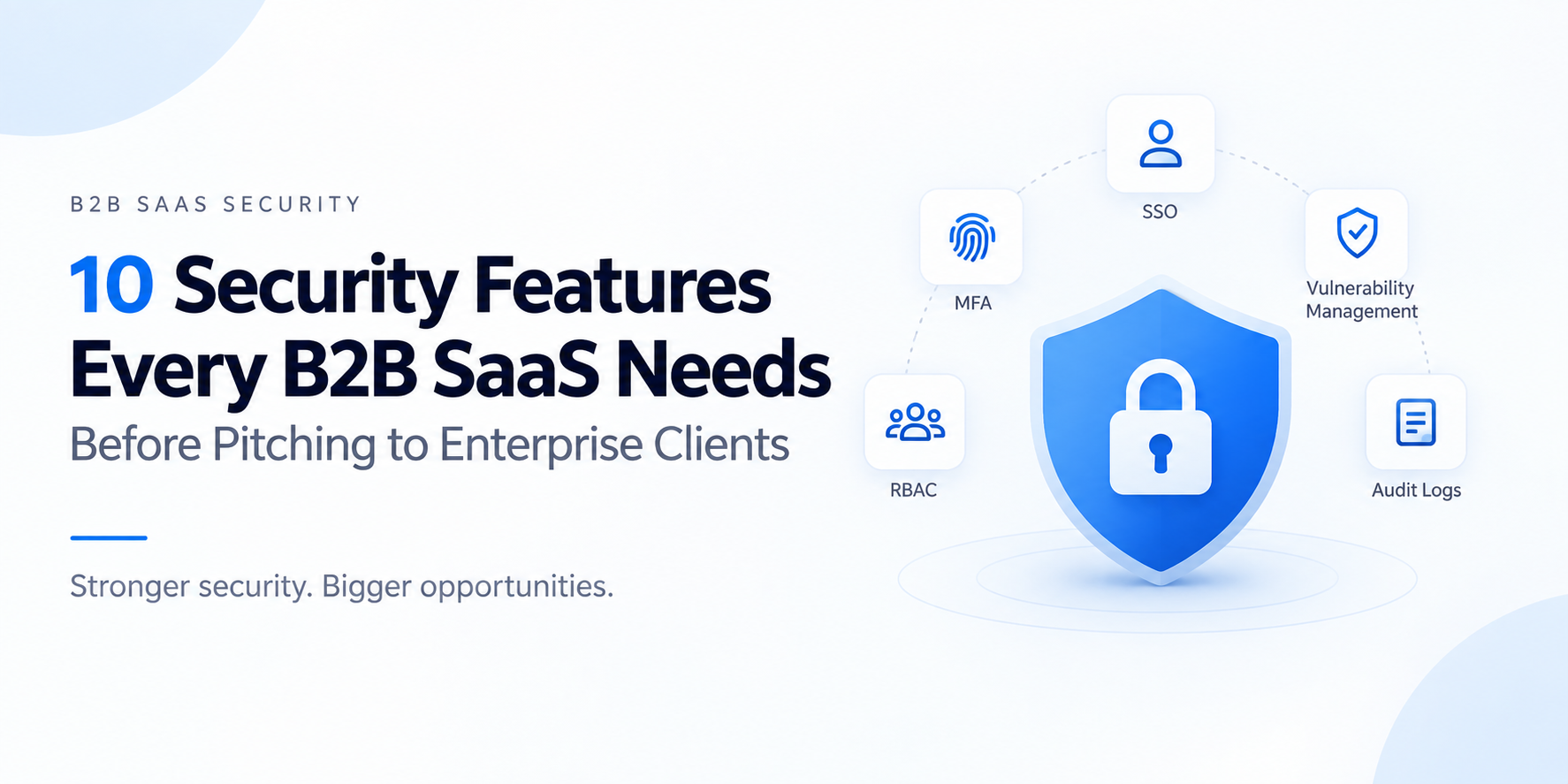
Selling a B2B SaaS solution to a company is rarely as easy as showing it to them. Enquiries swiftly transcend functionality and cost when the buyer's security, IT, procurement, and compliance teams get engaged. They want to know how users log in, who can access client data, what happens when an employee leaves, how vulnerabilities are found, what data is recorded, and whether the vendor can provide proof of its controls.
This modifies how application security works. The product team is no longer behind it. Security becomes a crucial component of the product, the engineering process, and ultimately the go-to-market strategy for a SaaS company that approaches corporate sales.
Frameworks like NIST's Safe Software Development Framework, the OWASP Application Security Verification Standard, and CIS Controls consider safe development, access control, vulnerability management, and security logging to be ongoing engineering practices rather than one-time testing.
The barrier is significantly greater for SaaS offerings that include CRM systems, APIs, enrichment platforms, AI services, and automated processes. Each integration creates a new identity, credential, data flow, or automated action that must be managed.
Before employing a B2B SaaS solution in large commercial engagements, the following security measures should be in place.
1. Enterprise SSO With SAML or OpenID Connect
Business clients do not want hundreds of employees to have different passwords for each SaaS service they use. They anticipate the application to integrate with their present identity infrastructure.
As a result, one of the most significant technology needs to meet is single sign-on (SSO).
A B2B SaaS application should be able to interface with existing identity providers using protocols such as SAML 2.0 and OpenID Connect. According to Microsoft, SAML is a well-known federation protocol that is frequently used in commercial applications, but OIDC is better suited to current web apps, mobile applications, and APIs.
There is more to the technological effort than a simple "Sign in with SSO" button. A production solution requires tenant-specific identity settings, certificate or key management, claims mapping, redirect URI handling, session management, and transparent access limiting.
In the case of a multi-tenant SaaS platform, SSO settings should be associated with the relevant client tenant. The identifying configuration of one organization should never be applied to another.
2. MFA That Actually Protects the Account
Another essential security step is multi-factor authentication (MFA), but its implementation is not finished by just offering an authenticator app option.
The implementation of MFA, which accounts for the need, what happens during account recovery, and whether privileged acts call for more stringent authentication are the main issues.
Routine authentication and higher-risk activities are distinguished by an appropriate design. Even after the initial login, further verification may be required if financial information, security settings, API credentials, or administrator permissions are changed.
CIS controls specifically incorporate access-control management and the use of multi-factor authentication as security protections.
The rehabilitation process demands special care. If an attacker can defeat MFA by requesting a password reset via a flaw in the recovery method, the presence of MFA is mostly cosmetic.
3. RBAC With Real Least-Privilege Enforcement
What an authorised user is permitted to do should be determined by role-based access control (RBAC), not just which interface buttons are visible.
A typical SaaS permission model might look like this:
User → Tenant → Role → Permission → Resource → Action
For instance, a salesperson could be permitted to see leads but not export the entire customer database. Invoices may be managed by a billing administrator without requiring access to the security configuration. Critical processes still need additional limitations, even when a platform administrator can keep an eye on users.
Regardless of the frontend, the API must uphold these decisions. It is not authorised to conceal a button.
For multi-tenant systems in particular, this is crucial. Every request to access tenant-owned data should ascertain if the user is permitted to access that particular resource inside that tenancy in addition to determining whether the user is authenticated.
Access-control management, which encompasses privilege creation, assignment, maintenance, and revocation, is a crucial security measure, according to CIS.
4. Strong Tenant Isolation
RBAC responds to who is capable of carrying out an activity. Tenant isolation determines which customer data an activity may access.
This differentiation is crucial for a B2B SaaS offering.
Imagine an API request containing:
GET /customers/18472.
The requester's valid session shouldn't be the only factor used by the program. It must confirm that the user's job permits access and that customer 18472 matches the tenancy linked to the permitted identity.
Both the server and data-access levels need to have this check. It is never appropriate to use the tenant identification that the browser provides as evidence of ownership.
Shared databases, different schemas, and database-per-tenant models will all have different architectures, but the security objective is always the same: a customer's authorised session cannot lead to another customer's records.
Therefore, rather than being a database configuration item in commercial SaaS, tenant isolation should be considered a crucial application-security feature.
5. Continuous Vulnerability Management
A once-a-year penetration test cannot determine whether a vulnerability created by last week's dependency update is still active.
Security requires a procedure that extends beyond the first product delivery.
CIS Control 7 particularly demands continuous vulnerability management, which includes identifying and tracking vulnerabilities in order to repair them and limit the exposure window. NIST's SSDF also covers discovering and reacting to residual vulnerabilities as part of secure software development.
A practical workflow looks like this:
Discover → Assess → Prioritise → Assign → Remediate → Retest → Close
Examples of this strategy include dependency scanning, static analysis, dynamic application security testing, container scanning, infrastructure inspections, and recurring penetration testing.
The number of security tools is not as important. It relates to post-fix verification, repair timelines, severity standards, and whether discoveries have owners.
6. Dependency and Software Supply-Chain Controls
A SaaS application is rarely built fully with code written by its own developers. Frameworks, packages, container images, SDKs, APIs, cloud services, and third-party components are all necessary for its operation.
Every reliance increases the potential risk of vulnerability.
Therefore, a well-developed development process should be aware of the components that are being added to the program and whether or not they have known vulnerabilities. This might include software bills of materials (SBOMs), signed artefacts, controlled package sources, dependency scanning, container image scanning, and CI security gates, depending on the situation.
The goal of NIST's SSDF is to include security procedures, such as software protection and safe release creation, within the software development lifecycle.
This is particularly important for AI-enabled SaaS. The dependency chain of an application includes model APIs, vector databases, agent frameworks, browser automation, and external AI services. Safe development and risk management across the AI lifecycle are addressed as distinct technological concerns in NIST's generative-AI security recommendations.
7. Centralised Security Audit Logging
Developers can learn what the software was doing via application logs. Security audit logs must provide security teams with information about what transpired in terms of access and control.
Useful events can include:
- login_success
- login_failure
- mfa_enabled
- mfa_disabled
- role_changed
- permission_denied
- api_key_created
- api_key_revoked
- user_invited
- user_removed
- sensitive_record_accessed
- security_setting_changed
While maintaining the sensitive data that the event was intended to protect, the logs should offer sufficient context to analyse an occurrence.
While higher assurance levels involve recording authorisation decisions and sensitive-data access without retaining the sensitive data itself, OWASP ASVS 5.0 mandates that authentication activity and unsuccessful authorisation attempts be recorded.
Additionally, audit logs must be collected, examined, maintained, and used to identify, understand, or recover from attacks in accordance with CIS Control 8.
This functionality could be equally important to a business customer as the login procedure. When something goes wrong, they require documentation of what happened.
8. Encryption and Proper Secrets Management
Encryption should safeguard data as it is sent over networks and, if needed, while it is kept.
This covers encryption rules for databases, backups, object storage, and other sensitive data repositories in addition to TLS for application communication.
But encryption only solves part of the issue. Database credentials, API keys, signing keys, OAuth credentials, service identities, and integration tokens are examples of secrets on SaaS systems.
Source code or traditional configuration files that have been committed to Git shouldn't include these secrets. For privileged operations, they need rotation, restricted access, controlled storage, and an audit record.
This is particularly important for AI automation and GTM engineering. Many credentials may be needed for a procedure that connects a CRM to a messaging platform, an AI service, and an enrichment provider. Sometimes, an automated credential that has been compromised can access or change a lot more data than the average application user.
As a result, security must monitor not only the user signing into the SaaS interface but also the data and machine identities involved in the workflow.
9. Security Monitoring and Actionable Alerts
Gathering logs without examining them results in a storage system instead of a security monitoring capability.
Events that need to be addressed should be described in a SaaS platform, along with how they generate notifications.
For example:
Repeated login failures → Multiple source IPs → Short time interval → Potential account compromise → Security alert
Abrupt permission changes, strange API key creation, persistent authorisation issues, unforeseen administrative activity, or unusual access to vital resources are further significant symptoms.
Depending on the product and threat model, different detection criteria will apply. It's crucial that security events have a defined operational destination and a person in charge of responding to important alerts.
CIS specifically concentrates audit logging not just on collection but also on alerting, review, and retention.
10. Security Evidence for the Enterprise Buying Process
The fifth component is less obvious inside the product, but it usually shows up throughout the procurement process.
Security architecture documents, penetration test findings, vulnerability management techniques, incident response paperwork, access-control rules, data flow diagrams, and independent assurance studies can all be requested by enterprise buyers.
This is the point at which the engineering discipline of a product is incorporated into its GTM motion.
The AICPA Trust Services Criteria, which cover security, availability, processing integrity, confidentiality, and privacy, are the foundation of SOC 2, for instance. It shouldn't be offered just as a label designating a product as "secure" the scope of the investigation and the underlying controls.
A sales team need more than a website's security credentials. A defensible response is necessary when a prospect asks about client data migration, access control, vulnerability management, or evidence to support such claims.
This is where GTM operations, engineering, security, and compliance start to come together.
Where AI and GTM Automation Change the Security Equation
The modern GTM stack may look significantly different from a standard SaaS application.
Online forms may transfer customer data to CRMs, enrichment services, AI models, lead scoring pipelines, and ultimately sales automation.
Website → CRM → Data Enrichment → AI Processing → Scoring / Qualification → Automated Action
A data transfer and a system boundary are indicated by each arrow.
AI adds a new factor: instead of only producing text, the application may now enable a model or agent to influence behaviours. In addition to emphasising risk management across the AI lifecycle, the NIST AI Risk Management Framework and its generative-AI profile also include security, privacy, reliability, transparency, and related trustworthiness attributes.
Scoped API credentials, tenant-aware permissions, defined approval boundaries for high-impact operations, prompt and output handling, audit trails for automated actions, and a clear division between what an AI system may propose and execute are examples of practical controls for AI-powered GTM systems.
This difference is crucial in corporate sales. Before an automated agent alters CRM records, sends out external communications, or accesses sensitive customer data, the buyer can accept AI-assisted analytics.
A Practical Enterprise SaaS Security Checklist
Before approaching larger customers, a SaaS team should be able to answer these questions clearly:
- Can business users utilise OIDC SSO or SAML for authentication?
- Is it possible to employ MFA for both privileged operations and users?
- Are server-side RBAC and least privilege used to enforce permissions?
- Are renters' consumer data adequately segregated?
- Are vulnerabilities routinely identified, ranked, fixed, and retested?
- Is dependence on external parties kept an eye on?
- Are security incidents collected and archived centrally?
- Are API secrets and passwords stored and cycled safely?
- Are monitoring and warnings connected to pertinent security events?
- Can the company provide solid proof of its security protocols?
If there are still several responses that say, "We plan to add that later," the product might not be prepared for the security issues associated with commercial purchases.
When designing their security architecture, teams utilising cloud infrastructure, AI services, CRM interfaces, and automated GTM procedures should keep the system as a whole in mind. Instead of addressing each layer as a distinct implementation process, Rushkar Technology links application design, integrations, automation, and AI capabilities to solve this kind of engineering work.
Conclusion
A week before a sales meeting, adding a security page to a SaaS website does not accomplish enterprise readiness.
Identity verification, permissions enforcement, tenant isolation, vulnerability tracking, secret protection, security event recording, and automated systems working within predetermined boundaries are engineering controls that give birth to it.
When a product is integrated with AI services, CRM platforms, APIs, data-enrichment systems, and automated GTM procedures, it becomes even more crucial. The security architecture must be more thoughtful as the number of systems involved increases.
Gathering every potential security feature is not the objective for a developing SaaS firm. The goal is to provide controls that can be watched, tested, demonstrated, and clarified when a corporate customer starts posing challenging queries. At that moment, application security becomes a component of the product's capacity to penetrate wider markets rather than just a technological checkbox.
FAQs
What security features should a B2B SaaS have before approaching enterprise customers?
An enterprise-oriented SaaS solution must include strong authentication, SSO, MFA, role-based access control, tenant isolation, vulnerability management, secure secrets handling, encryption, security audit logging, monitoring, and a process for providing security evidence.
Is SSO more important than MFA for enterprise SaaS?
They address a variety of concerns. While MFA improves authentication, SSO integrates the SaaS product with the client's identity infrastructure. Business clients would expect both, particularly if the tool handles proprietary business data.
Why is RBAC important in a B2B SaaS application?
Depending on their responsibilities and permissions, RBAC restricts what authorised users may do. It must also work in tandem with tenant-level authorisation in a multi-tenant SaaS system to stop a legitimate user from one company from accessing the resources of another.
How should SaaS companies manage vulnerabilities?
Vulnerability management ought to be ongoing. The procedure should find vulnerabilities, evaluate how serious they are, assign blame, fix them, and make sure the fix is successful. Vulnerability response should be addressed as an ongoing software security activity, according to NIST's SSDF and CIS Controls.
Does adding AI to a SaaS product create additional security requirements?
It is possible. New data flows, model-provider connections, service credentials, automated decisions, and agentic actions are a few examples of AI applications. Access limits, data management, recording, human consent for sensitive actions, and monitoring should all be taken into account throughout the design of AI systems rather than after they are put into use. The appropriate restrictions differ from system to system.