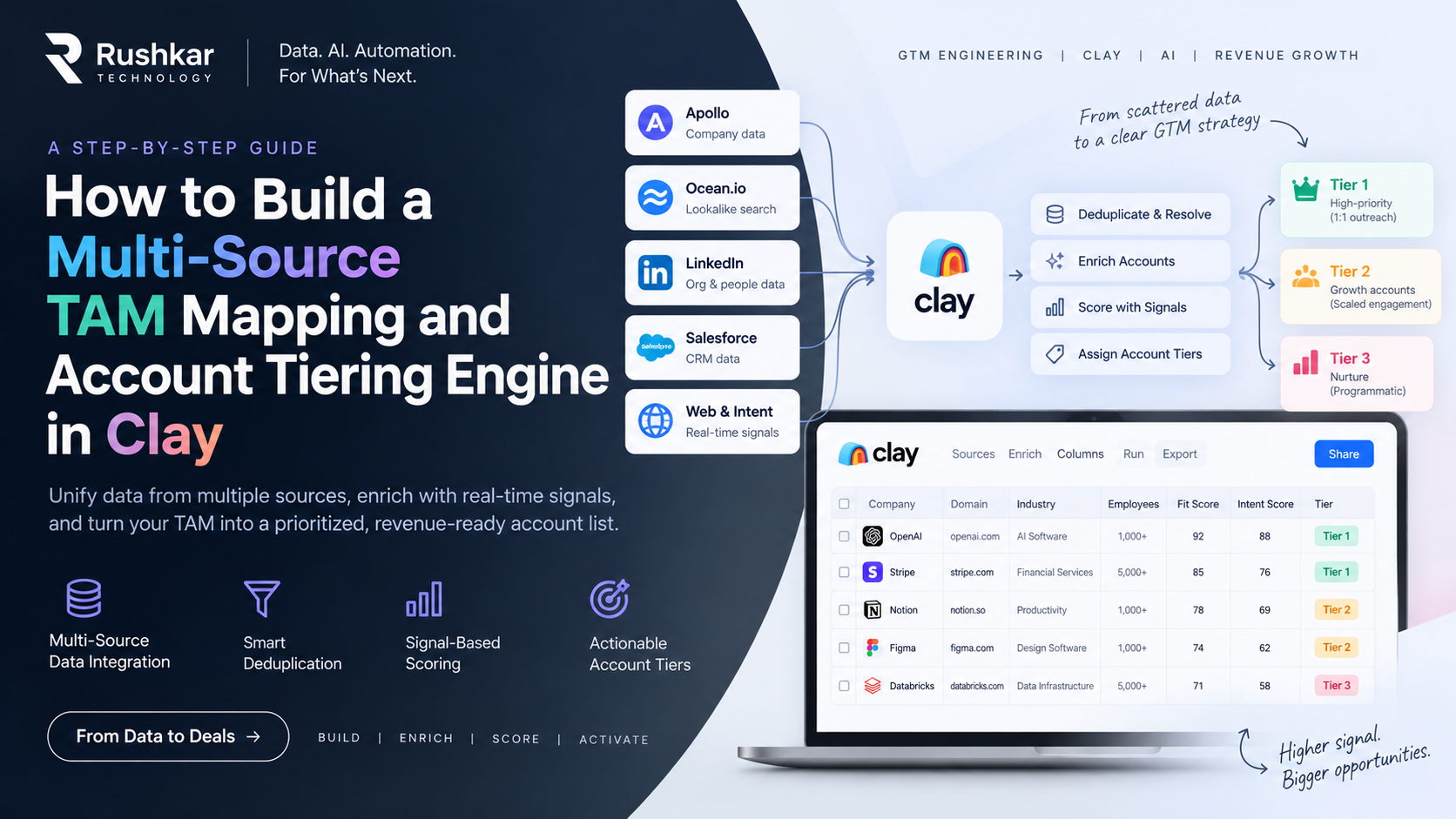
A total addressable market is not useful simply because it contains a large number of companies. The real value comes from knowing which accounts belong in the market, which ones actually fit your ICP, which ones are showing buying signals, and how much sales attention each account deserves right now.
That becomes difficult when the underlying account data comes from several sources.
One database may provide strong firmographic coverage. Another may identify lookalike companies. A third may provide better professional or organisational data. Your CRM contains first-party history, while product analytics, website activity, hiring signals, funding events and technology data add another layer of context.
Put those sources together without a proper resolution model and the result is usually a large spreadsheet containing duplicates, conflicting attributes and accounts that cannot be prioritised consistently.
Clay is well suited to solving this because its current data model supports company discovery, CRM sources, enrichment, webhooks, scheduled sources, transformations and exports within the same workflow environment. Clay's own documentation describes sources as the starting point for tables and supports company discovery, CRM imports, CSV data and webhook-driven inputs.
The important part, however, is not the tool.
It is the architecture.
A reliable TAM mapping and account tiering engine in Clay should separate account discovery, identity resolution, enrichment, signal collection, scoring and tier assignment. Once those layers are kept distinct, the system can continuously recalculate account priority instead of producing another static target-account list.
Why Build a TAM Mapping Engine in Clay?
Enterprise ABM platforms can package account discovery, enrichment, scoring and prioritisation into a single product. That convenience can be valuable, particularly when a company wants a managed system and does not need to control every part of its account-selection methodology.
Clay becomes interesting when the GTM team wants to compose its own account intelligence system from multiple data sources and business rules.
The distinction is important because ICPs rarely fit neatly into a vendor's default scoring model.
A B2B software company might care about employee growth, sales headcount, cloud infrastructure, funding stage, geographic presence, technology adoption, hiring activity and evidence of a particular business problem. Another company may care more about installed technology, regulatory exposure, geographic expansion and organisational changes.
A useful account tiering engine should reflect those commercial realities rather than forcing every account through the same generic score.
Clay's current GTM engineering guidance similarly frames the discipline around building revenue systems from data, AI and automation, with workflows tested on smaller batches before being expanded into production use.
The Architecture: Six Layers Instead of One Giant Table
The cleanest GTM engineering approach is to treat TAM mapping as a pipeline with separate responsibilities.
- Source layer: identifies potential accounts from multiple datasets.
- Resolution layer: determines which records represent the same company.
- Enrichment layer: fills missing firmographic and technological information.
- Signal layer: captures changes that indicate growth, relevance or buying activity.
- Scoring layer: converts fit and behavioural evidence into measurable account scores.
- Tiering layer: translates those scores into operational priorities for sales and marketing.
- The order matters.
If you score before resolving duplicates, one company may appear several times with different scores. If you enrich before removing obvious non-ICP accounts, you spend credits and processing capacity on records that should never have entered the prioritisation system.
If you assign tiers without separating fit from intent, a company with excellent firmographic characteristics but no evidence of current interest can look identical to an account that fits the ICP and is actively moving toward a buying event.
The architecture should therefore move from identity to intelligence to action.
Step 1: Build Your Multi-Source TAM
Start with account discovery rather than enrichment.
Clay's Find Companies functionality allows teams to search company data using characteristics such as description, location, industry and technographics, with exclusions and additional enrichment options available during the sourcing process. Clay specifically recommends using description keywords because broad industry categories can be too coarse for precise ICP construction.
For a broader multi-source TAM mapping exercise, you can combine several discovery mechanisms.
One source might provide broad company coverage, such as Apollo. Another can provide lookalike discovery through platforms such as Ocean.io. LinkedIn-based research can add organisational context, while your CRM supplies first-party account history.
Do not merge everything immediately.
Keep each source identifiable.
A useful source structure records the original provider, source record identifier, company domain, company name, country, source-specific fit criteria and import date. That source lineage becomes extremely useful when two providers disagree or when a sales representative questions where a particular account came from.
Clay's source architecture supports CRM systems, list-building sources, CSV imports and webhooks, giving a GTM engineer several ways to bring different datasets into the workflow.
Filter Before You Enrich
One of the easiest ways to waste enrichment budget is to collect a huge list and only then determine whether the accounts belong in the ICP.
Clay recommends narrowing company searches before returning large datasets and supports filters based on description, location, company characteristics and technology.
Use that principle aggressively.
If your ICP excludes consumer businesses, certain industries, very small companies or unsupported geographies, remove them before expensive enrichment begins.
The first version of your TAM does not need to be perfect.
It needs to be broad enough to avoid obvious blind spots and clean enough to make the next processing stage economical.
Step 2: Resolve Companies Before Scoring Them
This is where many home-built TAM systems become unreliable.
Suppose Apollo identifies a company under one name, Ocean.io finds it under a slightly different name and your CRM already contains another version of the same organisation. If those three records are scored independently, your account counts are inflated and your prioritisation becomes inconsistent.
Start with a strong company identifier.
For most datasets, the normalised company domain is a practical matching key. Remove protocol differences, www variations and unnecessary URL components so that the same domain resolves to one consistent value.
Company name should be a fallback rather than your primary identity key because names change, abbreviations vary and legal suffixes are inconsistent across providers.
Clay's own documentation recommends using a clean, consistent match key and notes that domain is generally more reliable than company name when using lookups to detect duplicates.
There is another complication that deserves explicit treatment: parent and subsidiary relationships.
A multinational organisation may appear as a global parent, regional entity, business unit and brand. Those records may represent different selling opportunities even though they belong to the same corporate group.
Clay now provides an account-hierarchy enrichment capability for mapping parents and subsidiaries, and its documentation recommends using a stable Clay company ID when available because names and domains can change during rebrands or migrations.
Your business rule should decide whether those entities are treated as one account, separate accounts or separate selling units connected to a common parent.
Do not let the database make that decision accidentally.
Step 3: Create a Canonical Account Record
After identity resolution, create one canonical account representation that becomes the foundation for every later calculation.
Keep the original source information available, but avoid allowing source-specific fields to become competing versions of the truth.
The canonical record should normally contain the company's primary domain, legal or trading name where available, headquarters, employee range, industry, revenue range where available, geographic segment, technology profile, parent company, source lineage and internal account identifier.
Then add the fields that your own business actually uses to define account fit.
For example, a software company selling AI infrastructure might care about engineering headcount, cloud usage, product maturity, funding stage, geographic presence and evidence that the organisation is actively investing in AI.
A generic employee-count score cannot capture all of that.
The ICP definition should determine the data model, not the other way around.
Keep Source Lineage Visible
Do not collapse multiple providers into one unexplained value.
If one provider identifies a company as having 800 employees and another reports 1,100, you need to know which value entered the canonical record and why.
Source lineage also helps when a data provider stops covering a company, returns stale information or produces an unexpected match.
The purpose is not to expose every internal detail to sales representatives. It is to make the underlying account model explainable to the people responsible for maintaining it.
Step 4: Add a Firmographic Enrichment Waterfall
Once you have resolved the account universe, fill the information required for scoring.
This is where a data enrichment waterfall is more useful than relying on one provider for everything.
No single provider has perfect coverage across every company, geography and data attribute. Clay's current waterfall enrichment guidance explicitly describes the problem as a trade-off between coverage and accuracy, with multiple providers chained so that the workflow can continue when the previous source does not return a usable value.
The sequence should reflect both quality and cost.
Start with the source that is reliable and economical for the attribute you need. Only move to another provider when the first source returns nothing usable.
That approach becomes particularly important when your TAM contains thousands of accounts.
There is little value in spending premium enrichment credits on a company that could have been disqualified by a simple ICP rule.
At this stage, also apply your negative ICP filters.
Remove or flag companies that clearly do not fit before they reach the scoring layer. This keeps the account score focused on genuine opportunities rather than producing highly precise scores for companies your sales team will never pursue.
Step 5: Build the Signal Layer Separately From Fit
This is one of the most important architectural decisions in account tiering.
Fit and intent are not the same thing.
Fit answers:
Is this company structurally similar to the organisations we sell to successfully?
Intent or engagement answers:
Is there evidence that something relevant is happening at this company now?
An account can have excellent fit and no current buying activity. Another may show strong activity but have poor structural fit.
Combining those signals too early makes the score difficult to interpret.
Build separate fields for events such as relevant hiring, recent funding, leadership changes, technology adoption, website engagement, product usage, event participation and other first-party or third-party signals that genuinely correlate with your buying process.
Clay's current ABM guidance similarly describes account prioritisation using separate dimensions such as fit and engagement, with live signals helping keep account priority current instead of treating the TAM as a historical snapshot.
Give Every Signal a Timestamp
A signal without a timestamp is incomplete.
A relevant executive hire from last week should not be treated identically to the same event from eighteen months ago. The same applies to funding, hiring, website activity and technology changes.
Store both the signal and its date.
That allows your scoring model to apply recency decay rather than treating old and recent events as equivalent.
Clay's custom-signal documentation describes scheduled enrichment runs and historical comparison as a way to detect changes over time. That makes signal monitoring more useful than a single static enrichment result.
Step 6: Build an Explainable Account Scoring Model
A useful account score should answer two questions independently.
How well does the account fit our ICP?
How strong is the current evidence that the account deserves attention?
Keep those components visible.
A practical model might combine firmographic fit, technology fit, business-model fit and geographic fit into one component, then combine current engagement, hiring, funding, first-party activity and other relevant signals into another.
The precise weighting should come from your own historical deal data wherever possible.
Do not copy a scoring formula from another company simply because it looks sophisticated.
A company whose largest customers have 500 to 2,000 employees should not automatically give the same weight to headcount as a company selling exclusively to global enterprises.
Clay's current account-prioritisation work demonstrates the broader principle of separating account fit from engagement and commercial potential rather than relying on one undifferentiated number.
Most importantly, retain the components alongside the final score.
When a sales leader asks why an account moved into a higher priority group, you should be able to explain the answer through the underlying fit and signal values instead of saying, “the model gave it 87.”
That is explainable account tiering, and it is much easier to maintain.
Step 7: Turn the Score Into Operational Account Tiers
The score is not the final product.
A sales team cannot act on 4,000 numerical values efficiently. It needs an operational classification.
Your tiering model might use three or four levels, depending on the GTM motion.
- Tier 1 can represent accounts that justify high-touch research and coordinated sales and marketing attention.
- Tier 2 can represent strong-fit accounts suitable for structured, personalised plays.
- Tier 3 can represent broader programmatic coverage or nurture.
The thresholds should be determined by capacity, not by arbitrary round numbers.
If the sales organisation can genuinely work 40 Tier 1 accounts at high depth, do not create 300 simply because the scoring distribution happens to produce that result.
Clay's ABM guidance similarly frames tiers around different levels of account investment, from highly personalised 1:1 treatment to broader programmatic engagement.
Track Promotions and Demotions
A dynamic TAM should not silently replace one tier with another.
Store the previous tier, current tier and the reason for the change.
That lets the system distinguish between an account that has always been Tier 1 and one that was recently promoted because of a meaningful buying signal.
The latter deserves attention because the change itself is actionable.
A weekly recalculation might discover that a Tier 3 account has started hiring heavily in the function your product serves. Instead of waiting for a manual account review, the system can flag the promotion and route the account into the appropriate GTM workflow.
That is the difference between a static TAM list and a living account-prioritisation system.
Step 8: Schedule the Engine and Push the Output Into GTM Systems
Account scoring should not be a one-time exercise.
Clay supports scheduled sources that can refresh data daily, weekly or monthly, with hourly scheduling available on Enterprise plans. Existing rows can also be updated when scheduled sources run.
The right cadence depends on the signal.
Firmographic attributes may not need daily refreshes. Hiring and intent signals can change quickly. Tier 1 accounts may justify more frequent monitoring than the long tail of Tier 3.
Once the engine produces a current tier, send that information to where the GTM team works.
That can mean Salesforce, HubSpot, a data warehouse, advertising audiences, sales workflows or another downstream system. Clay's platform documentation supports exporting data into CRMs and other workflows, while its bulk-enrichment capability is designed to process large datasets and send results to external destinations.
The objective is simple: the tier should change the work, not merely change a cell inside Clay.
A Practical TAM Mapping Example
Imagine a B2B technology company targeting organisations with a specific employee range, technology profile and geographic footprint.
The first source identifies a broad set of potential companies. A second source finds lookalike organisations based on existing customers. A third source provides additional account or organisational data.
After domain-based resolution, the raw records become a smaller canonical account universe. Negative ICP rules remove companies with incompatible business models or industries. Firmographic and technographic enrichment then fills the fields required for account scoring.
The scoring layer separates fit from current signals.
An account with excellent ICP fit but no recent activity remains a strong target, but it does not receive the same priority as an equally strong account that has also begun hiring relevant executives, adopted a complementary technology and shown recent first-party engagement.
The second account moves into a higher tier.
The next week, another account receives a new buying signal. Its score changes, its previous and current tiers are compared, and the promotion becomes an actionable event rather than an invisible database update.
That is the real purpose of the engine.
It continuously answers who belongs in the TAM, who matters most, why they matter and what changed.
Where AI and GTM Engineering Fit Into the Architecture
AI can make the system more useful, particularly when account research involves information that is difficult to represent through rigid filters.
An AI research step can classify company descriptions, identify relevant business models, summarise recent company developments or evaluate whether a technology is genuinely relevant to the ICP.
It should not replace deterministic identity resolution where a stable identifier is available.
Likewise, an AI-generated score should not become an unexplained black box that controls account routing without validation.
This is where AI Development Services, AI Integration Services, LLM Development, AI Agent Development Company and AI Analytics Solutions become relevant from an engineering perspective. The AI layer can sit alongside the structured data pipeline, enriching the account model where semantic interpretation adds value.
For more sophisticated workflows, AI Consulting & Strategy can help determine which parts of the account-selection process actually benefit from AI before implementation begins. AI Ops & MLOps Development becomes relevant when models, prompts, evaluations and production workflows need ongoing governance.
The same principle applies to GTM Engineering Services: the goal is not to automate everything. It is to identify the repeatable revenue process, model its data correctly and engineer the parts where automation creates measurable operational value.
Build the System Around the Decisions You Need to Make
The strongest TAM engines are not built because the company has access to more data.
They are built because the GTM team has specific decisions it needs the data to answer.
- Which companies genuinely fit the ICP?
- Which records from different providers represent the same organisation?
- Which accounts have enough current evidence to justify sales attention?
- Which accounts should receive 1:1 treatment versus programmatic engagement?
- Which accounts have recently changed priority?
- Which signals caused that change?
A Clay-based architecture can answer those questions when the workflow is designed in the right order: source, resolve, enrich, signal, score, tier and activate.
The tool provides the building blocks. The quality of the engine comes from the identity model, scoring logic, signal definitions and operating rules around them.
For Rushkar Technology, this is where AI Development Company, AI Software Services, AI Integration Services and GTM engineering capabilities intersect. A multi-source TAM engine is ultimately a data and automation system, and it becomes significantly more valuable when it can connect cleanly with CRM infrastructure, AI workflows, enrichment systems and downstream revenue operations.
Frequently Asked Questions
What is a TAM mapping and account tiering engine?
A TAM mapping and account tiering engine identifies companies that could potentially buy a product, resolves duplicate records, enriches the resulting account universe, evaluates fit and current signals, and assigns each account an operational priority. The important distinction is that the system should continuously update those priorities rather than producing a static list.
Why use multiple data sources for TAM mapping?
Different providers have different coverage, identifiers and strengths. Combining sources can improve market coverage, but only when the records are resolved before scoring. Without identity resolution, the same company can appear several times and distort account counts, enrichment results and tier assignments.
Why is domain matching useful for account deduplication?
A normalised company domain is usually more consistent across datasets than company names, which can contain legal suffixes, abbreviations, regional variations or branding differences. Clay's documentation also recommends clean matching keys and notes that domain is generally more reliable than the company name for duplicate detection.
How often should a TAM and account tiering engine refresh?
There is no universal schedule. Stable firmographic information can be refreshed less frequently, while hiring, engagement, funding and other buying signals may require daily or more frequent monitoring. Clay supports scheduled sources at daily, weekly and monthly intervals, with hourly scheduling available for Enterprise users.
Should fit and intent be combined into one score?
They can contribute to a combined priority score, but their underlying components should remain visible separately. Fit describes whether an account belongs in the target market, while 'intent' or 'engagement' describes whether there is current evidence that the account deserves attention. Keeping both dimensions visible makes the resulting tier easier to explain and adjust.
Can the same Clay architecture support AI-powered account research?
Yes. AI can be added after the core account model is established to classify companies, interpret unstructured information, summarise signals or support account research. The strongest architecture keeps identity resolution and critical business rules deterministic wherever possible, while using AI for tasks where semantic interpretation genuinely improves the result.